
Originally, the Sala de Arte Público Siqueiros was the famous muralist’s home, who donated it to the Nation as a sort of didactic museum to promote his version of muralism. The Sala was recently restructured, and among the changes was El Cubo, a new space dedicated to contemporary art. In the beginning, the space-separated the artist’s studio from his home, then it was converted into a covered patio.
Sofía Táboas’s proposal for an installation was based on the idea of somehow recovering the exhibit space’s original characteristics and vegetation. The initial concept of the work of art as being transient became instead a process. The space would be filled with thousands of flowers –an organic matter that would change continuously throughout the show’s duration.
During the opening days, the piece resembled a compact mass of vegetation, at the same time a hedge of flowers and an area of 90 square meters with tightly-packed grass. A narrow lateral path allowed the spectator to walk by the grass patch’s edge, which extended from one wall to another, completely invading the exhibit hall. It gave the sensation of treading an open path at the end of an exuberant pasture.
The artist constructed a structure of branches that served as the flowers’ hidden support. The long-stemmed flowers were placed vertically in such a fashion that they formed a sort of compact block 1 meter high on the side where the public entered it. The farthest side was lower, achieving a visual depth that extended the grass patch gardens' apparent length.
But not all was visual. One of the key points in Táboas’s work is the involvement of other senses. In this case, we had the sense of smell. The fragrance emanating from a couple of tons of flowers can be quite evocative. The intense aroma coming from this garden of cut flowers, without soil or water, maybe reminded us of a cemetery, widening the installation’s range of possible readings.
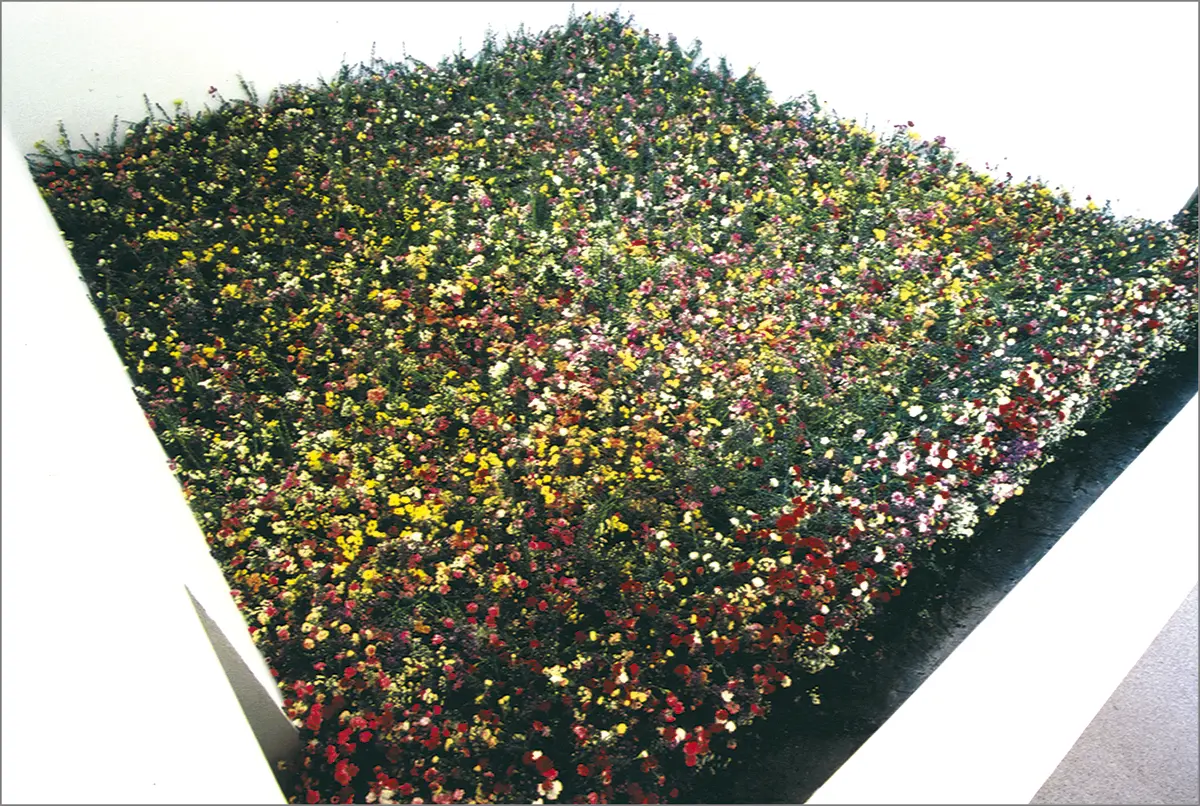
Seen from another angle, Táboas’s piece gave the sensation of a fragment that was moved from somewhere else; it was also an artifice that in no way had the intention of hiding its inherent falsity. This false fragment of a false pasture and a false path set against a false landscape highlighted the architecture as containing something whose presence is unthinkable in architectural terms (even if it took that particular architecture to its original function as a container). This game of contradictions was established from the title itself Silvestre (Wild). It alludes to a natural world that excludes the very carnations (definitely a domestic type of flower) used in the fantastic and false and ephemeral garden.
It’s not the first time that Táboas uses vegetal matter in her work, nor is it the first time she’s used the idea of a garden to perhaps elaborate a certain discourse regarding the constant mutations found in the reality of daily life. But in her previous works she used live plants; the changes derived from their own growth, as it happened to a garden of petunias she placed on a convent’s patio (1995), or the succession of plants she hung in an untitled installation in 2001.
Recently-cut flowers have an ephemeral life. This led the spectator to intuit that the process of decomposition would heighten sensory stimuli, mainly by means of vegetal degradation. But instead of rotting, the flowers dried out. The landscape slowly lost its color, and the fragrances faded away. The overall change of the piece wasn’t as noticeable as it had been expected. A subtle paralysis took over the garden, taking it to a sort of gray area where time apparently simply stopped.
The connotations suggested by Sofía Táboas in this work could open a reflection on several aspects of our relationship with nature, particularly the sublimation of a domesticated and fragmented flora in order for it to work as architecture’s subsidiary or a brief detail of urbaneness. In fact, the artist’s point of departure was the modification of architectural space to rescue some of its own history —a garden between two constructions.
In our culture dominated by the urban world, it doesn’t mean that wilderness it’s not an artificial decoration, a condescending wink to the nostalgia felt by some for a nature that has gone too far away. Nevertheless, the artist wants to characterize her work as a catalyzer of sensations and emotions, a way to interact silently with the public. Maybe her attitude is similar to leaving the door open before leaving.
ENRIQUE JEZIK