Before the huge amounts of photographs and monitors invading today’s art spaces, it seems difficult to find a group of pictorial works that can take head-on the new technologies. On the other hand, the conceptual frameworks deriving from all sorts of artistic practices seem so distant from painting, which is both manual and artisanal. Before this panorama, Mexican artist Yishai Jusidman has always presented incontestable arguments that remind us of the need and actuality of painting, as well as its imminently conceptual aspects.
The exhibit Mutatis Mutandis, presented in Badajoz after being held at the Stedelijk Museum Voor Actuele Kunst (S.M.A.K.) in Ghent, Belgium, includes the last series that Jusidman has been working on and has titled, significantly enough, Pintores trabajando (Painters Working). In it, the artist has taken pictures of several Mexican painters. The camera has been propped on the upper corners of the canvases on which the painters are working. The photos capture the moment when the painter has taken a couple of steps back and becomes, for an instant, the spectator who’s evaluating his or her own work in progress. These photos then become two real-scale paintings that Jusidman places side by side and then joins with a piece of carpet stained with paint-splattered from his own work. In the middle of the construction is the space where the unseen painting should be, always remaining invisible.
It seems like the whole exhibit has been conceived with this idea: artists looking at their own work, evaluating it before continuing. The majority of the show is made up of re-works that Jusidman has made from more complex series such as Sumo and Bajo tratamiento (Under Treatment). The exhibit then becomes an exercise in outside revision presented by the artist himself, mainly as a creator but also —and why not?— as spectator and critic –another of the facets that Jusidman develops assiduously in the Mexican and international media.
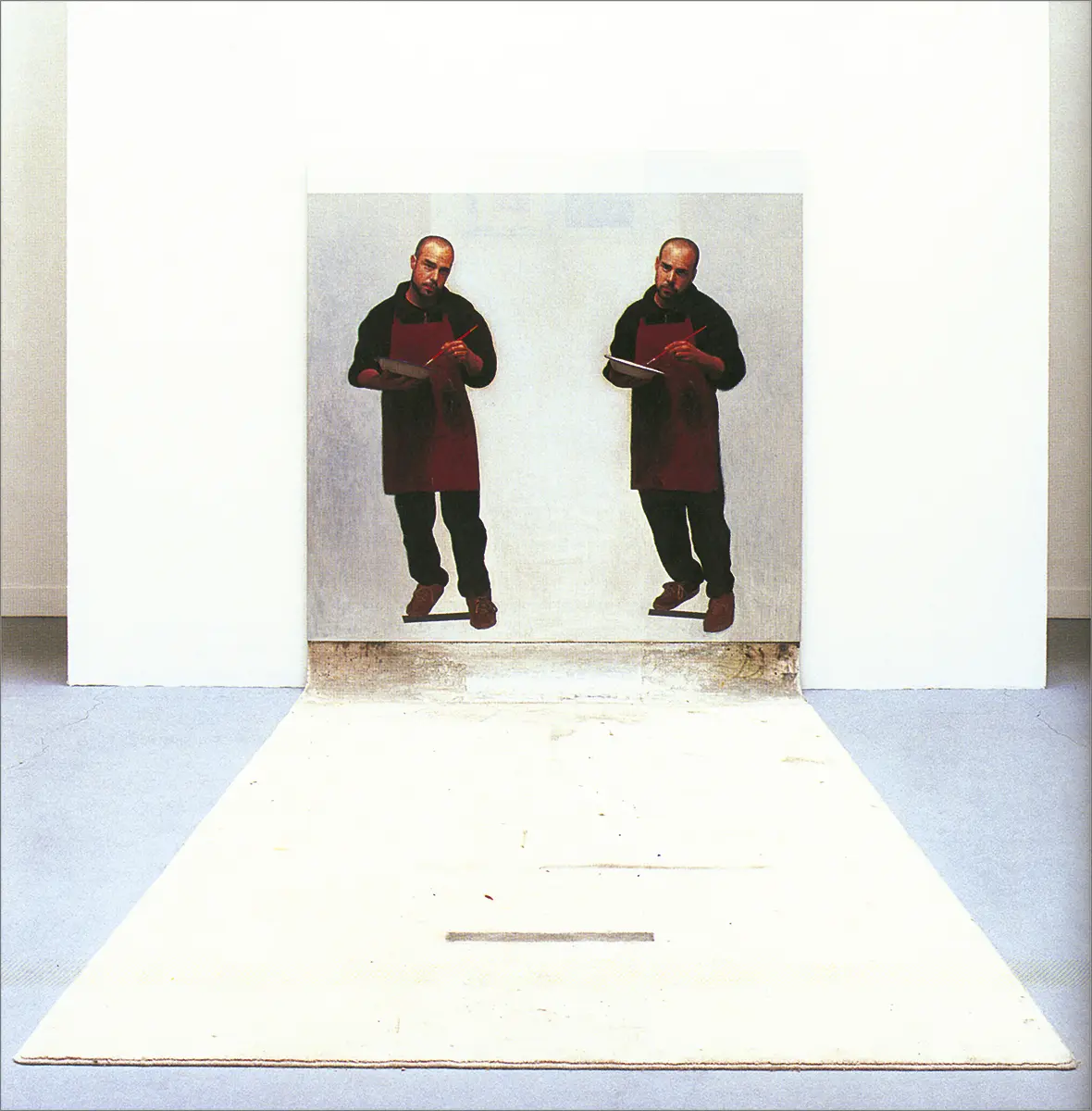
It’s also meaningful that this revision utilizes media other than painting: installation, tapestries, photographs, plotters, digital superimpositions, and electrostatic impressions, but always as tools to aid him in a deeper analysis of the painting, both as practice and as a medium.
The series Bajo tratamiento has been deconstructed by scanning images of Jusidman’s paintings and then superimposing them on the photographs that function as a base for the painting. The distance between the pictorial and the photographic image –between model and reproduction, but in this case which is which? collapses though not completely, leaving behind subtle differences. Instead of providing a better definition, these differences «undraw» the portrait subject until it becomes ghostly. A metaphor of representation. Another alteration is that the series has been done on tapestries intervened pictorially by the artist. The faces of the patients have been isolated and then blown up to cover the entire weave. This amplification has turned the unitary image into a field of pixels that disfigure the identity of the subject, transforming the horizontal plane into a chromatic exercise that’s almost abstract. What remains from the subject’s identity is the book of art that he or she was holding. The book was then placed inside a glass case, where you can still see the image that the patient had selected from the book. The relationship between the two objects is reinforced by a piece of rug jutting out from the tapestry. It functions as the base for the glass case, and the visible link it creates is more conceptual than anything else.
The manipulation of Sumo is more impacting in the sense that the deconstruction produces two elements that, formally speaking, are completely separate from one another. They clearly put in evidence the idea of painting as the process and transformation of a given reality. The Sumo wrestlers have been removed from the paintings, leaving behind the geometrical and colorful backgrounds against which they were wrestling. Each painting is a composition that has lost its function as a container of figures, thus gaining formal autonomy. Using once more the piece of rug extending toward the spectator, Jusidman has also placed glass cases, but in this case, they hold the original photos used to create these pieces. They are documentary-type, black and white photos; their original backgrounds were the spectators watching the wrestling matches. Seeing both elements helps us uncover the figurative base that the painter used to create the abstract backgrounds. The recomposed images suddenly gain a new meaning, where Jusidman has confronted the narrative element with the formal element.
Overall, the exhibit is an extremely reflexive proposal taking on a series of themes that are absolutely valid when discussing contemporary art: the notions of representation, gaze, and reproduction, the idea of the original, the incorporation of new media, etc. It represents an important new point in the extremely interesting work by a clearly cerebral and analytical artist who at no moment disdains the workmanship and quality of a well-done painting. He leaves us with the curiosity and the desire to see, once more, a richer painting that’s constantly renovating itself.
ISSA MARÍA BENÍTEZ DUEÑAS