In a small but successful show, limited both in terms of volume and space, Arthur Luiz Piza presented a rational trajectory that traces the artistic and spatial transformations his work has undergone during the last 40 years. Since 1965, the exhibit hall at the Centre Culturel Calouste Gulbenkian in Paris is part of the namesake foundation created in Lisbon in 1956. It also has a branch in London. FCG is a private foundation dedicated to working, in Portugal and abroad, on charitable causes, the arts, education, and the sciences.
The show (approximately 40 pieces), titled From Collage to Movement, is a preview of the great retrospective show that the artist will have in August at São Paulo’s Pinacoteca do Estado, before going on to Porto Alegre. Piza’s trajectory in Europe is identical and different from other artists of his generation who traveled to France during the early 1950s. It’s similar in the sense that the artist, just like the others, arrived in Paris with no project other than to work in S.W. Friedlander’s printing studio. Around that time, he also begins to work on collages. And different, because Piza created, based on work on paper, fluid colors, and poetic questioning of space, a singular focus that is not related to any style school, or trend. Undoubtedly there are similarities, but above all, there’s great freedom and a subtle pictorial desire, both insufflated by the artist’s sensibility to materials. His initial attraction to Surrealism is visible in some of the “materic” works that were part of his first important series, during the 1960s.
The first collages from this period propose geometrical shapes, voluntarily informal, composed of cardboard fragments of different sizes, generally glued “tone over tone.” The part of the collage that remains free is made up of colored carved wood, or perhaps the canvas remains empty. In most cases, using an identical color, or one of the same chromatic range will extend the shape’s artistic impact made by the cardboard collage. Color contrast is scarce in these sorts of “landscapes,” similar to “skins” with low-scale tones, where ochers, reds, and bronzes predominate. The chromatic unity between background and shape reflects an equally intense spatial fusion. The constructive dimension found in these works is full of a tactile sensation (which we could associate with an esthetic of the senses) that makes Piza’s “geometry” “touchable” –as it was rightly described by the Brazilian critic Roberto Pontual. With certain variations in the number of materials used (sand and glue), these works remind us of certain Fautrier’s of the time, and some of his “landscapes” evoke the style of the Mexican Gunther Gerszo and his mysterious architectures-ruins.
Later on, shapes will disintegrate and the obsessive “constructions” will be replaced with a sort of “cartography,” a “territory” full of memories where we don’t know what’s more important for the artist, the materials used or the deconstruction performed to “unlink” the geometrical shapes (small rectangles and squares) from one another. The series’ largest collage still keeps the structure of a fine web, where the superimposition of small cut pieces evokes the shiny roughness of a reptile’s skin or the texture of papyrus.
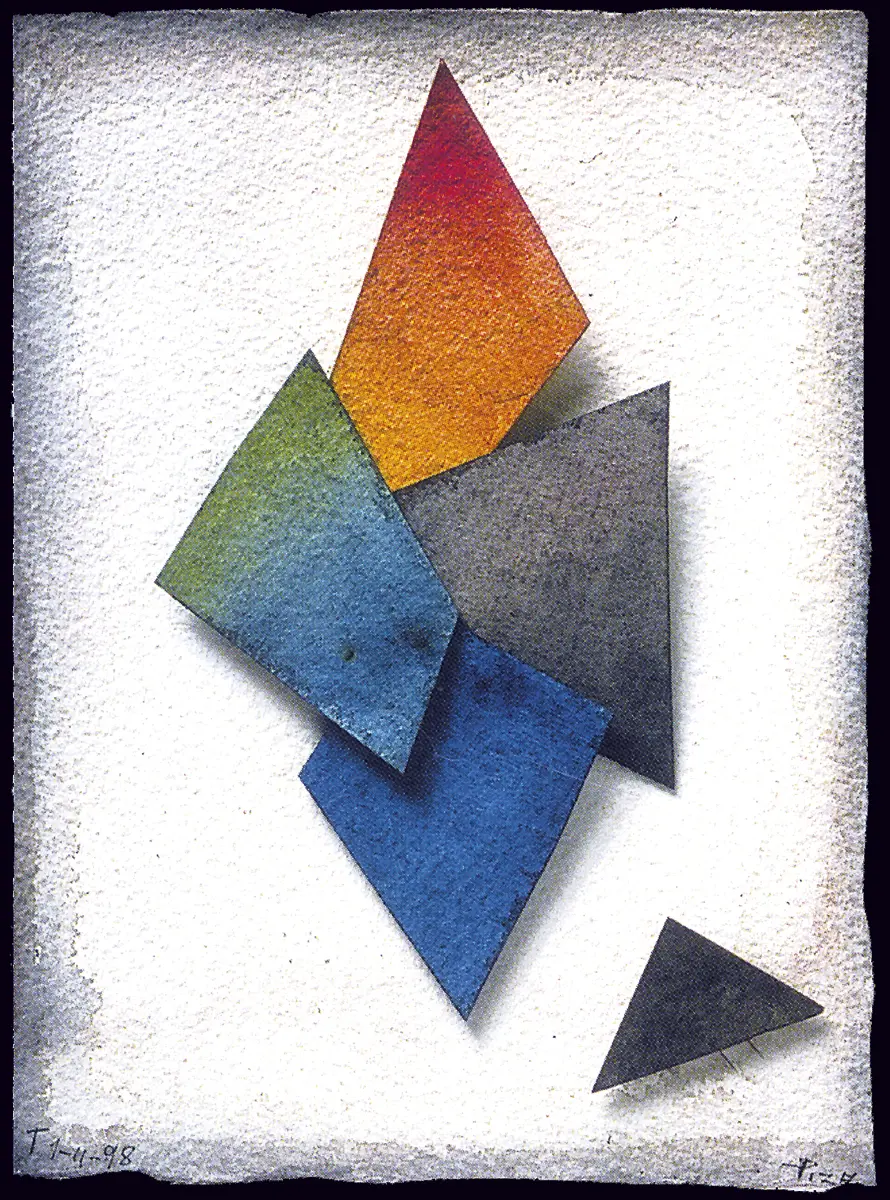
In another group from the 1960s that is also included in the show, the “landscape” turns more and more into relief, becoming something in between a collage and a build-up of different materials. It is in this third great series that Piza highlights, even more, the three-dimensionality of his pictorial objects, separating the shape from its background and nearing a more explicit kinetic dimension. But the works still have a lightness and transparency highlighted with watercolors, impregnating subtly the raised cardboard. With this new gesture, Piza’s sensitivity comforts what’s tangible or palpable —that dematerialized materialness— and changes it into an esthetic emotion where light touches are predominant. The kinetic character can then seem relative. Later we’ll find movement in some clippings of the 1990s (cardboard strips cut as arrowheads). But above all, here we find ourselves inside a subtle and refined game where shapes emerge from space with a certain tension and a delicate and sober gesture. More than a movement, what we have here is a “scripture,” a “calligraphy,” a sort of musical variation that his first materic collages expressed by means of dense materials and opaque colors, though still warm due to their strong texture. Now we have the softness of the pastel, with rhythmical incursions into light and ethereal blues, reds, and blacks.
Piza abandoned the “soil” of his first works to become increasingly immaterial, ethereal. Similar to a somewhat dreamy “Madi,” the fourth and latest series of works (cardboard that has been cut and painted with watercolors, then pasted onto thick paper) perpetuate the artist’s search for color and space. Separated from their support, these delicate “constructions” vibrate in stopped time. To finish, the last two works from 1995 and 2000 exalt, in their separation from their support, the lacerations that the artist has turned into spontaneous surgings. When he cuts the cardboard, when he twists and bends it, it is so to subdue it in his defiance of space. Movement is still present, captured in its immediacy and purity. In Piza’s works, space has a dimension of infinity where the construction is only a stage: the instantaneous step toward timeless poetry.
CHRISTINE FRÉROT