Who are you?
What is a human being?
Isn’t it unfair that life has to end at some point?
Is there life beyond death?
Where does the world come from?
How should we live?
One of the elder Greek philosophers thought that philosophy arose from the capacity of human beings to be amazed. And that the ability to be amazed is the only requirement to be a good philosopher. Children are continuously amazed by their surroundings, but as they get used to the world and grow to become adults, everything seems normal and they quit being amazed. These ideas have been taken from Sophie’s World, by Jostein Gaarder, but I extracted them apropos Carlos Estévez’s latest exhibit. As Gaarder himself has said, “The best way to get closer to philosophy is by asking philosophical questions.” Estévez seems to try to philosophize from his drawings. All of them are an enigma… all of them suggest multiple questions… all of them reflect the artist’s amazement with life, other people, the society in which he lives… the world.
Ten years ago, Estévez gave me my dog, Naná. And I was the one amazed when he said to me, “At least you can kick her when you’re angry.” I have never done such a thing, but I was left wondering what would be the opinion of other human beings of someone who said something like that. And the most curious thing is that he is a young man, one who doesn’t talk much, and when he does, he whispers, and who has the appearance of being measured, self-contained, even sweet. Maybe that’s why the poetry that many people see in his drawings might be questionable.
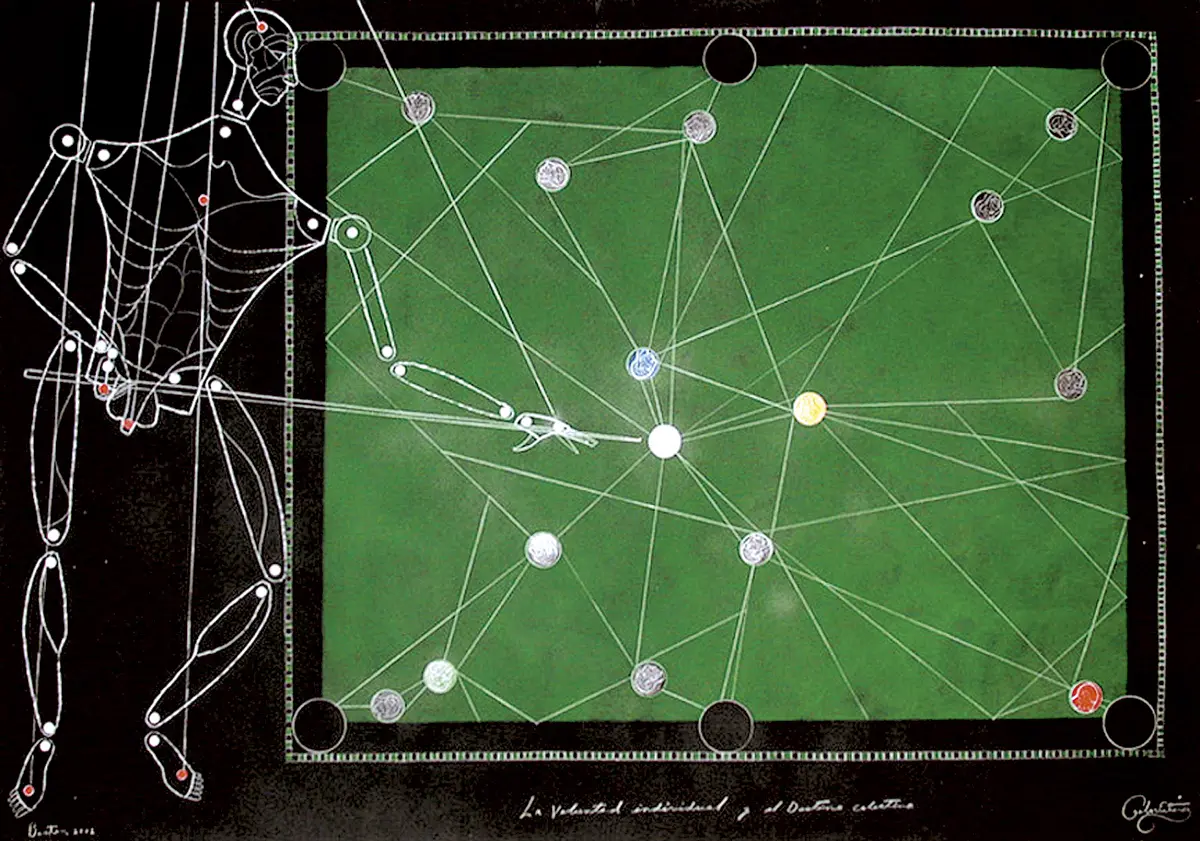
When he has made sculptures or installations, they have always been strong, solid, and formally “forceful,” to put it somehow, though they have always posed those questions regarding human existence. But his drawings –in this case, done with mixed technique on large sheets of black construction paper, have always been delicate and apparently fragile. This time around, most of them are done with intertwined white lines, as if part of a spider web, making them visually attractive, almost ethereal.
The exhibit was titled El alma es un lugar (The Soul is a Place). Some of the pieces included —among others, Teatro personal (Personal Theatre), La carrera de la vida (Life’s Race), and La voluntad individual y el destino colectivo (Individual Will and Collective Destiny)— more than ask questions, represent the artist’s own answers and conclusions. And there we see a mixture of sarcasm, bitterness, and skepticism. All the puppets drawn by Estévez seem to find positive answers only within themselves, mostly in pieces like El pensamiento y otras levitaciones (Thought and Other Levitations), Yo soy mi casa (I am my Own House), and Un lugar seguro para descansar (A Safe Place to Rest). They refer more to the concept of nation, family, and the artist’s sense of self-belonging –a man who’s not only trying to understand the world that surrounds him but himself as well.
This and other exhibits by Estévez have worked with a markedly symbolic character. But not a single element is in excess —even the visually overloaded pieces are pregnant with meanings, always pointing toward the cognitive. Basically, the artist’s interest lays in the knowledge of history, and in a sort of re-elaboration of the role played by each individual within history’s larger-than-life tales.
He does the same for religion. Although his work exudes a mystical breath, the way the artist approaches the divine world is also quite personal: More than an ecstatic or mad creator, what we have is an artist who has an insatiable curiosity for the unexplainable or the undecipherable, for all the mysteries in the universe. Whatever the reason may be, the truth is that Estévez is an excellent draftsman working with a style that attracts very different sets of spectators.
ERENA HERNÁNDEZ