The defiance of the limits of the physical and conceptual space is definite in Danilo Dueñas’ work. It’s not easy for the spectator to determine exactly where each piece begins or ends. When you enter the exhibit hall, you go through without any order, trying to find focal points in order to establish formats and meanings. But his works suggest a multiplicity of readings in regards to the border as a container and as a contained space as well. In that duality of perceptions is where we find the meaning of the liminal space, which is the exhibit’s title (Espacio liminal).
Dueñas creates his pictorial compositions using materials such as metal and wood aggregates. Huge Formica panels —not necessarily a part of the montage— contrast with small assemblages of broken sticks, steel nails, cardboard angles, and paint strokes. Among them, we find small rectangular formats with white lines fusing against the wall, and black lines limiting the colors. As aerial views or zoning maps, these compositions created with raw materials don’t require a canvas or a paintbrush.
The exhibit hall’s walls are like a blank music sheet that the artist has filled randomly, though with a level of conscience that establishes rhythms and relationships between one piece and the other. For this, he makes incisions on the wood, perforations between the composition’s lines, and eventual three-dimensional allusions. Wooden frames resembling windows reveal paint strokes that look like blurred images caught by the eye while there’s movement. The strokes’ greenish and reddish tonalities repeat themselves in other works found elsewhere in the hall’s spaces. The spectator determines the order when establishing the subjective relationship between the different elements.
Standing out among the exhibited pieces is a glossy black Formica panel on which the artist has organized, according to size, a series of broken sticks painted in white. The piece calls our attention because of the contrast between black and white, and the comparison established by the smooth, reflective surface and the roughness of the opaque wood, which also shows layers of bark. From a distance, they resemble a collection of bones arranged apparently by somebody who’s engaged in a minute study of dissection. Without having to allude to figurativeness, the artist has left a trail of his logical thought process when he attempted to arrange what cannot be arranged. But he has also left the door open for the spectator’s interpretation.
Another piece that stands out is the “compass” placed on the floor. Several wooden volumes painted in black have been placed on the white surface. A bunch of twisted nails is on one corner, reminding us of those navigational tools that have been improvised, like magnetized needles on water. As if in a metaphor, the artist gives the spectator subtle tools so he can gather his bearings in that space.
Looking at the broken aggregates, the rusty metals, and the nails hammered halfway in, we ask ourselves whether the artist first made a draft of what he wanted to do and then looked for the precise materials, or if the materials were the ones who dictated him how to act intuitively on the compositions. To this, the artist answers while emphasizing the idea of freedom and movement. He says that conditions are both present and absent at the moment of creation: "To experiment with what you have before you is what allows you to continue working. The work itself is the one that creates the conditions at any given moment, and the subjective notions we have regarding that particular work is what determines our way of relating to the world."
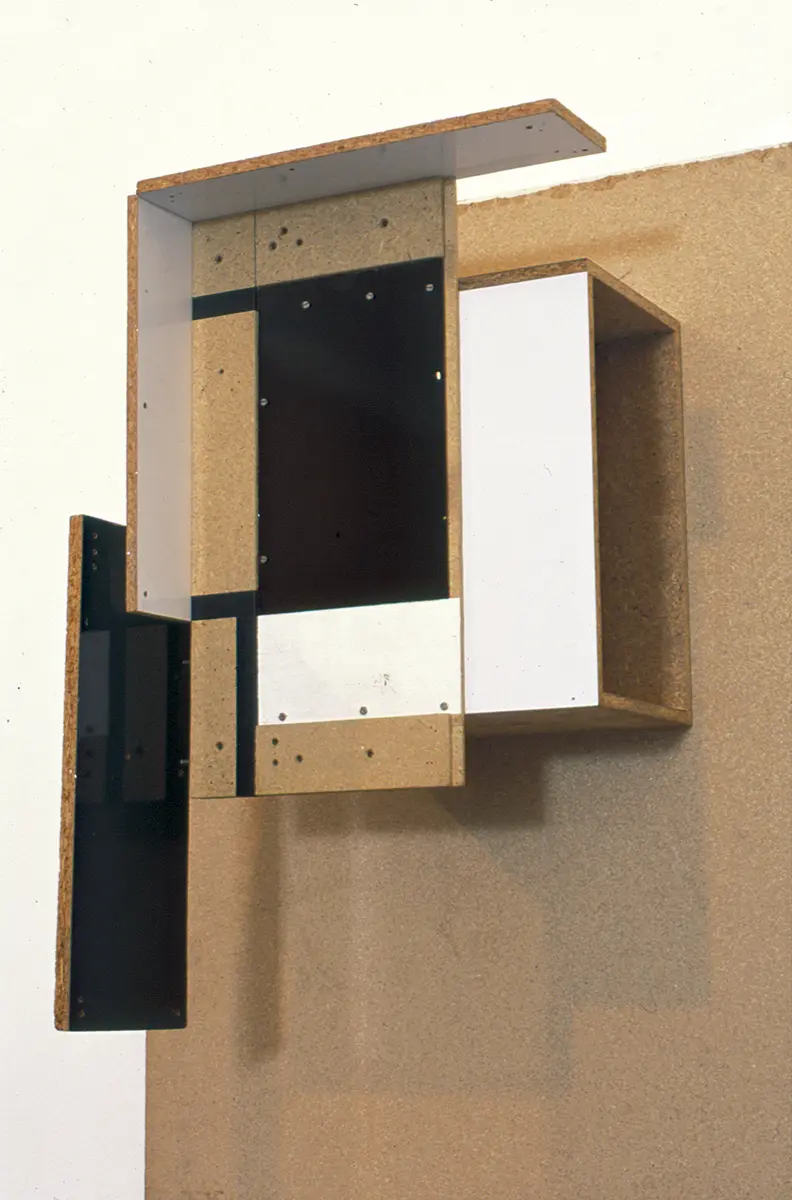
One of the exhibit’s most curious elements is the unpainted wooden panel that was part of the crate used to transport Dueñas’ work. It was propped against the upper portion of a wall and used as background for one of the pieces shown. On it we can read the artist’s name and address; he has left it out in the open as if it were the signature of a huge piece, the entire exhibit. It could be understood as an appropriation made by the artist of his own work, and it reflects the show’s mobile character since the container is obviously moveable. Ironically, the piece corresponding to the container is not part of this exhibit, but it shows the thread of a body of work that has been produced consistently from 1995 to 2002.
In the show, there’s a singular piece made by a huge wooden beam painted in black and white. It has been placed between two walls, projecting a straight line to create a virtual triangle. The piece contains that triangular space, establishing ephemeral limits between the created borders. Not only that: the beam’s white portion also blends against the background wall, creating the illusion that there’s a black stripe floating in mid-air. At the same time, the black stripe has some nicks that follow a rhythmic pattern. Between the nicks are punctures, holes, and nails.
Another interesting ingredient found in these works is the handling of different microcosms inside a macrocosm. On the right side of several pieces, there’s a small red paper dot glued on the wall. They seem to represent the period at the end of a paragraph that’s part of a larger text.
Toward the back of the exhibit hall, there is what seems to be a blank white wall. When we get closer, we see that the wall is covered with white Formica panels joined together, revealing the artist’s intervention in the space. The Formica reflects the pieces hanging next to the wall and the spectator as well as if they were part of the piece. This particular area makes it clear that any action, no matter how insignificant, affects the overall space and its perception. Each moment has unique contents and multiple interpretations.
Finally, it’s necessary to talk about time as a factor in the exhibit, and as a tool to elucidate the artist’s intervention in the space and the objects. The fact that each element clearly has its own history and that it has been recontextualized once and again is enough proof of the mobility of ideas.
Movement as a concept and physical factor is very important in Dueñas’ work. He proposes that there are no static ideas; if they didn’t change, we wouldn’t have the active universe to which we all have access. As a creating artist, Dueñas doesn’t want to impose his own criteria to define his work; instead, he’s "appealing to ethics" when he allows the spectator to move about his works to try and understand them with no preconceived notions or judgments. In this esthetic experience, the spectator ends up understanding that in art there are no exact meanings and that its essence can be found in feeling that it has its own thought.
MARÍA JOSÉ RAMÍREZ