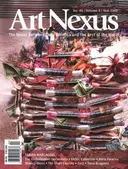
The II Bienal Internacional de Estandartes was inaugurated at the Tijuana Cultural Center, in the border city that bears the same name. It portrays itself as being one of the most exceptional shows whose periodicity has been favorable throughout the years, being a reference in the Latin American Fine Arts.
Among the requirements that the guest artists should meet in order to participate are the measurements of the works: 16 feet high by 72 inches wide. The works should be worked on both sides since they art looked at in full content. The banners are to be hung from rods on the ceiling as was done in the pavilions of medieval times and the likes of the labarum that was used as a sign of the Kingdom, a feud or a battle that had been won.
Herein nothing else but the contemporary is accounted for, yet openly inscribed in the significance of the space in which these works are being exhibited- meaning that Tijuana a border city of great cultural wealth simultaneously is a space of people struggling to cross over the border in pursuit of new job opportunities.
With ES2002, an important question arises on the subject of the globalization in the arts. While artists regularly produce works that can equally be seen and read in any of the world’s largest exhibition centers, they find themselves here exhibiting works precisely identified with a geographic space. A reality that in many of its facets is difficult to assimilate, especially, when using archetypal languages with specific trajectories. They admitted their banners to a public that, in that moment and in that city, understand and share the interpretation of a problematic border or consent to denounce the situation of the arts, although they are acquainted with, it is worth visiting them by the guest artists that grant us new approaches to old topics.
Marta Paulua, the head curator of the event since its establishment in 1996, invited this year as judges: professor Selma Holo, director of the Fisher Gallery of the University of Southern California; Rosina Cazali, curator and art critic from La Curadería en Guatemala project; and Victor Zamudio-Taylor, curator, writer, art critic and independent researcher.
This group had to evaluate the works of 35 artists from12 countries where Mexico’s presence was the majority, with 14 participants. Among the others were: Argentina, Belgium, Canada, Colombia, Costa Rica, Cuba, Chile, China, Ecuador, Spain, United States, France, Puerto Rico, Trinidad and Tobago and Uruguay.
The jury’s final verdict delivered by Zamudio Taylor makes it clear that some of the major contributions of this biennial are (despite the rigorous peculiarities in participation and the strict formal parameters of this event) the heterogeneity and the diversity of the guest artists’ proposals.
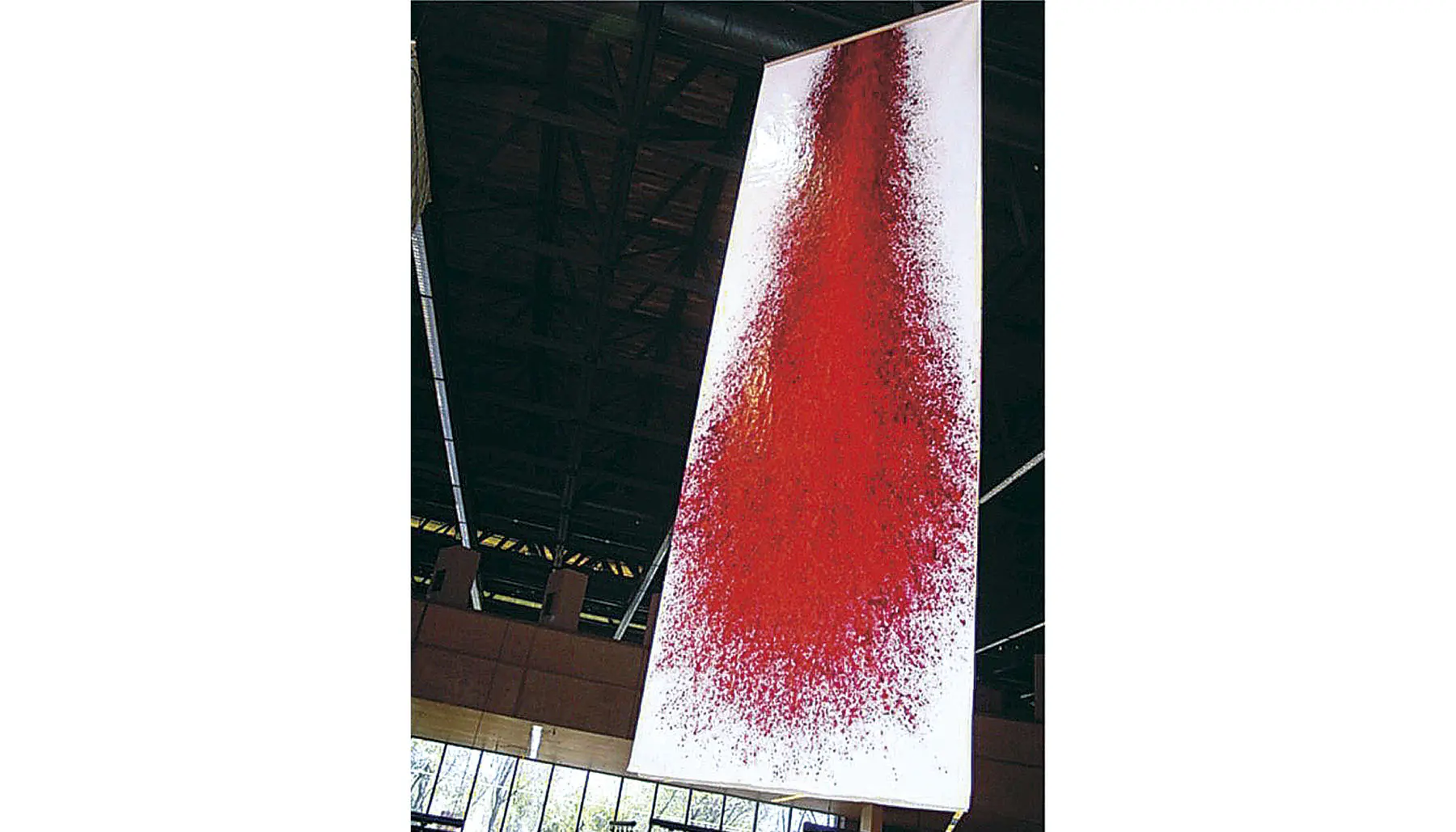
The first and second place prizes, were endowed with $100.000 and $50.000 pesos (approximately US$10,000 and US$5,000). First place was bestowed to Delcy Morelos from Colombia, for her impressive piece Rojos por Naturaleza (Naturally red), which drastically affects simultaneously on political, social, artistic and corporal issues in an evocative way. A large red shape violently descends towards us when, little before reaching its final destination it starts to soften and to spread onto the support evoking an enormous and brutal stream of blood.
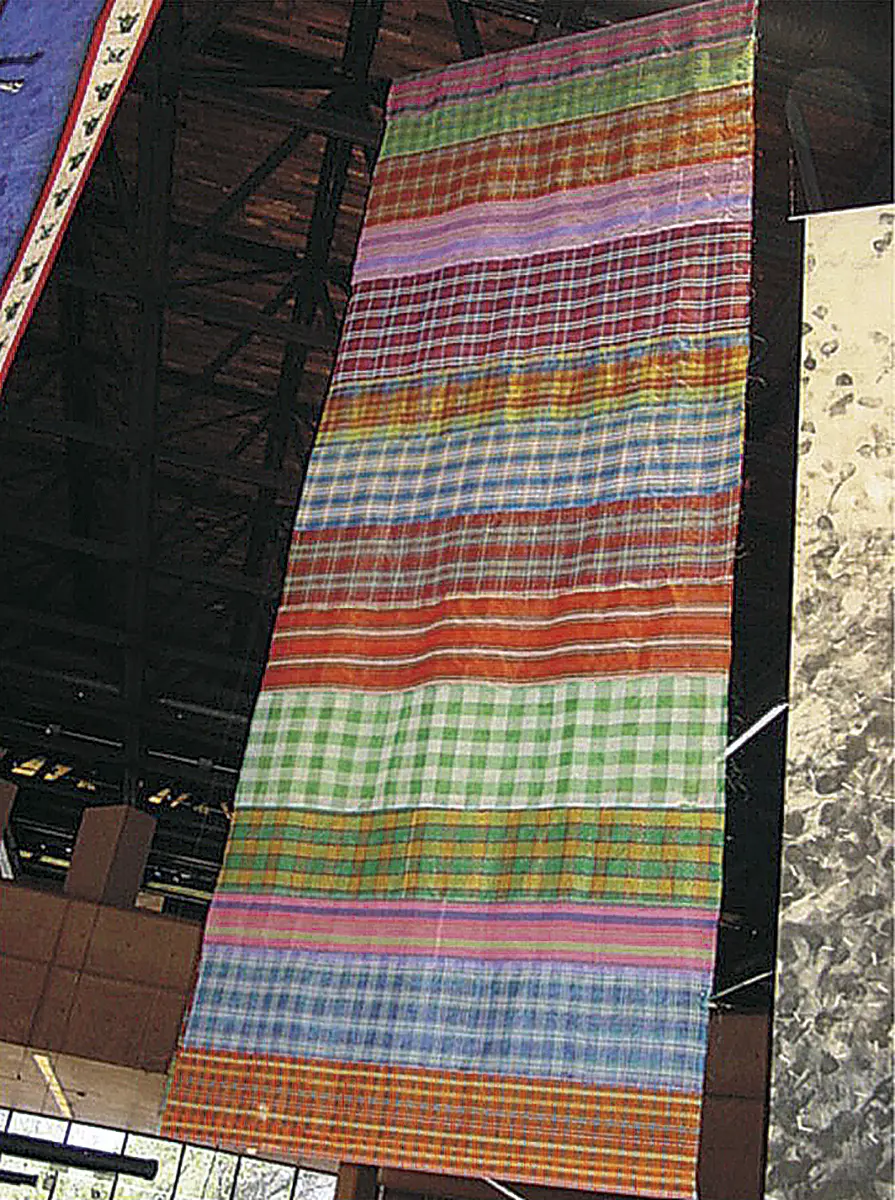
The second place was awarded to Thomas Glassford a Mexican-American for his witty piece Hotel California, made of nylon mesh of the same material used to make market bags. His work undoubtedly suggests the exchange of people who, many of them coming from rural areas and with few means, carry their scarce belongings in these types of bags, always ever so attractive and of flashy checkered patterns that add brightness to the popular Latin American markets.
Honorary mentions went to Xu Bing for As aftackment, a replicated Oriental calligraphy on paper that actually reads USA and San Diego. To Alberto Gassol for his digital image Manos arriba (entre la espina y la pared) Hands up (between the spine and the wall); and to Philippe Hernández for his work Quería ser artista, (I wanted to be an artist)- hand labeled canvas on both sides, which recaptures the urban images of the spectacular ads that offer consumer goods, services. Even the ad itself, as is the case with this piece, containing only the word DISPONIBLE (AVAILABLE) on one of its sides, waiting for whomever wants to rent it or employ the services rendered by the artist on the reverse side.
Among the participants that received neither awards nor honorary mentions were artists such as: Luis Cruz-Azaceta, Mónica Girón, Victor Lerma and Mónica Mayer, presenting a collaborative piece. Irma Sofía Poeter, with a splendid work that captures the best in the tradition of paper cutouts and embroidery, that reconstructs houses loaded with eroticism. Ambra Polidori, Ana María Rueda, Raymundo Sesma, for a large one-sided braid and on the other a text that read: “Made in Mexico 431 hrs”; Rosa Velasco and Robert Youds, among others.
ES2002 is scheduled to visit some of the most important institutions of the Mexican republic before the works return to their owners. The contemporaneity and the aesthetic possibilities of the exhibitions, such as the one that we are dealing with today, have established, in a particular way, of confronting large formatted works from artists whose trajectory has embraced different formats, or better yet, have rarely chosen the two-dimensional object to express themselves.
In their ruling, the biennial’s jury requested that the guest artists be endowed with a fund to support their creation. In the next edition of this biennial (ES2004), we shall see how the authorities have received this one which can undoubtedly be, one of the deciding factors for the existence of the biennial’s quality.
SANTIAGO ESPINOSA DE LOS MONTEROS