José Dávila (Guadalajara, Jalisco, 1974) has become an important name in Mexico’s young artists’s scene. For a few years now he’s participated actively in it. Initially, he did it collectively, with other artists that also have gained a reputation. In 1997, a group called Los Incidentales (The Incidental Ones) was formed, made up by Gonzalo Lebrija, Javier Dueñas, Hugo Cervantes, Cheque, Foit, Diego Quiñones, Francisco Ugarte, and José Dávila himself. They participated in the last two editions of the Expoarte Guadalajara International Gallery Fair, presenting perhaps the freshest and most interesting proposals of both editions. Besides having a stand at the fair, they also exhibited in it. Los Incidentales began to experiment with spaces, concepts, and art forms. Meanwhile, Dávila began to work in interventions —installation, photography, and video where one could trace his principal preoccupation: space and the different ways to represent it, subvert it, change it, etc. Los Incidentales elaborated their urban intervention projects in peculiar places, working with the notion of contextual insertion and engaging in a constant dialog with the place and its function. They mounted projects in different locations around Guadalajara, such as the top floor of the city’s tallest building, some public squash courts, an abandoned house in the city’s most expensive residential area, a TV studio, and an architect’s office. The group dissolved in September of 2000.
Dávila talks of his experience with the group as “something very important in my formation as an artist, since it was there that I linked architecture and art. Also, there I learned to experiment with the many ways to approach a project. It was important partly because it was there that I began to work as an artist while being an architect.”
José Dávila has let his formation as an architect greatly influence his works, demonstrated masterfully in his most recent shows. In 2001, he held a show at the London Camden Arts Center titled Temporality is a Question of Survival, where took advantage of the ongoing construction in the Centre’s exhibit hall to build, outside the galleries, an interior space. This interest in reverting the inside and the outside is a key point in Dávila’s current research.
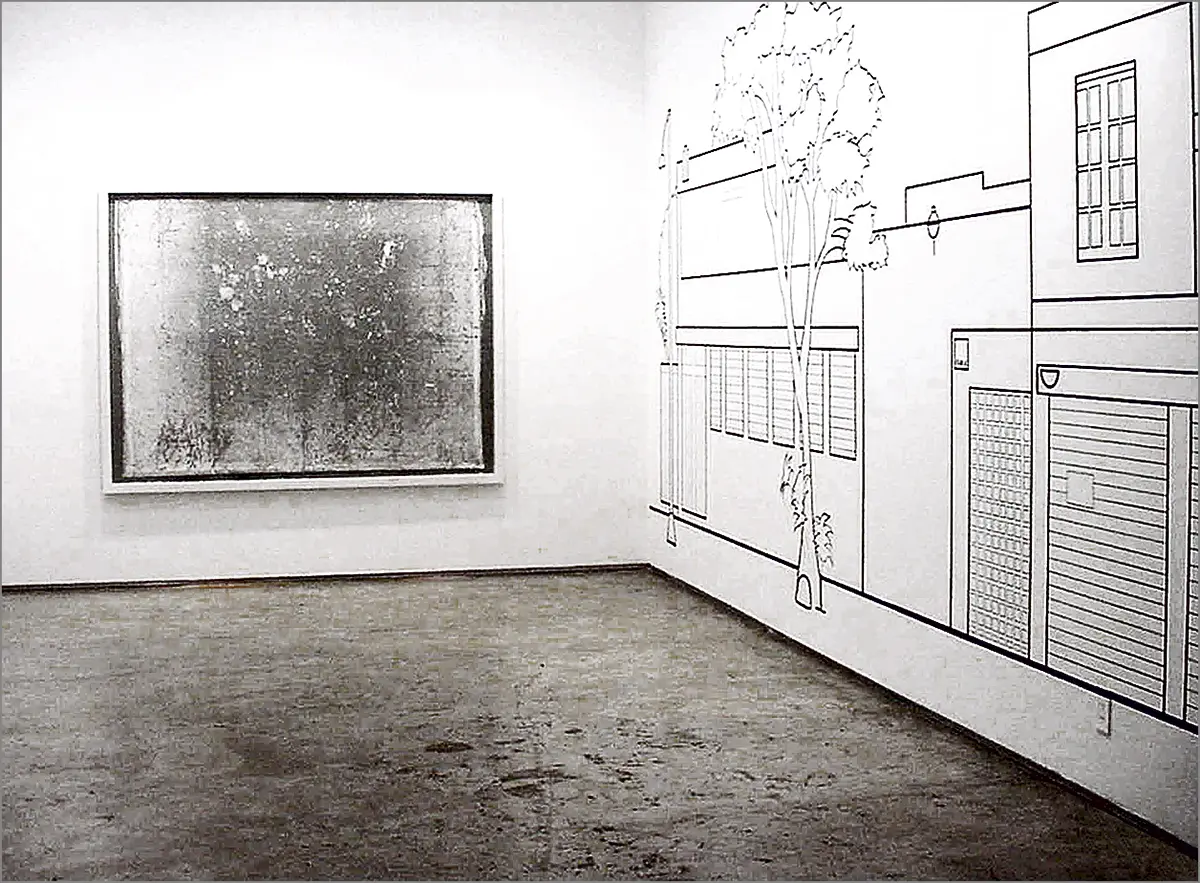
For this, his first solo exhibit at Galería Enrique Guerrero, Dávila intervened in the space in a subtle but powerful way, mounting a three-part show: he changed the color of the space’s façade and inserted a catalog card, made a schematic drawing of the street where the gallery is located, and included three framed pieces titled Plástico plástico I, II y 3 (Artistic Plastic I, II, and III).
Galería Enrique Guerrero’s façade originally was painted pink, yellow, and blue, reminiscing the architecture of Luis Barragán and Ricardo Legorreta, who have remained in the collective imagery as undoubtedly Mexican. When Dávila painted it white and inserted the card “Fachada, 2002, pintura sobre muro” (Façade, 2000, paint over the wall), he succeeded in neutralizing and annulling the wall’s memory, wiping out its most distinctive trait. At the entrance, on the main hall’s longest wall, he painted a simple and schematic rendition of the street where the gallery is located. He synthesized the line, uniforming everything into white and black, eliminating depth by showing only the first plane and forgetting about context or traits such as color and texture. The façade, now white, becomes its own “ideal and neutral” parallel to the gallery’s interior.
Finishing the show are Plástico plástico I, II y III, three large-format frames approximately 2 meters high. Each one contains, behind glass, a piece of plastic that had served as floor protection when the gallery’s walls were being painted white between shows. Up to Dávila’s appropriation, these pieces of plastic served, both literally and metaphorically, to wipe out the memory between exhibits, returning the walls to neutrality. Each drop of paint on the plastics means that gravity took the better part of it and didn’t let it reach its destination (the wall), finding a home on the piece of plastic protecting the floor. In terms of form, these three huge “plastic protectors against floor spillage” have had a better fate thanks to Dávila, who found in them a beauty that once it has been framed, becomes irrefutable. Thanks to Duchamp and his great contribution to the ready-made, these three pieces of plastic have become formal abstract paintings with a clear reference to Pollock.
To revert spaces, to annul memory, the color white, and to show neutrality are the exhibit’s conducting threads. José Dávila is handling them with a steady hand, showing that besides having clear and strong conceptual principles, he also maintains technical quality and inherent beauty.
FRANCISCA RIVERO LAKE