Terra incógnita. Proyecto Papaver somniferum (Terra Incognita. The Papaver somniferum Project) is the result of a research that Juan Fernando Herrán began in 1999. The project aims to investigate “the problematics of the cultivation and harvest of opium poppy, as well as their economic, ecological, and social implications. It refers to the existence of two opposing realities: producers and peasants in rural areas, who hardly have another option for survival, and the authorities, whose main role is to implement eradication campaigns.”
The investigation’s initial results were a series of photographs first seen in Bogota in 2001. There, the poppy flower was at the center of Herrán’s interest. The artist approached the object not only from the vantage point of someone who is searching and wants to know its particularities but also from an aesthetic perspective, showing the delight that can be experienced before a beautiful flower—if we can forget the interdiction weighing on it, that is. The flower is damned in Colombia, while in other countries—Turkey, for example—it’s grown legally. During his trip to that area, Herrán was impacted by the great extensions of poppy fields, conceived as an industrialized crop, while in Colombia, the same flower is grown undercover, in small plots, hidden to avoid the repression roused by its production.
For the unaware spectator, the apparent recreation of a beautiful landscape turns into unsettling images that generate questions about a plant that’s legal for some and illegal for others. This knowledge of the object and the contradictions it generates took him to delve into the problem from a different perspective—the peasant who grows it as a form of subsistence, and those who fumigate it as it’s an illegal crop. Herrán is conscious that those rural spaces do indeed exist and are notorious only in relation to their illegal crops.
Terra incógnita is the result of careful exploration into different sources: press and police archival material, aerial photographs taken by the authorities to locate crops and plan eradication campaigns, and information he gathered while traveling throughout the areas destined for the growth of poppy. The piece is made up of five sculptural elements distributed in an ample, darkened space. Made out of the lead, each element replicates large stones. When we get closer and touch the rocky formations alluding to territories and topographical particularities, we realize they are a series of miniatures. Each stone introduces the spectator to a reality with which he’s not familiar, unsettling, proposing him an aerial view of such areas. Peasants, animals, ravaged forests, cadavers, and farming tools are part of the situations recreated by the miniatures. It’s not a predictable tale, there’s the economy of information, and the objects, which must be discovered, are charged with symbolic meaning. The contrast in scale gives the piece a wider reading.
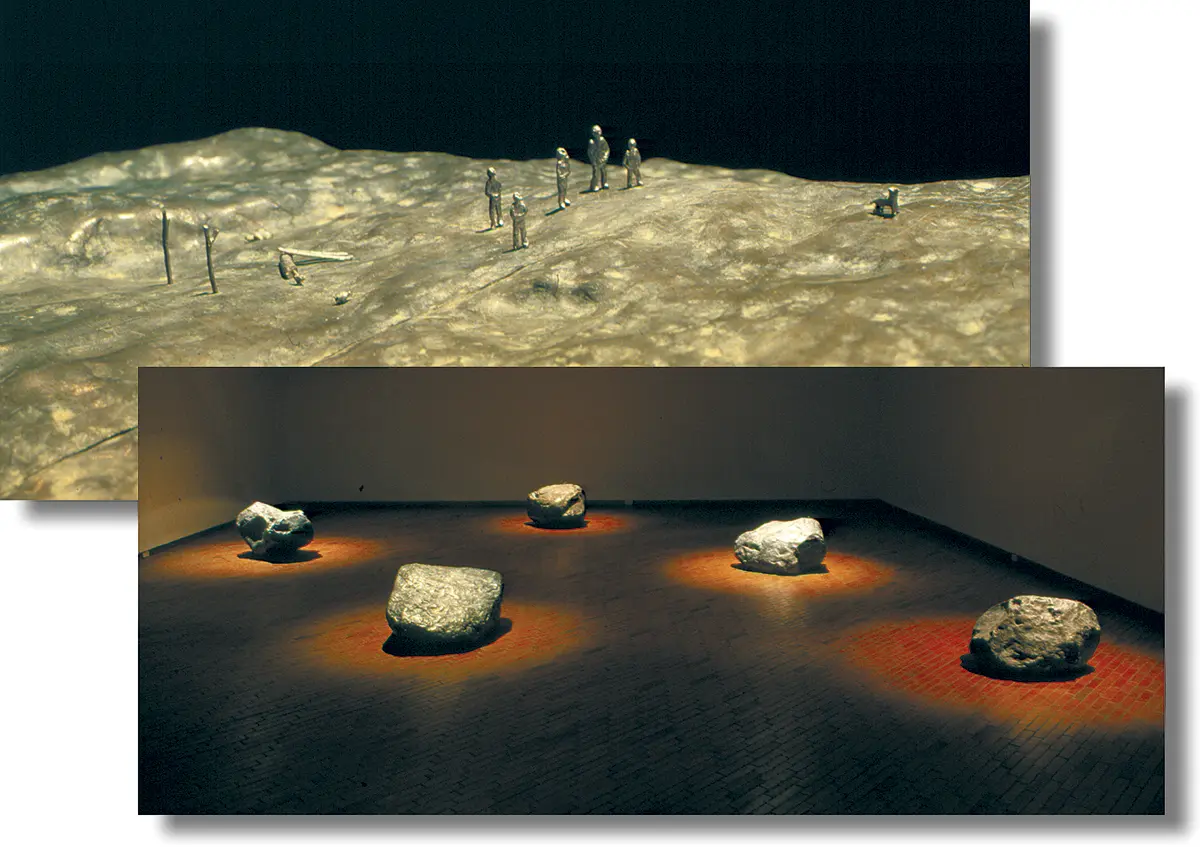
Three elements are worked with special patience: space, color, and light. The distribution of the rocks in space is done without losing the relationship between them. They maintain their specificity, showing the magnitude of the problem. If the subject matter is the same—the implications of the growth of poppy—geographically speaking, the piece alludes to distance, and lack of communication, before a reality that’s expanding throughout the country.
With respect to color, the chosen materials give both distance and nearness. Monochrome avoids falling into predictable stories, without losing sight of all the symbolic load that a metal such as lead in an environment laden with violence.
The use of strong zenithal light, as well as other lights, defines the space between the rocks, serves as an area of transition between them, and delineates the figures, inviting a silent perusal. The darkened areas serve as a nexus, emphasizing each situation’s particularities while going from one place to another. It would appear that there’s no relationship between one rural reality and another as if each group of peasants is working in isolation from one another.
The two worlds presented by Herrán—the peasant who grows the poppies and the authority that fumigates to destroy them—end up being even more unsettling because they are perceived as parallel worlds that see each other but aren’t talking to one another, each functioning according to its own logic. We are confronted with a diversity of points of view, adding complexity to the problem behind the territorial dispute, the illegal crops, and the situation of the peasant who grows a plant that has been reviled, but for whom it represents an object of consumption that allows him to survive the authorities’ repression.
Since Herrán is successful at presenting the enormity of a desolate reality, where destruction is daily bread, the spectator cannot remain a passive onlooker. His work confronts us with the two searches he undertook with his investigation, one oriented at seeing the problem of illegal crops and their implications in rural society, that’s to say, from a sociological standpoint. And on the other hand, he turns this experience into a personal esthetic search. Both objectives are completely achieved in Terra incógnita.
IVONNE PINI