Manifesta’s 4th edition took place in Frankfurt from May 25 to August 25. The European Biennial of Contemporary Art has been held previously in Rotterdam in 1996, Luxemburg in 1998, and Lubliana in 2000. The biennial’s structure is nomadic and dynamic. More than a conventional biennial, it’s an open platform that each time changes city and curators. This year, the curators were Iara Boubnova, from Sofia; Nura Enguita Mayo, from Barcelona; and Stephanie Moisdon Trembley, from Paris.
This fourth Manifesta was both lucky and unlucky to be held near Kassel, where Documenta XI was taking place at the same time. This coincidence diverted toward Frankfurt an international public —especially a non-European public— who would otherwise not have gone, as was my case. In another sense, this fact wasn’t as fortunate because the public coming from Kassel found that before the ambitious and complex Documenta XI, Manifesta seemed curatorially weak. And even if Manifesta was a complex undertaking in the way it conjugated works from emerging artists in Europe, it still had a school-like air.
The participating artists were generally young. They came from all over Europe —not only from the Euro countries and cities (such as Frankfurt) but also in Eastern Europe. This is what the organizers were talking about when they stated, quite pompously, the event’s “pan-European” mission. And although the circumstances were ripe, this edition brought along little freshness. The tendency was to politicize, establish cross-disciplines, and professionalize artistic practices. The show’s main strategies appeared to be to show off artists delivering various services to institutions (graphic design, exhibition design, collection of publications, or providing intellectual production to events) and the tendency to use institutionalized criticism. But they worked less as alternative ways of thinking about art and its socio-political context, or as producers of frictions and openings. They seemed more like unfinished, even ingenuous, formulas since artists generally cannot resolve the readability issue of their own projects (and sometimes the problem of their basic visibility). What I want to say is, that when an interesting project appeared on a press release, when I went to look for it in the exhibit’s concrete space, it was invisible or had been “deactivated,” rousing, understandably, my skepticism. In that regard, the Spaniard Daniel García Andujar’s project was one of the most successful. It consisted in designing and operating e-mani-festa.org —a virtual and physical space dedicated to the free discussion of proposals made by artists and curators. Another interesting one was the generous project done by the Revolver group, which presented a kiosk with a vast collection of independent contemporary art magazines it has been gathering for some years now.
Among the projects seeking to democratize the biennial’s processes and spaces was Luchezar Boyadjiev, who offered to take pictures of anonymous citizens of Frankfurt for a modest fee. The Finger group produced a showcase exhibit; the people from the European Institute of Cultural Anthropology and Ethnology made some posters that told the history of several places in the city. Mathieu Mercier designed an exhibit space for Manifesta 4’s archives. Sal Randolph created the concept of a Free Biennial, open space available to any artist who’d want to exhibit at Manifesta.
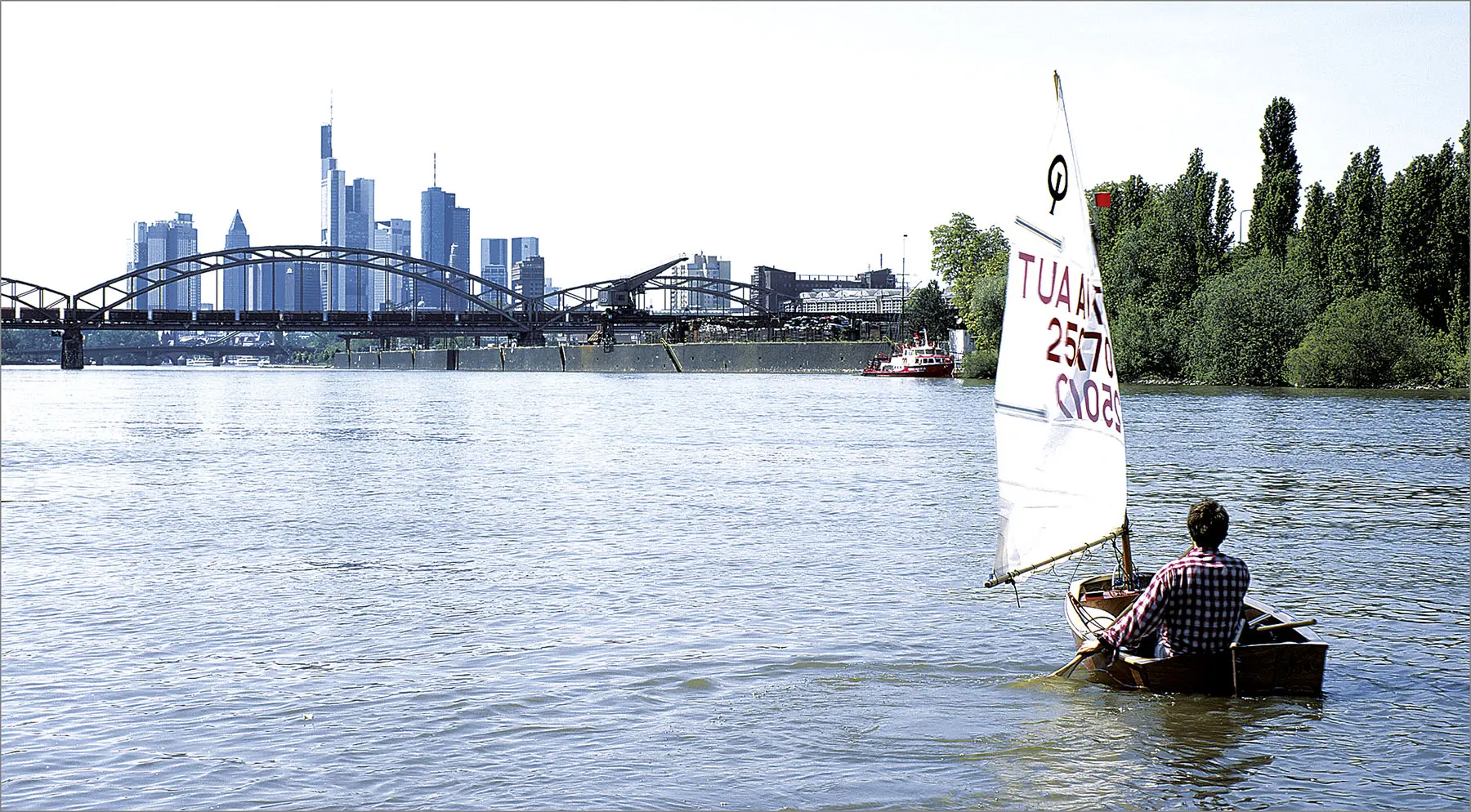
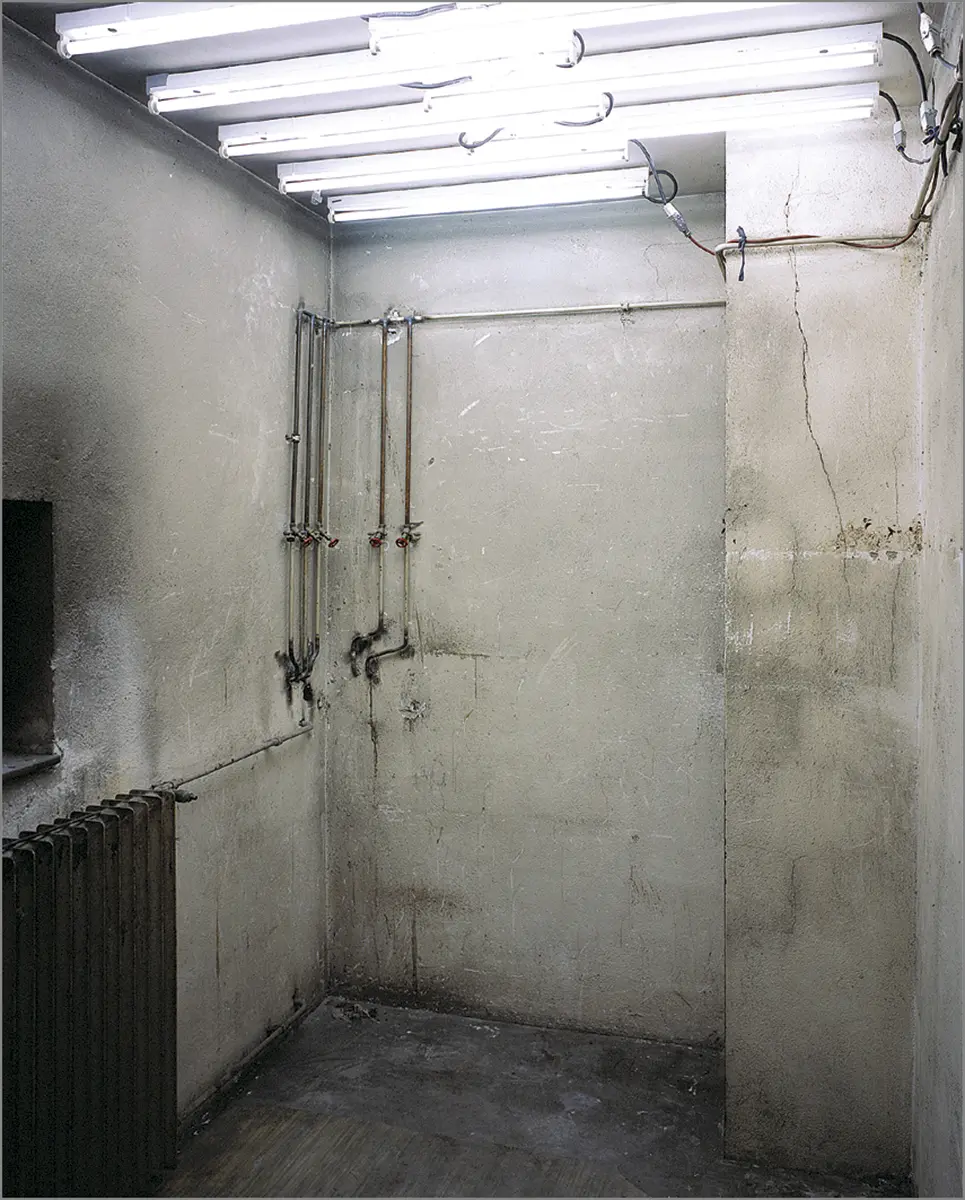
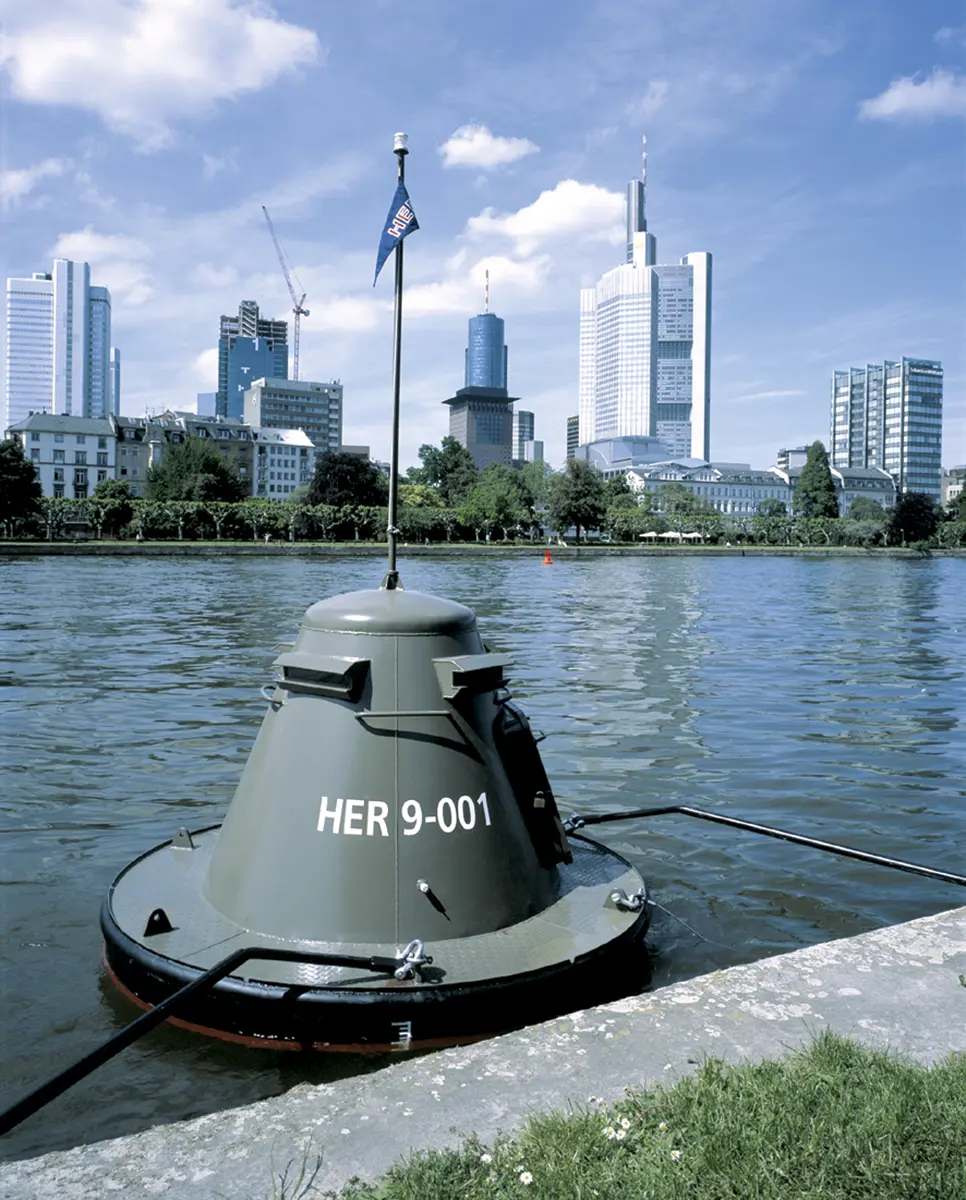
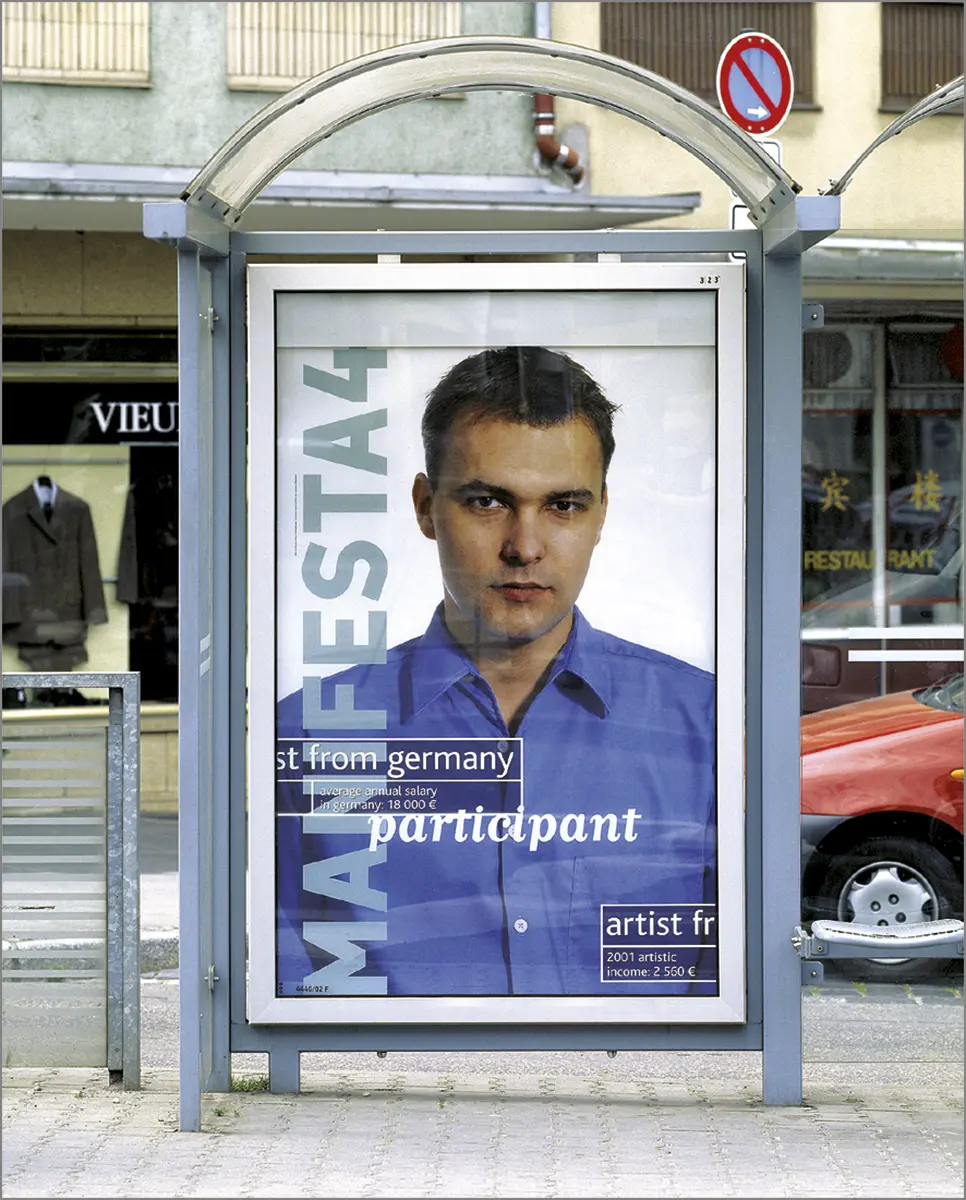
Those interventions aside, the show was emphatically anti-objectual. The works were distributed in four venues (Frankensteiner Hof, Portikus, Frankfurter Kunstvereing, and Städelsches Kunstinstitut) and a series of alternative spaces ranging from a train station to the airport, from the river banks to an island. The novice visitor surely had difficulty in finding these spaces, despite the fact that this Manifesta’s “image” was a series of red typographical arrows that appeared on the catalog and several maps, and were placed as signals in those locations displaying works.
This Manifesta’s most interesting works were, then, videos, movies, and documentaries. One of the most intelligent and simple works was Jun Yang’s video dealing with the issue of diaspora. Jun was born in China in 1975, and his family moved to Vienna when he was still a child. His video is a brief and comical story about the changes the artist’s name undergoes in the Western world: it is badly written, it gets confused with names of girls (for example, “Miss June Young”), or simply it is said backward. Israel’s Yael Bartana’s Trembling time, an enigmatic and somewhat gloomy video, shows, at different speeds and recessive rhythms, the silent slowing down of night traffic on a Tel Aviv highway during a “national siren.” Olivier Bardin, from France, invited a group of foreign women living in Frankfurt to sit before his recorder in an advertising set. The video is an extremely subtle composition; a narrator is off-voice and the images thread a complex social situation among a group of women who don’t speak the same language. The delirious video Why It’s Time for Imperial… Again Gerard Byrne, is a re-enactment of a conversation that Frank Sinatra and Lee Iacocca had in 1980 regarding the ideal American car. Published originally as a Chrysler ad, the piece is a parody of American culture through the fantasies of two of its most paradigmatic icons, interpreted here by two unknown actors. Cars and motorcycles also seem to be the protagonists in the brief, incomplete stories that Jeanne Faus filmed with a group of residents of a new residential area in the German suburb of New-Allermohe. Another series of videos commenting on the social space in habitational projects are the two videos in which artist Pia Ronicke analyzes, with a didactic-anthropological approach, a modern urban complex’s everyday reality through guided tours to the site and testimonies from people who live or lived there.
The show’s curators were Iara Boubnova, director and founder of the Institute of Contemporary Art, Bulgaria; Nuria Enguita Mayo, chief curator at the Tàpies Foundation in Barcelona, Spain; and Stéphane Moisdon Trembley, independent curator and co-founder of bvd (bureau des videos), Paris, France.
INÉS KATZENSTEIN