A new fluidity and freedom that blurs the limits between figuration and abstraction are what we find in Raúl Recio’s intensely colored canvases. On them, organic shapes are piled up with a neo-Baroque sense of movement, and there is a tension adding up similar or dissimilar elements. Together with the constant allusions to urban popular culture, the elements link these rigorously contemporary works with Pop art of the 1960s and other similar trends.
As a product of a late avant-garde, the promiscuity of media imposes a diversification of the languages used. The work on paper, the bronze sculpture, and the neo-Dadaist object, all-around up a repertoire of expressions that, added to the oil paintings, give faith to the versatility of an artist who makes use of any available resource to translate a single vision into several concepts of representation.
Above all, the subject of insularity is one of the most important referents in this exhibit, where the landscape serves as the bridge the artist constructed to close the gap between art and nature. Sea water, sand, and salt are mixed into the pictorial material, not only as add-ins for texture but as testimonial resources of paintings created at the seaside, where nature and ocean intervene as the cascades and rocks of Frank Lloyd Wright’s homes.
These open and expansive paintings resemble fragments of environs and landscapes. They integrate strokes that could be seen as reflections on the water. As abstract landscapes or lyrical abstractions, they remind us of French painting of the 1950s more than the American expressionism of the same time. The artist’s favorite resource is color, and he borders on monochromes of blue, green, red, or intense yellow. He adds up contrasting elements in daring yet refined harmonies, where the drawing is the space’s hierarchical element in terms of curvilinear gestures of spontaneous precision, whose freedom and expressive immediacy sway back and forth between horror vacui and accumulation, to a detachment that’s spiritually akin to zen.
The painting’s plane is vindicated in all cases, though, even in the urban landscapes. In these, we find remains of architectures integrated by color into specific environments, not only chromatic but also atmospheric, propitiating thematic associations between the different pieces. Seen in terms of composition, the drawing’s curvilinear rhythm contributes to the overall organization, providing formal hues to the unity imposed by the prevalence of blue or solar yellow.
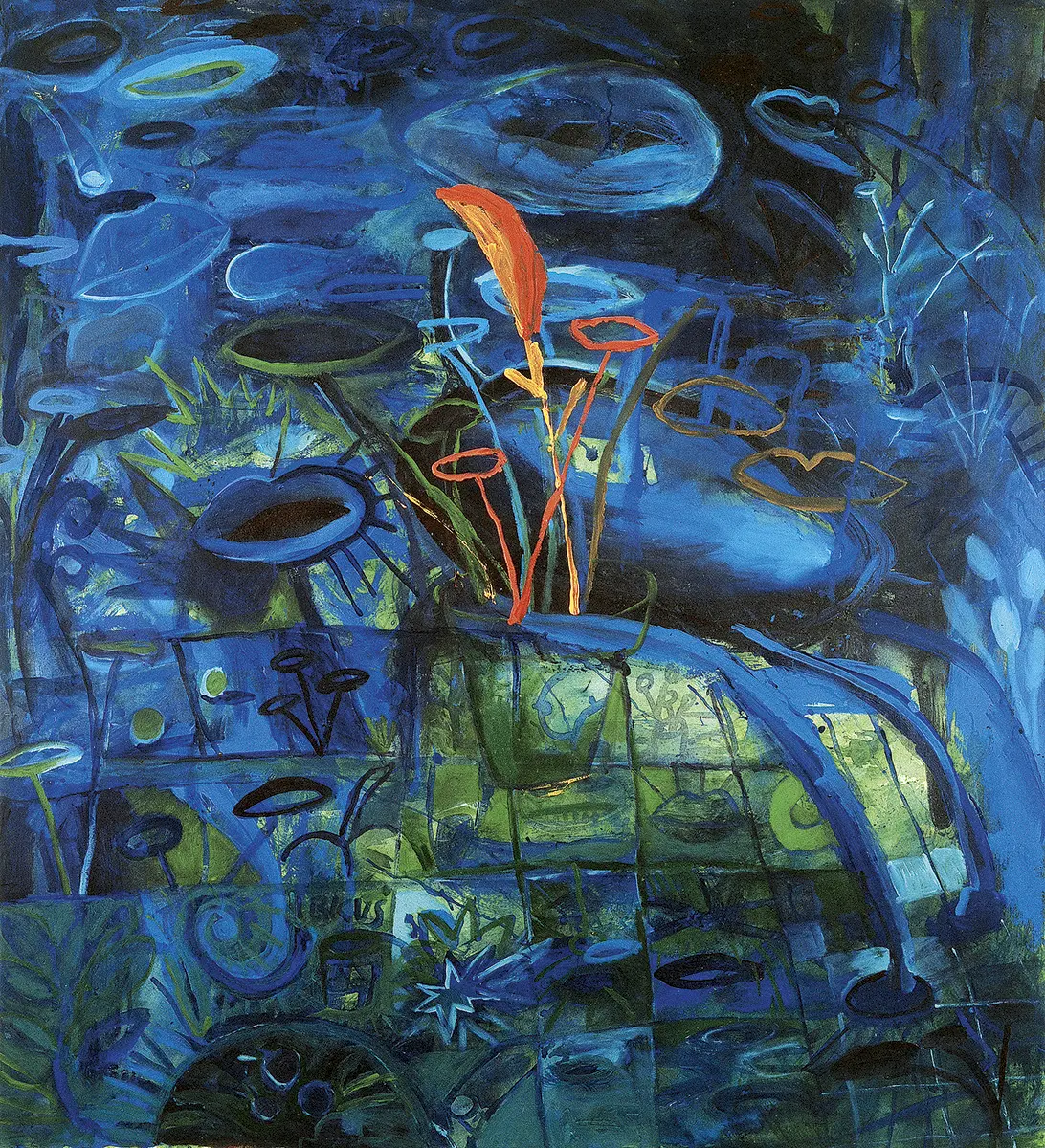
In other cases, there are references to Impressionism, specifically that of Monet’s late water lilies. This work didn’t reach the essentiality of abstraction by means of mysticism or the depuration of shapes, but through a sensuality that’s devoid of structure. It doesn’t perceive reality through categories of calculated temporal spaces, but as a continuum that flows not unlike Buddhism’s Samsära, the reincarnation.
Beyond the phallic symbols and the more or less hidden sexual allusions, this feast of the senses probably shows with great strength Recio’s erotic and hedonistic art, its gusto and freshness. Also evident in that peculiar aggressiveness is a relaxed demeanor that makes use of color and form to achieve a strong aftertaste of poetry, both robust and popular.
Another important reference is the American junk sculptures from the 1990s, in particular the three shelves where the artist groups together personal memories, objects, and photographs. As Sylvia Karman Cubinas, the show’s curator has pointed out, this approach is well within an aesthetic that’s akin to Puerto Rico’s Pepón Osorio’s, but also it has an affinity with the first installations done by the Dominican artist Marcos Lora Read.
From the pork of the local fiestas and the vicissitudes of the moto concho (the popular mode of transportation in Dominican cities that inspired the four bronze sculptures) to that canvas of a submerged city (a neo-romantic and contemporary version of the triumph of nature over civilization), or to the series of quick and sketchy drawings, or the sexual symbols reiterated throughout his work, or the objects piled up as baits for the memory that grant the necessary autobiographical note to the show, Recio’s work sways back and forth between the island’s nature and urban context and its cultural referents, from the collective to the private, and from every day to the mystical. Besides their obvious points of contact, Recio’s works distance themselves from attitudes that Hal Foster, based on Barthes, attributes to artists such as Andy Warhol, who tend to “de-symbolize” the object and turn it into a mere surface, with no meaning or intention. On the contrary, here we see subjectivity as the knot tying up and articulating its own discourse, where the artist’s presence is clearly behind the work.
In any case, the show’s title, Todo tiene su nombre (Everything Has Its Name), makes reference to the invention of a personal world from a collective, and even natural, world. Here everything has its place, and the artist’s function is similar to that of Walt Whitman’s –to create a poetic inventory. It’s a magic operation, according to which the images and objects assume the rank of signs and names, and each one points to a vital and concrete experience whose context is the totality experienced by subjectivity.
LAURA GIL