A foreigner who arrives in 21stcentury Havana for the first time could very well ask this question: Where’s Havana’s charm? It’s also the double-entendre title of Ricardo G. Elías’ latest exhibit, held at Galería Habana. Well inserted within Cuban photography’s experimental and renewing character of the last twenty years, this creator —who defines himself as a political artist— usually works with social facts and circumstances that have a decisive historical repercussion. But this time, the counterrevolutionary sabotage perpetrated at the store named El Encanto during the 1960s, serves as an excuse for the artist to comment with ambivalence on the country’s current destiny.
Three series make up the show. Artistically suggestive, the first one plays with the popular diloggún, a term used in the Regla de Ocha, or santería, to designate the divination system that uses cauri shells. In Cuba is quite common that believers and non-believers alike resort to diloggún when they’re ill or dissatisfied with their lives. The answers sent by the santos are called refranes (refrains), and they’re interpreted by the sacerdote, or priest.
The artist makes several diptychs using the cauri shells, first in their original color against a black background, and, on the other panel, painted black and set against a white background. The pieces’ titles are the refrains from the Ifá board, and the artist has placed the shells altering the rules of the religious exercise, in which the interpretation is done only after the shells have left the santero’s hand. The white shells against the black background predominate in each pair of photos —alluding possibly to the room for improvement that each human being has. But this series also appears to be commenting on the manipulation that the individual might be subjected to when renouncing his or her free will as a consequence of a voluptuous or frivolous behavior. The artist’s position is ironic before the religious canons; he subverts them by suggesting that a person can determine his or her own destiny according to his or her actions.
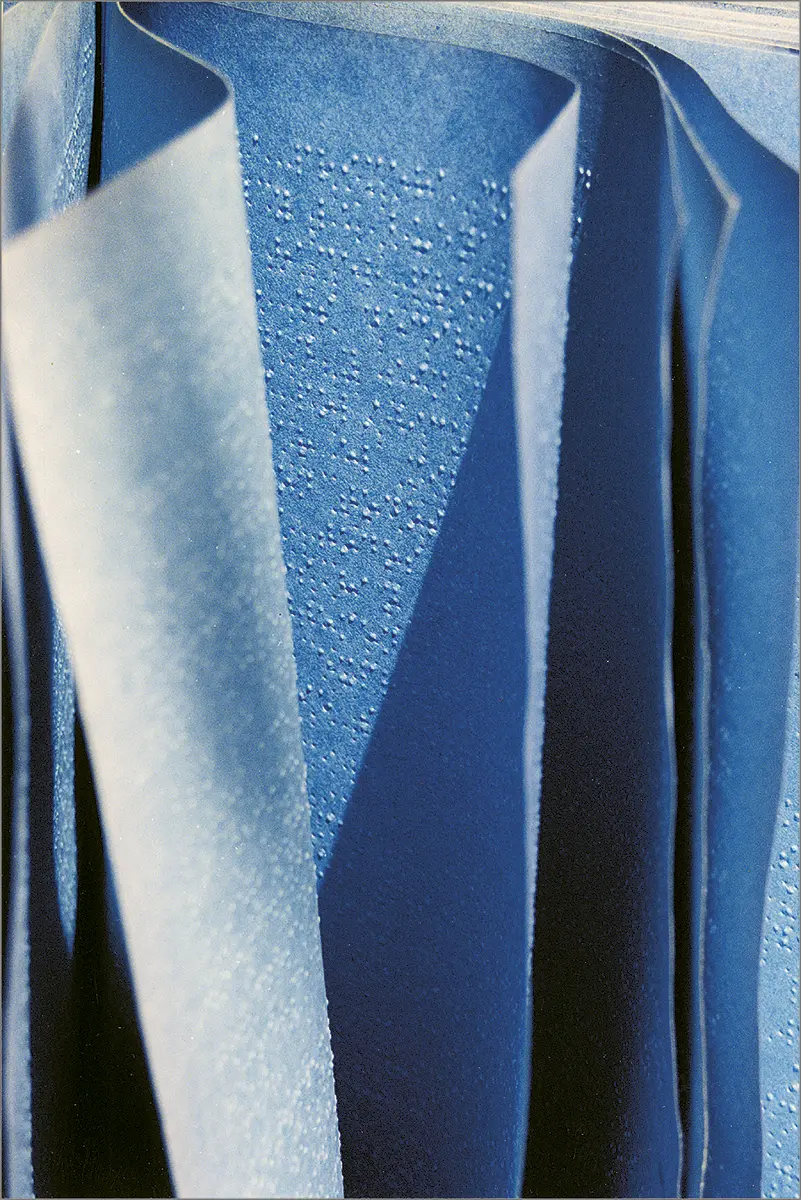
The second series, La historia me absolverá (History Will Acquit Me), are color photographs of Fidel Castro’s self-defense when he was put on trial for his 1953 assault on the Moncada garrison. Elias took images from the book (which was also published in Braille language), then treated them with blue tones, apparently abstract. In this historical document, the Cuban leader outlined his criteria and proposals for reforms in housing, land, electricity, unemployment, lack of sanitation, and other important issues contributing to the country’s low standard of living. When it’s turned into an objet d’art, the text gains a new autonomy and its meaning is reevaluated under new coordinates. Elías seems to be telling us that in today’s Cuba, even the blind have the right to educate themselves and read the Revolution’s political program. But this reading cannot be made inside the gallery, not only because photographs cannot be read by fingertips but also because the game of lights and shadows, along with the angles used to take the photographs, render the text indeterminate, preventing the spectator from deciphering it. It could be understood as a commentary on an act of faith. The photos’ blue color, associated by psychologists with love but also with nostalgia, tells us of ambivalence in the creator’s discourse.
The third series, ¿Dónde está el Encanto en La Habana? has been resolved through several photographs and a video. The photos refer to eight locations in the capital city that have a common denominator the deterioration of one of Latin America’s most beautiful cities. In the video, the artist uses archival images as a mnemonic resource; he shows events from the Machado and Batista regimes, and of the revolutionary period as well. Among others, the images seen are of popular demonstrations, the persecution of revolutionary fighters by the regimes, the fire provoked at El Encanto, Fidel Castro’s entrance into Havana at the end of the war, and the desecration of Martí’s statue by a US marine. Two scenes are projected simultaneously in a 16-mm. format, creating a counterpoint between the anguish of the pre-revolutionary years and the gains achieved after the triumph. The message here is also ambivalent: It is true that there are buildings crumbling, but the absence of abuse and other perturbing activities make Havana a peculiar place.
As in literature, Elías uses a part to show the whole. In his proposal, Havana becomes the entire island of Cuba. Like another group of renowned photographers who have de-automatized photography, Elías proposes a vision of Cuban reality that’s filled with ineffable interstices. He talks about politics without pamphleteering, unveiling good and bad decisions of a system that has tried to maintain a social ideal. Everyday Cubans still behave with the joke’s “discreet charm,” which is an efficient therapy against adversity: the need to survive during difficult times prevents them from taking themselves all too seriously.
AMALINA BOMNIN