Organized by the Museum of Contemporary Art, Chicago, and The Museum of Contemporary Art, Los Angeles, this exhibition focuses on the ten years Roberto Matta lived in exile in New York. Like many of the members of the Surrealist movement, Chilean-born Matta moved to America during World War II. During this period, he created some of the most distinctive and significant works of his career, and participated in the local art scene, having a profound influence on the younger generation of American artists that would later be known as the Abstract Expressionists.
The exhibit brings together paintings and drawings from public and private collections in the United States, Europe, and Latin America. More than twenty-five drawings illustrate the development of his individual style. Exceptional drawings in crayon and pencil, sometimes with watercolor added, in which strange flaming personages seem wracked with sexual tensions, demonstrate Matta’s talent as a master draftsman. One of the most beautiful examples is The Red Sun (1940), a colorful abstract landscape dominated by organic shapes and delicate fluid lines. An unusual drawing on black paper, Dark Light (1940), is an exquisite example of surrealistic imagery. Another drawing, Woman Playing Ball in Front of the Volcano (1940) illustrates the influence the Mexican landscape will have on his imagery, after visiting the country.
But the major focus of the exhibition is the pictorial component. The works on canvas reveal the evolution of his approach to painting, which depicts man’s inner universe in relationship to events in the world around him. Many of Matta’s early masterpieces are featured in the show, including Invasion of the Night (1941), The Earth is a Man (1941-1942), The Onyx of Electra (1944), and A Grave Situation (1946). In Miami, the exhibition includes loans from area collections, including Crucifixión (1938), the first painting ever made by Matta, urged by his friend, British artist Onslow Ford.
There is no doubt that the most important piece of the exhibit is the monumental canvas The Earth is a Man (1941-1942), a Surrealist landscape where the outside world fuses with the inner soul. The scene depicts the beginning of the universe and shows both the earth’s outer landscape and man’s inner world. It is a powerful amorphous landscape, illuminated by a sun eclipsed by a red planet and surrounded by metamorphosing forms. With the use of line and color, he depicts states varying from liquid to crystalline. The image is a composition of fluorescent shapes, colored with rich jewel-like layered tones. By sponging on and wiping off the painting, Matta creates a true atmospheric appearance.
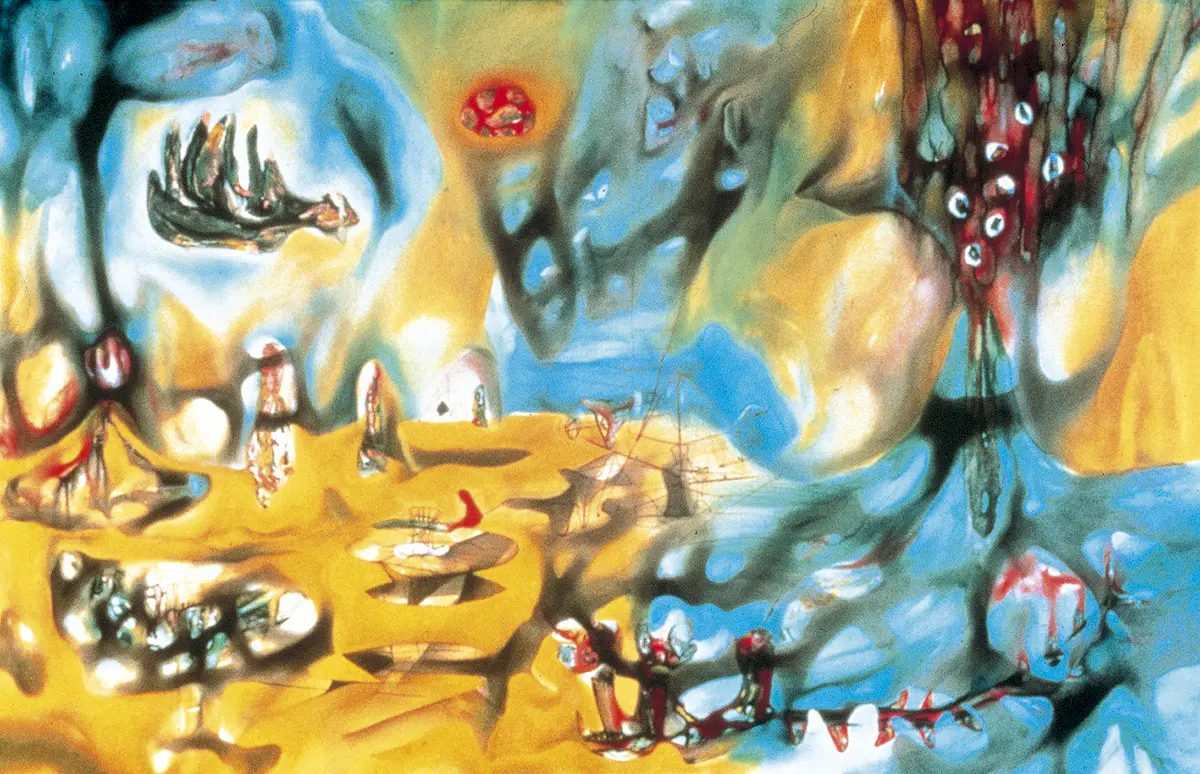
Its size, immense by the standards of easel painting, and its apocalyptic qualities —which like its size, were indebted to Picasso’s Guernica and to the murals of Rivera, Siqueiros, and Orozco that Matta saw in México- had deep resonance among the new generation of American artists. They were familiar with the Cubist structure and Surrealist dream imagery, but Matta’s new form of abstraction really caught their attention.
Matta’s earlier experience as an architect has a strong connection with his painting’s strategy. Trained in Chile, his compositions have a clear architectural component. From a thematic point of view, the relationship between Catholic mysteries –he studied at the Catholic University- and Surrealist painting seems decisive. This relationship is present in powerful works such as Rocks (1940) –which also depicts the volcanic Mexican landscape-, Foeu (1941), and Invasion of the Night (1941). In these particular works, the apocalyptic imagery is secular and it unfolds a clear narrative of dual creation and destruction.
Some of the works selected for the exhibit illustrate Matta’s familiarity with major European figures such as Le Corbusier, Federico García Lorca, Salvador Dalí, Alvar Aalto, and Marcel Duchamp, among others. The Bachelors Twenty Years After (1943), for example, is a clear reference to Duchamp’s famous work. In this piece, Matta depicts linear overlapping shapes suggesting machines that transfer the matter to glass creating labyrinths floating in an otherwise empty canvas. It is complex imagery that reiterates his unique style and frame of mind.
As time progresses, Matta’s work addresses his concern with social issues and the way they affect peoples’ lives. He is particularly touched by the disasters of war and the impact of technology on society. By the end of the decade, his work had moved in a more illustrative direction as seen in However (1947), a painting that describes a mechanized assembly line where robot-like beings perform monstrous deeds, making reference to the Nazi concentration camps. There is a clear interest in imagery that, in some cases, sacrifices the more powerful abstract representation of his early works. At the Miami venue, this is clearly illustrated by the last work shown, Untitled (1968), a huge painting that fails to fit within the context of the exhibit. It is a much later piece that belongs to a completely different period and distracts rather than compliments, because of its disproportionate size (232 x 118 inches) and its lack of thematic and stylistic force.
Nevertheless, the exhibition is a unique opportunity to appreciate the most important pieces of this Latin American master and to fully understand his role in the development of art history in the twentieth century.
FRANCINE BIRBRAGHER