Tania Bruguera’s show at the San Francisco Art Institute’s Walter and McBean Galleries took place in parallel to her stint as artist-in-residence at the institute’s school. Tania Bruguera arrived on the scene as part of a somewhat intermediate generation, sort of a generational bridge between the artistic movements in Cuba in the 1980s and younger artists who emerged from the 5th Havana Biennial of 1994.
Diverse generational characteristics have converged in Bruguera’s work to generate very personal propositions, resulting in work that continuously gains authenticity. Such authenticity derives from the artist’s formative experiences and achieves its current form thanks to Bruguera’s notable presence in international circuits and institutions.
Moving in an international sphere, Bruguera’s work has evolved towards an equilibrium between political and social preoccupations, on the one hand, and inquisitions about the individual’s most intimate condition on the other. This equilibrium is arrived at through suggestion and exploration, instead of relying on univocal meanings. Tania Bruguera prefers subtlety, privileging doubt (sensorial, ideological, mediatic) above any definitive assertion. She assumes a solemn, ritualistic spirituality, close at times to religious feelings. Hence the tone of her work with the body: her exploration of physical being turns anatomy into a sacred, suffering space.
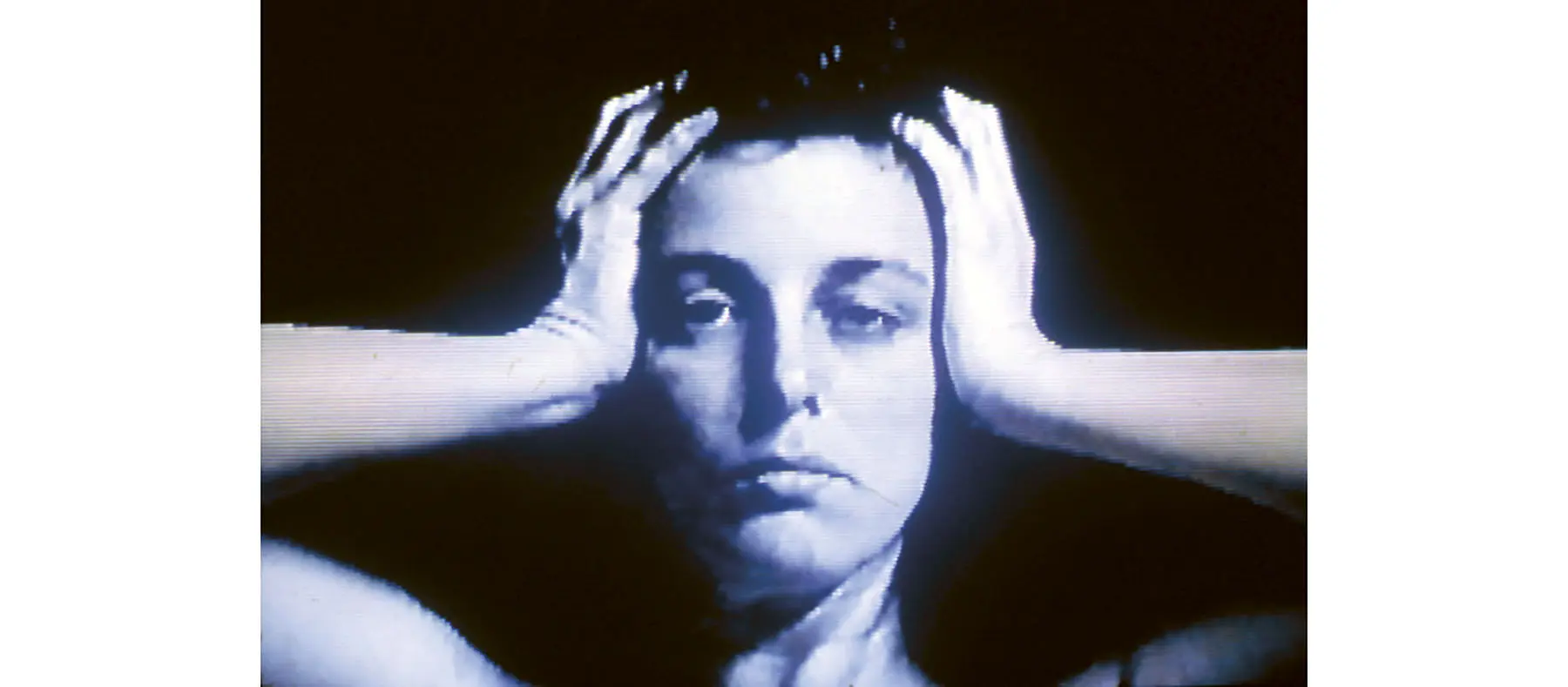
All of this becomes evident in her installation La isla en peso (The Weighed Island) (2001), which establishes a dialog with the poem of the same title written by Virgilio Piñera in 1943. Here, eight synchronized video monitors show the artist’s face looking at the camera, facing the viewer. Bruguera gesticulates differently on each screen. The image’s manipulated speed influences the piece’s rhythm, and so does the methodical, at times convoluted character of Bruguera’s gesticulations. There are intimations of masochism: the artist pulls her own hair, arching her body back, or squeezes her tongue between her lips; she also forces one whole hand inside her mouth. These gestures, resembling some ritualistic punishment, fascinate us with their quasi-eroticism, but they quickly become difficult to handle: we become extremely sensitized to the heroic plasticity of the body, to the tense face with its eyes incessantly trained on us. The discomfort is augmented by the video’s soundtrack, which includes the bleating of sheep and sounds of wind and of breaking waves. At times, the screens are darkened and we hear, disengaged like the remains of a shipwreck, Piñera’s corrosive, desolate verses.
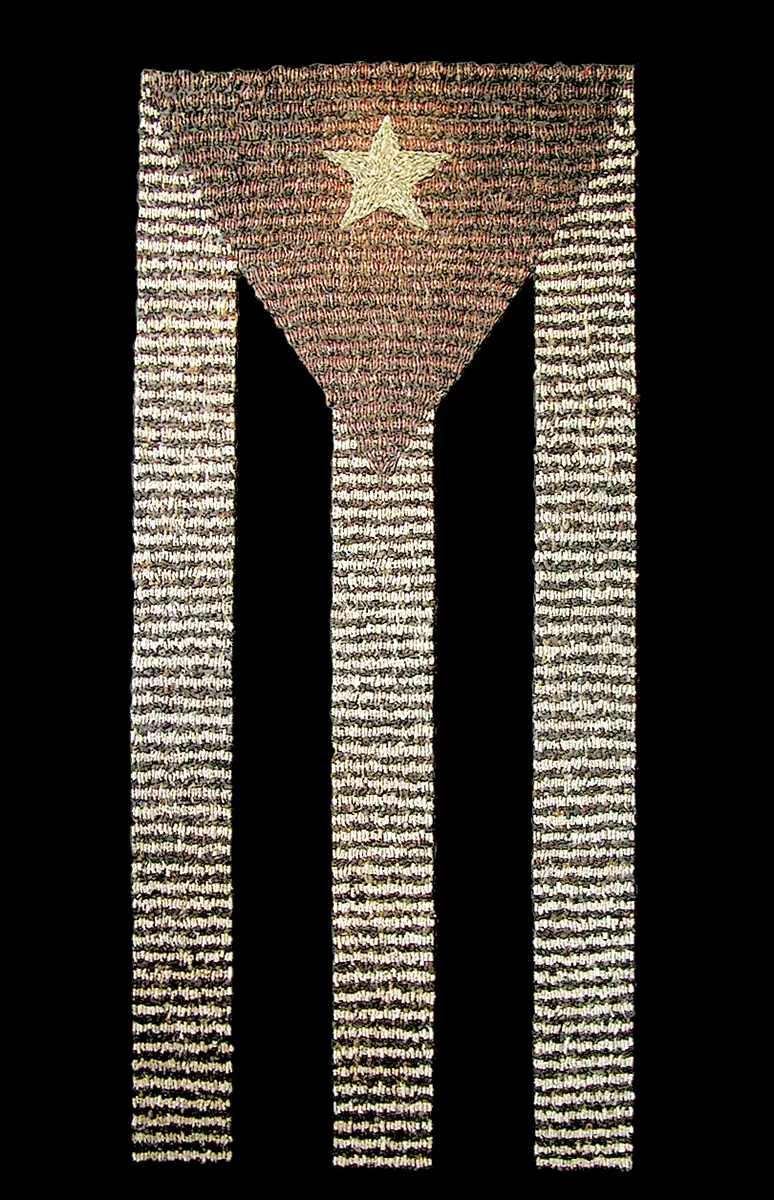
Estadística (Statistic), originally made in 1995 and reconstructed in 2000, fuses the public and intimate dimensions. The design of a Cuban flag is reproduced at a large scale on a wall. The national symbol’s original colors (red, blue, white) are darkened into black, ochre, and a drab shade of gray. In this somber version, these colors come from the earth, blood (sheep’s blood), and the body. In fact, from the body of many: in the flag’s stripes we find tens of small knots; in the triangle, strands of intertwined fiber. It’s human hair, braided with ribbons of faded colors. The homeland’s most absolute symbol is made, at least in this instance, of its literal soil, as well as of its citizen’s very substance.
Bruguera’s show included a work in progress that explores the production and consumption of tea; it is, as such, a commentary on the tension between the colonial legacy and the metropolis. Also, Bruguera presented over a dozen studies or her installation at Documenta 2002. This piece, which promises extreme complexity, is part of a series-in-progress titled Ingenieros de almas (Engineers of Souls).
ANTONIO ELIGIO FERNÁNDEZ
Cuban artist, art historian, and curator.