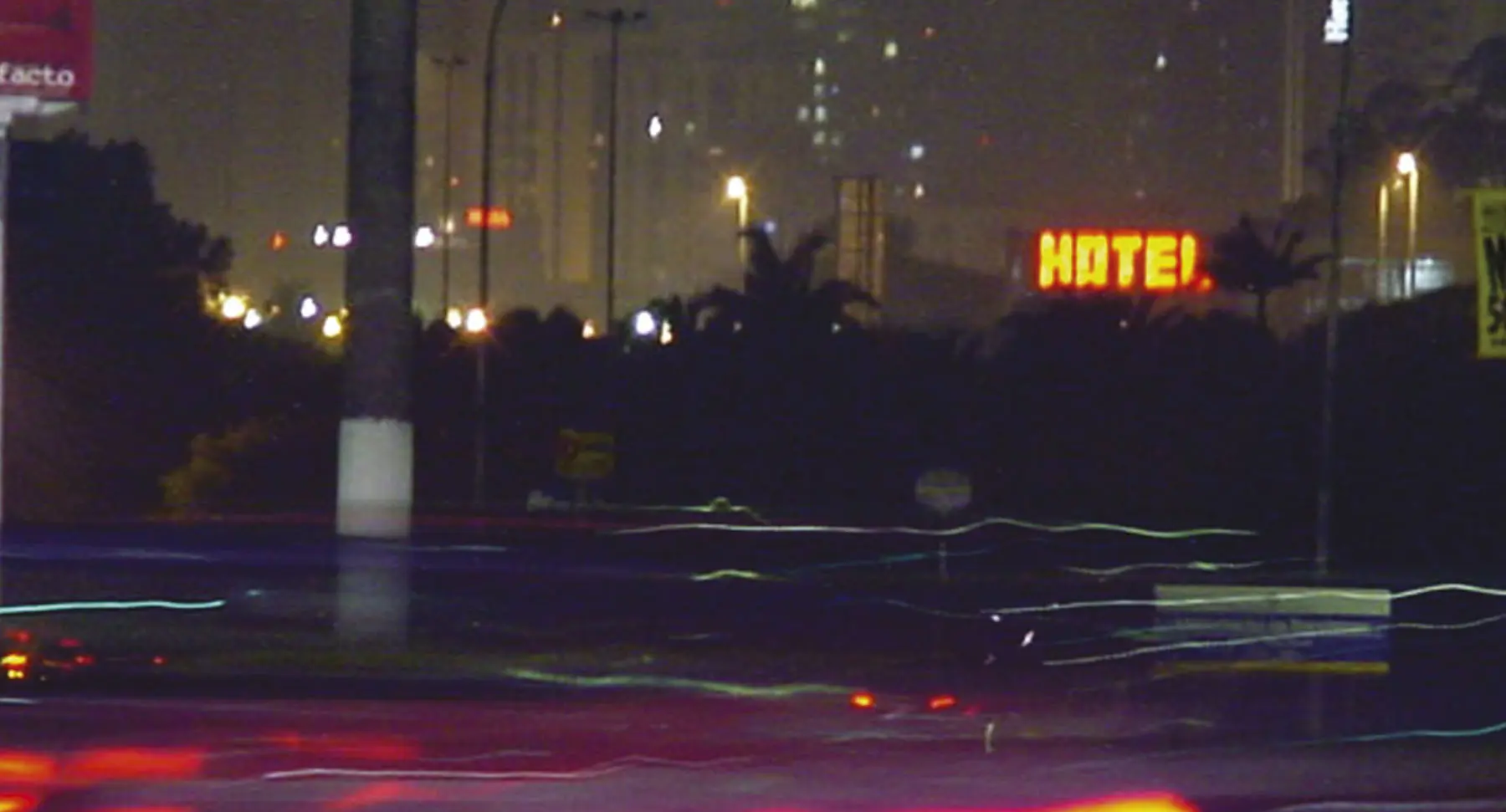
After four long years and a series of crises, the Ciccillo Matarazzo Pavilion once again housed the São Paulo Biennial. Today, in its 25th edition, it constitutes one of the world’s oldest and most important contemporary art events. Once again, artists, curators, and critics gather in a city to confirm once more what they might already know, or perhaps they try to be surprised. Carmela Gross, from the host city, registers the visitors’ somewhat innocuous stay in São Paulo with a neon sign on the façade of the Oscar Niemeyer building. The sign reads: HOTEL, a synthetic, ironic sign that perhaps is announcing what will become of these kinds of exhibits. Or maybe it’s an invitation to search for strategies that can change them into debating grounds and experimentation platforms for the benefit of contemporary art, and not into temporary storage spaces for an array of objects, both national and foreign.
50 years after the creation of the São Paulo Biennial, this should have been (or still could be) the opportune moment to ask ourselves whether such an ambitious and expensive exhibit shouldn’t be more than a stand on which each artist tries to present a good work of art, or that it shouldn’t go unnoticed in the eyes of the critics. And whether an event of this size, which moves many of the country’s resources, shouldn’t have the obligation to also be a field for research and experimentation, dedicated to reflection. Such issues, among many more, are posed by the critics. But the real challenge is that they should be presented to The São Paulo Biennial Foundation, the institution itself.
The XXV Biennial’s big innovation is the nomination of a foreign general curator –Germany’s Alfons Hug, a professional curator at the Goethe Institute. Since 1984, Hug has worked in Lagos, Medellín, Brasilia, Caracas, Moscow, and now Rio de Janeiro. The topic he selected for the XXV Biennial was the Metropolis. Even if it isn’t the most original of topics (many contemporary art exhibits have been organized around it), it is, without a doubt, relevant to the city hosting the event. São Paulo is one of the world’s first megacities, overwhelming, rich in contradictions and contrasts, and lacking representations and reflections on itself. After four years without a megaevent, it’s understandable that the megacity has built high expectations about a biennial that’s tackling the metropolis as subject matter.
In this edition, the 30,000 square meters of pavilion house three exhibit clusters, the show’s thematic axes: "Metropolitan Iconographies," "Special Halls," and "National Representations." As a continuation of the imitative developed in the XXIV Biennial in 1998, there is a web art segment showing works using that medium.
The "Special Halls" abolished the "Historical Nucleus" of the last edition, and they returned to the previous biennials’ model, where the so-called "museological," weather-controlled pavilion houses small monographic shows of the great masters. Even if the XXV Biennial seems to have taken some steps backward by presenting several disjointed exhibits (in the XXIV edition, the "Historical Nucleus" shows were thematically and conceptually joined around anthropophagy), its greatest and most welcomed change was the replacement of shows of great historical artists (from Van Gogh to Picasso) with the works of contemporary masters. Meanwhile, even if contemporary artists and "Special Halls" were retaken to the detriment of a historical or thematic reference, Alfons Hug showed little conceptual innovation or articulation when selecting paintings by Jeff Koons and Sean Scully, photographs by Thomas Ruff and Andreas Gursky, performances, and registers by Vanessa Beecroft. The space reserved for the Brazilian artists was occupied by Nelson Leirner, Carlos Fajardo, and Karin Lambrecht, chosen as a group due to the selection of national artists for each of the Biennial’s segments. A question must be asked within this context: What is it that makes these shows, works, and artists more "special" than the ones exhibited outside the weather-controlled pavilion? The notion of "special" is presented as anachronistic and conservative, quite distant from contemporary artistic and curatorial practices, finding its justification only in reasoning dominated by marketing the wrong kind of marketing. On the other hand, what’s more, noticeable while taking into account the curator’s overtly Third-World discourse, is the apology for marginal art and the absence of artists who are outside the European or American exile, with the obvious exception, of course, of the Brazilians. In previous biennials, the presence of Latin American artists in the "Special Halls" and the "Historical Nucleus" was becoming increasingly consistent. It’s worth remembering them if only to understand the importance the art from the rest of the continent has meant for the Biennial: Jesús Soto, Diego Rivera, Torres-García, José Bedia, and Rufino Tamayo, in 1994; Wifredo Lam, Pedro Figari, and Gego, in 1996; Armando Reverón, Roberto Matta, David Alfaro Siqueiros, and Guillermo Kuitca, in 1998. In the end, the São Paulo Biennial, the continent’s most important art exhibit, always took seriously the responsibility of giving visibility to Latin American artists in the "Special Halls," and many foreign critics and curators came to São Paulo looking precisely for that. Will the Biennial end up disregarding the fundamental role it has played historically?
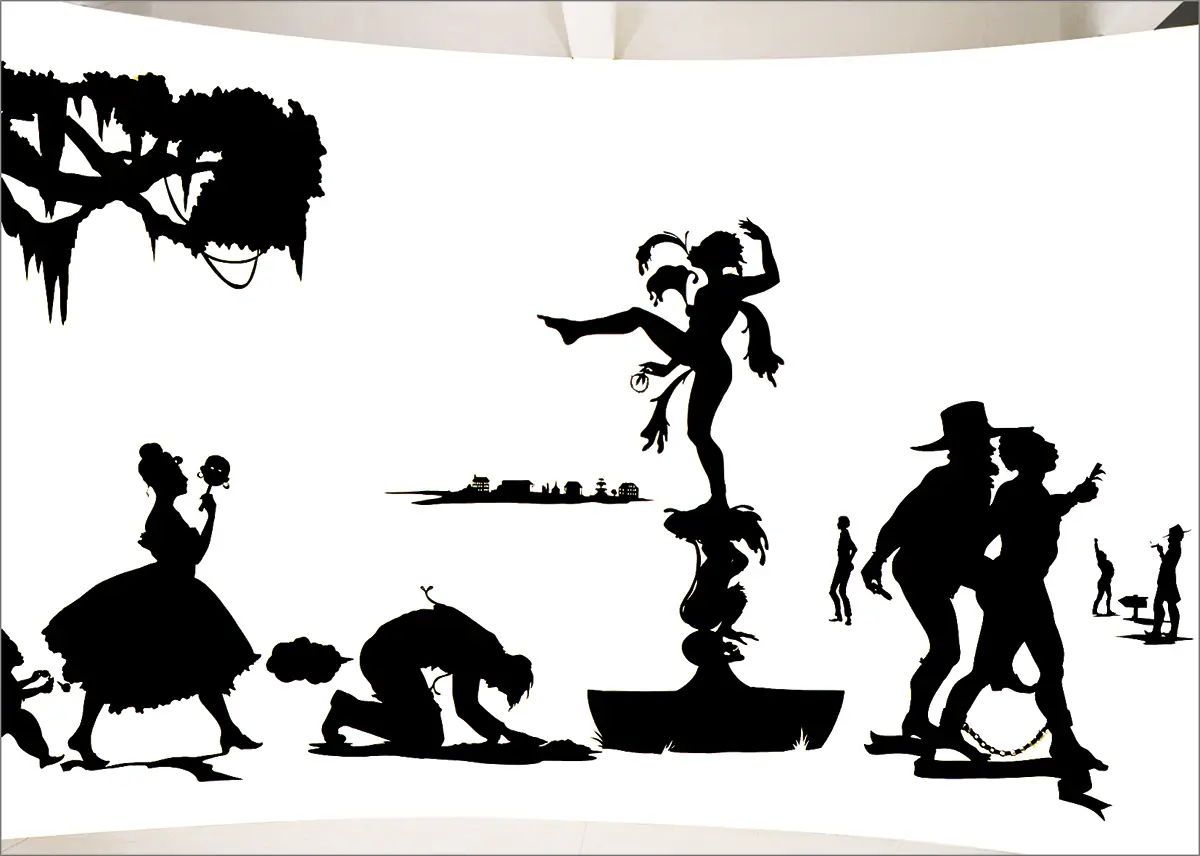
By choosing one artist from each country, the "National Representations" segment repeats the previous editions’ worn-out model —space inside the provisional storage space that the building has become. According to its curator in the introductory text, the Biennial engaged in an intense dialog with delegations from other countries to ensure a better placement of the works presented within the proposed theme. The diversity that the different countries could have presented was replaced by a thematic unity that was almost imposed upon each representation: to think and illustrate the megacity from the countries where it exists. National representations survive in São Paulo due to the hefty investments that richer countries placed on individual shows, something that the Paulist biennial cannot do, especially in a period undergoing a marked financial crisis. What we frequently see are the jugglings of critics and curators trying to justify the selection of countries. A case that must be mentioned here is the United States, which brought Kara Walker’s beautiful work, which retakes the imagery of black country folk during slavery. The only justification found to include such work that has the contemporary metropolis as the subject matter is the radical counterpoint or the other.
One of the greatest criticisms in regard to the "National Representations" segment is the suspicion of the unwanted and unacceptable connection between official diplomacy and its bureaucratic counterpart. In Venice, the countries try very hard to eliminate it, but in São Paulo it showed its hard face. Taiwan, a country accepted in this segment, held its own exhibit of Chien-chi Chang’s photographs. It was organized by the Taipei Museum of Fine Arts, who of course paid for all the costs involved. In the event’s opening week, the Biennial Foundation informed the curator Fang-wei Chang that Taiwan could not participate as a country since Brazil doesn’t recognize it as such. The institution had been pressured by the Chinese delegation, who threatened to withdraw if Taiwan was included. The final decision was to leave the artist’s name along with the Taipei Museum, turning his presence into an isolated case. In a gesture of solidarity, on the opening night, six countries spelled out the name of the country on the exhibit’s doors. Austria contributed the lowercase "t;" Singapore, the "a;" Croatia, the "i;" Costa Rica, the "w" by splitting an "o" down the middle; Canada, the other "a;" and Panama, the "n." The following morning, the institution got rid of the gesture, claiming to be following the chancery’s policies. More than a bureaucratic upset, what happened here is a clear symptom of the damaging effect that official diplomacy can have on the arts. The termination perpetrated by the official bureaucracy is a total disrespect to the pavilion. It’s just one more proof that this XXV São Paulo Biennial is not interested in opening spaces for the debates that must go beyond the model nor is it willing to yield to them. Without wanting to, the institution elicited a collective response from its own artists regarding the structure it proposes and the relationships it perpetuates: It closed its eyes to the political consequences of its own doings.
The nucleus "Cities" is the main segment expressing the notion of "Metropolitan Iconographies." It’s the brainchild of Alfons Hug, the curator, to unify around the segment the production of 11 megacities in the world, and an additional series of works made around a twelfth city —a utopic one. The chosen cities were New York, London, Berlin, Moscow, Istanbul, Johannesburg, Beijing, Tokyo, Sydney, Caracas, and São Paulo, evidencing the intention of looking for production from the extreme urban situations found in the Third World, more than giving privilege to the great art-producing centers. The central criticism that can be raised here is the fact that there’s little relationship between the twelve cities, and, above all, around the very concept of icon. The interest here is not in the dynamic relationship that many artists today seek to search and develop amidst the weave of a city but in its simple "iconography." The city’s superficial appearance takes over its structure and operation. The pavilion’s self-sufficiency as an exhibit space is another tell-tale sign of the little social permeability found in the curatorship’s argument. The city must fit in the exhibit, not the other way around, and to think of the city in practical terms has been lost this way. There were, despite this, works that have complex strategies for dealing with the theme. Drunk, a video installation by Gillian Wearing, from England, is a good example of how to show the city through the effects experienced by its inhabitants. In any case, we could say that the theme here is more urban than metropolitan. The selection of the twelve cities obeys Hug’s own knowledge regarding the production of art in each one of them, where in many instances he had worked before some of them.
Countries, cities, and artists appear and disappear in the labyrinthic architecture built for this show. Truly, a segmentation of space that does little to encourage communication between the different works, opting instead for excessive cuts and a dizzying succession of white cubicles (and black ones too, as was the case of several videos that on the second floor formed a tedious corridor). For such a universal theme, one could benefit from the contamination strategies found from one reality to another. The museography behaves more like a water reservoir, radically compartmentalizing the different discourses. The profusion of small cubicles for the works in the video was the most dramatic testimony attesting to this fact. There isn’t a geopolitical stance in relation to the montage. Why these cities? Why put them together? Why name these curators? These are some of the most obvious questions the curatorship leaves unanswered.
Built for the IV centenary of the foundation of São Paulo, the Ciccillo Matarazzo Pavilion and the Ibirapuera Park where it’s located, are the witnesses to a city that in the 1950s began to see itself as modern, as a focus for development and perhaps the desire to become a little of the "promise" that Hug proposes for the twelfth city. The Biennial is conceived from such conscience and desire to make a metropolis out of São Paulo. Almost 50 years after the building was inaugurated, the resulting exhibit proposes to talk about metropolitan iconographies while forgetting its own function as an icon for modernity, whatever that may imply. It hasn’t thought about its heritage nor its power or responsibility to the city where it belongs. To a lesser or larger degree, the problem seems to spread to all other aspects of the exhibit. To be a show dedicated to the (metro-)polis, it lacks political conscience and the conscience it should have as well regarding its own political role within the city. Supporting this fact is the building’s self-reference, for it is the only and omnipotent exhibit space for the city’s events.
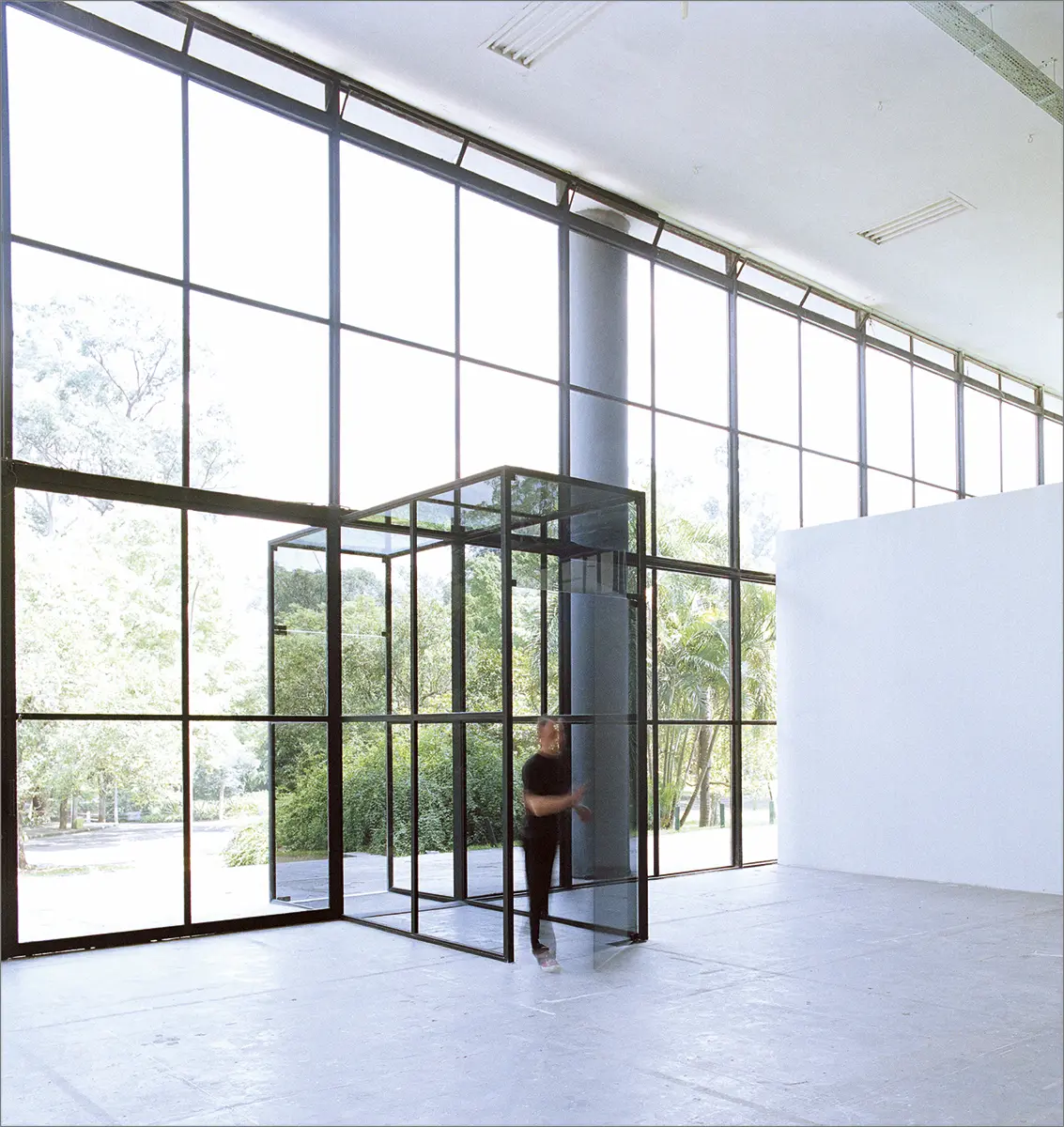
Happily, the exhibit sometimes reaches its objectives, mainly in terms of what some of the works and situations confirm as being the event’s own conceptual limitations. With his work Vazadores (Leakages), the Brazilian artist Rubens Mano was able to show this feeling in relation to the institution. Being one of the artists invited to think about São Paulo, Mano cloned a module of one of the building’s façade corner braces, pointing at both the building’s interior and exterior. There he opened a different door from the official entrance and placed it on the opposite side of the pavilion. The passageway, which allowed free and clandestine access to the exhibit, a few days later attracted the media’s attention and forced the Biennial Foundation’s directors to regulate the number of hourly visitors. It’s important to think of this thoroughfare not only as a way of cheating the ticket box office but also as a way to egress the exhibit without having to use the exit determined by the institution. An emergency exit. Finally, after many misunderstandings with the institution on how the piece should work, Mano himself had to use the emergency exit when Vazadores was disassembled a few weeks before the exhibit closed.
Making a more historical reading of the conditions in which the exhibit culminates, we should ask ourselves, regarding the lack of successes, if the institution hadn’t really been resented when faced with all the organizational problems and the power struggle that ensued around its real importance. It’s worthwhile to remember that Alfons Hug accepted the invitation to lead the Biennial a little over a year before it opened. The year 2000 can be remembered as the year the institution went into crisis, and 2001 when it suffered the consequences of celebrating its 50th anniversary. Tackling also the theme of the metropolis, but within Brazil, Biennial 50 Years became a fiasco when it tried to gather artists, designers, and architects under the same roof. The Biennial Foundation’s more recent news, posted in July, said that Hug will also curate the event’s next edition. With a project titled No One’s Land, the curatorship continues the political project developed for the XXV Biennial.
Returning to the exhibit’s limitations, one can see that the group of segments making up the XXV São Paulo Biennial ends up building a grid of semi-metropolitan, semi-national representations, and the hope is that curators should be able to squeeze out the contemporary art that’s produced and disseminated internationally today. The accumulation resulting from those representations in different fields and with different degrees could constitute a sort of statement, a declaration, or a question regarding the pertinence of the country’s notions of representation and the use that diplomatic and state organisms give to the culture produced in their respective countries. Meanwhile, at no moment the exhibit provide solid proof of being fully conscious of the complexities surrounding these questions, aside from the mere juxtaposition of different levels of representation which, in themselves, elevate the level. We can only hope that for future projects, the institution and the self-knowledge of the concepts developed a return to the Biennial a complexity that’s up to par with its historical importance.
RODRIGO MOURA
Assistant curator at the Museu de Arte da Pampulha, Belo Horizonte. He’s a regular contributor to the Brazilian newspaper Folha de São Paulo and other publications.
CARLA ZACCAGNINI
Brazilian art critic and curator.