
The incessant search for new expressive avenues based on the every day, on the one hand, and the notable expansion of abstract art (even, interestingly, into photography and sculpture), on the other —a dichotomy that could be considered strange and unusual for an artistic scene long dominated by social critique, parody, and a degree of institutional rejection— appear as the most significant elements in the art of recent generations in Cuba. Left behind is the exploration of the political imaginary, the constant signaling of historical flows, and the use of myths in relation to social and cultural action. Growing ideological fatigue has resulted from the lack of effectiveness in artists’ prolonged private and social battles to transform their surrounding reality —battles that, in many cases, resulted in works that were more irritating to the viewer than they were meaningful or significant.
Many art shows held over the last two years attest to a substantial shift in the content and themes of Cuban art, as well as in the predominant approaches and trends. In the 1980s and 1990s it would have been virtually impossible to present a show titled Art Is Not Meant To Be Understood as the Center for the Development of the Visual Arts did in 2001 for an exhibition dedicated to photography as a mode of expression. It would have been equally difficult to have art exhibitions with titles in English, such as the group show Free Jazz at Casa de las Américas in 2001, or René Peña’s Man Made Materials at La Casona in the same year (these locations are all in Havana). Some artists’ catalogs already come in two languages, Spanish and English, and the first large-scale Cuban Art Auction, organized by the Ludwig Foundation of Cuba and Casa de las Américas as part of the VII Havana Biennial in 2000, helped systematize the phenomenon, with new, institutionally-supported publications beginning in 2002.
In this cultural and economic context, as the century and the millennium turn, new artists have emerged who engage with seriousness and discipline in the local and international scene. Among them are Carlos F. Montes de Oca (Camagüey, 1968) and Aimée García, who recently showed their most recent work at the Centro de Arte Wifredo Lam in Havana, in shows respectively titled The Triumph of Persistence and The Flavor of Silence. These shows were presented in adjoining galleries, in what amounts to a kind of generational integration and understanding, more than a confrontation.
Montes de Oca has indeed shown great persistence in the rigorous exploration of the collective imaginary (national sports, human communication, manual labor, social mobility), relating it to a number of personal obsessions. To achieve this he resorts to baseball bats and balls The Idol, 2002, phone wire, cleaning mops, mirrors, manual mills of the kind used by farmers to ground coffee, and a series of drawings on paper. He arranged his works in the gallery in such a way that they could be seen as sculptures, objects, or installations since each of them has features of all of these genres. The only exception is the drawings, which keep their fidelity to the tradition of line on paper.
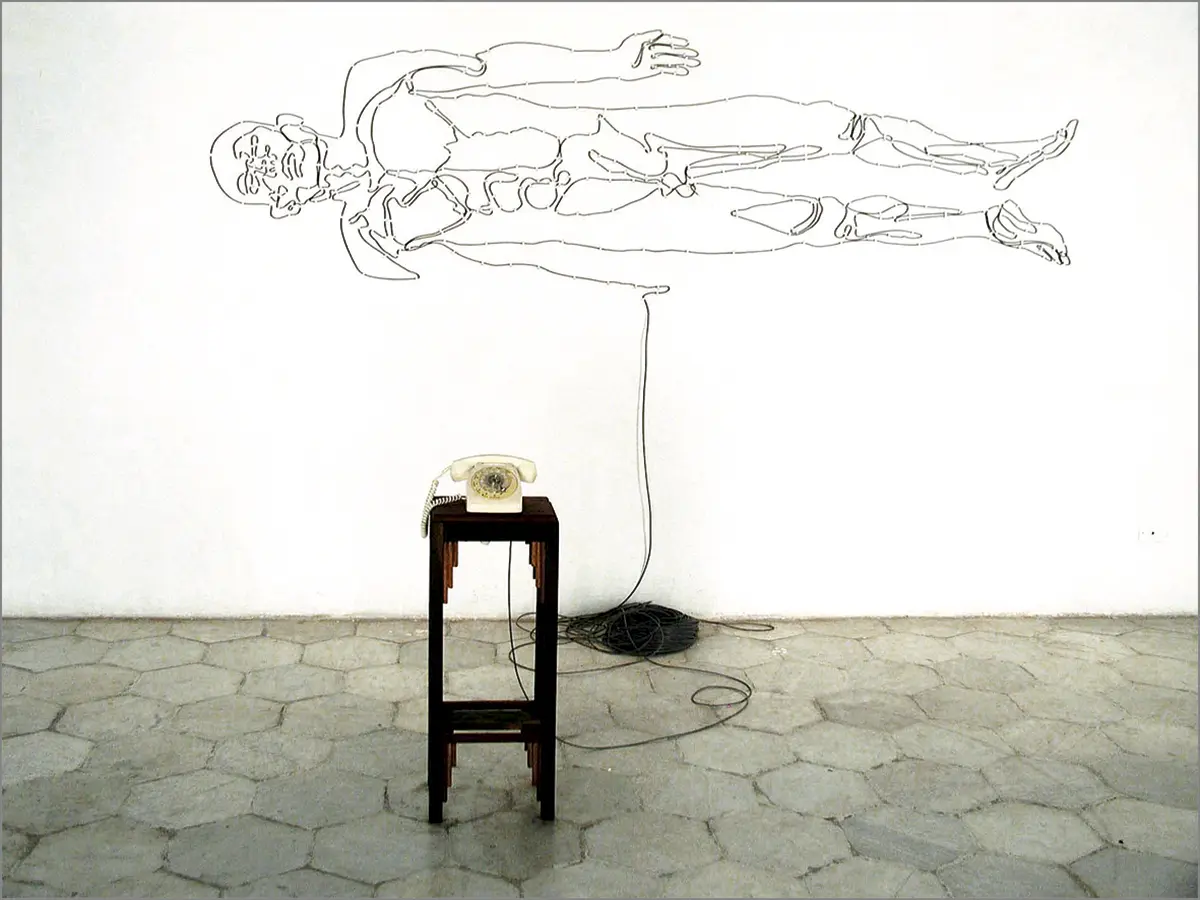
Montes de Oca has demonstrated a singular ability to move between different genres and structures, paying equally devoted attention to both the details and the work as a whole, without getting bogged down in disquisitions about internal coherence or in extreme formal definitions. He has found a balance between creative freedom and a degree of commitment to the national moment while avoiding an excessive preoccupation with finding resonance abroad. This is one of his skills, tested in this show and marked by the contemporary situation in Cuba. Montes de Oca is, undoubtedly, an heir to the artistic explosion of the 1990s, which boasted of its capacity for play and negotiation through intense allegories and ellipses; today, these allegories and ellipses provide meanings that are perhaps less explosive, but of a greater and more complex expressive subtlety.
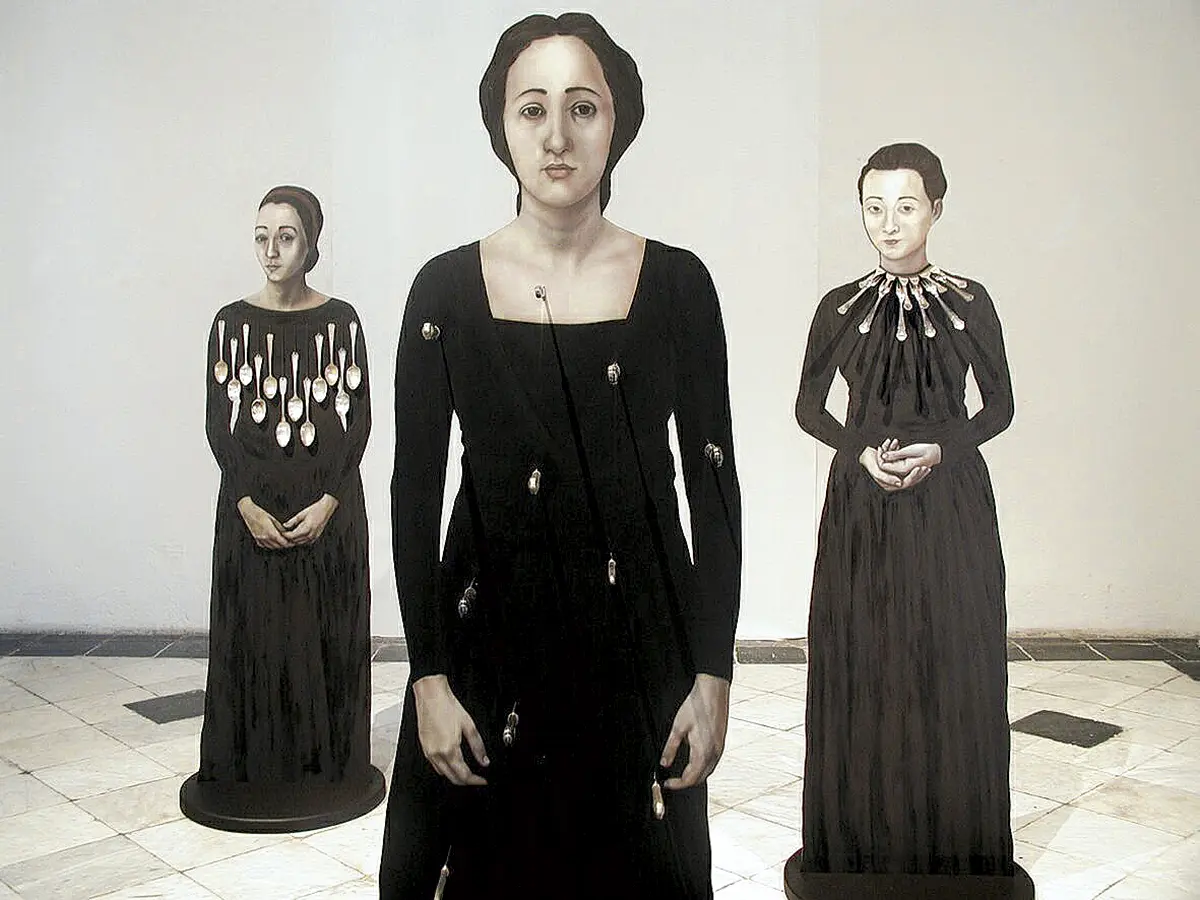
Aimée García, meanwhile, maintains an evident fidelity to her well-known work of the past —something quite surprising in a 30-year-old artist. Yet, she has found new and surprising angles, variations on the narrow bi-dimensional plane, and transit to the three-dimensional organized around the everyday domestic objects found in kitchens. Leaving canvas and paper momentarily aside, she decided to explore the depths of our everyday experiences, emphasizing without ambivalence the traditional role of women in the domestic space, without avoiding harsh truths, truths that are painfully current even if we live in a society that has attempted to change the situation for the better. Reality hits us in the face, and it is, to a degree, as if time hadn’t moved. Aimée García contributes to this revelation with the most sincerity, through a series of works of unquestionable human and visual value.
For a long time (longer than most artists devote today to the creation of one or several works), armed mostly with patience and perseverance, García sewed and embroidered cast iron and aluminum pots, pressure cookers, coffee makers, jars and containers, and skillets, in the style of mothers and grandmothers of the past —an attitude that today offers intimations of madness, given the inherent difficulties of “embroidering” objects as hard and resistant as these. Numerous tiny holes were perforated in every one of these kitchen utensils, both through their bottoms and their sides, and colored threads were used to embroider and decorate them with geometric shapes taken from classic women’s crafts books or with texts alluding to the object’s function. García’s title for her show, Sabor del silencio, leaves no doubt as to her purpose. The topological level of her works is denser than that of Carlos Montes de Oca’s, even as she confronts her topic directly, without allusions. The contrast between the recycled object’s material and the threads generates an initial sense of anxiety, which can only be eased through the careful reading of the texts and drawings.
Both artists take us back to an emotional encounter with handcraft, to the pleasure of the tactile sensations produced by certain materials, to the joy found in worked wood and in the familiarity of certain objects presented simply, with a degree of humility, despite us living in a world that tends, increasingly, to dismiss their value.
NELSON HERRERA YSLA