
Mexico City’s Galería OMR presented Autumn-Winter, a new exhibition of works by Alonso Mateo (Havana, 1964) and, undoubtedly, the signal of a new development in this artist’s career. The show alludes directly to a taste for traditional men’s fashion. Without abandoning his ironic approach to texts and photographs from publications such as Hola!, Vanity Fair, and the like, and with the technical excellence that has always characterized his work, Alonso Mateo now explores that which has been socially established as “good taste.”
Otoño-Invierno has its roots in previous series started (and not yet abandoned) by Mateo, such as his jewelry series or his series on drugs, presenting hyperrealistic pills such as Prozac, Viagra, and Tylenol. There is also his series of anamorphical courtiers, where notorious figures from the tabloid press, such as Prince Charles, Princess Diana, the Duchess of Windsor, or even some countess’ little toy dog, are presented as elongated images, immensely tall and thin.
Taking his clue from the interplay of names and brand names, Alonso Mateo preserves his own name within each piece as if it were just another brand of clothing, perfume, or furniture; by stamping his name like a Versace, Bill Blass, Armani, or Herrera, Mateo gives his works the character of branded objects, or, in the case of this show, designer pieces.
Mateo’s flirtation with the commercial world, preferably that of Madrid, Mexico City, and Los Angeles, also brings him to sideline the Court Painter in favor of the Court Couturier, the dress-maker who attends, resolutely, to the inner Narcissus we all possess.
This ironic positioning of himself not as the artist but as the fashion designer of his works brings him closer to certain characters that are increasingly more common in high society circles, where a filmmaker is also a successful writer or an elegant and attractive woman is also a splendid hostess. He was just a painter. The game is now for him to be also the Court’s dress-maker.
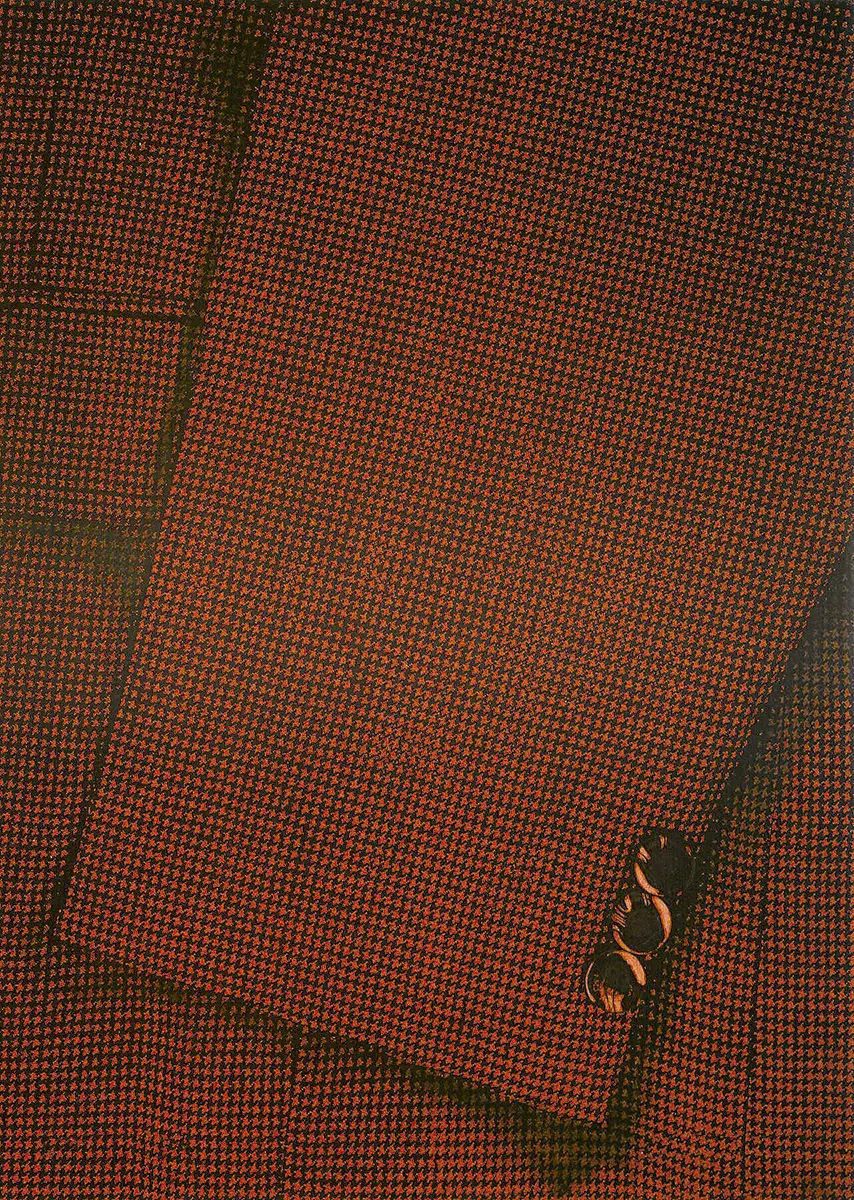
Mateo knows that in today’s world, the tailor has precedence over the fashion designer; the portrait artist over the painter… This is why the pieces presented at Galería OMR were manufactured by two tailors whose commercial establishments in Mexico City are a far cry from the Mexican Jet Set’s favorites. However, these deconstructed garments have been created, in their essential parts, following the strictest orthodoxy of traditional male tailoring.
Thus, even if there are large areas of what appears to be a chromatic silence in cloth, there are also buttons in real-life sizes, folds that replicate exactly those of a traditional suit, sleeves of a size 42, and pockets with an interior lining that can (and do) contain a fine silken kerchief that peeks out, boastfully, from the sewings of the bag that holds it.
This is more than a minimalist proposition. The suit is traditional, and it follows the dogmas of traditional tailoring: there are linings (one of them carries the designer’s signature: Alonso Mateos), there are ironed lapels, there are Oxford pinstripes. Yet, this suit has been manufactured to dress a wall, not a human being. Most of its parts are human in scale and human-inspired, yet humans are not its wearers but its admirers —the admirers of this new thing that the suit has become.
The titles of the works are equally ironic. They evoke the common practice among fashion designers of naming their pieces by merely referring to the time of year for which they were created, unlike a filmmaker who comes up with titles for his films or a visual artist who christens a show. In particular, a tailor’s pieces are to be recognized by designations such as “Three-Button Jacket," “Wide Trousers with Tucks," “Classic Blazer," etc.
From this economical use of language Mateo has derived the titles of his own works: Autumn-Winter (Double-Breasted); Autumn-Winter (Three Sleeves); Autumn-Winter with Sleeve and Hat; Autumn-Winter Gray Double Sleeve; Autumn-Winter Red Double Sleeve; etc. The show is also complemented by texts taken from society-page photo captions, while texts attributed to characters such as Grace Kelly give splendid variety to the proposal. Among the texts taken from magazines is the one reading “A thousand written-press journalists, more than two hundred photographers, sixty television stations from fifty different countries prove that high couture is alive and well again.” Is further illustration necessary?
Otoño-Invierno reveals a Mateo coming out of his narrow figures, expanding into ample chromatic spaces that before only surrounded the central character but now acquire a greater presence, given that now, unlike before, things happen in a non-symmetrical construction. This is a great visual leap in Mateo’s career, one with far-reaching consequences.
Almost simultaneously with his show at OMR, Mateo presented a show at Emma Molina’s gallery in Monterrey. This was a small retrospective covering his work between 1994 and 2000, although some graphic pieces similar to those presented in Mexico City could also be found.
Mateo is also preparing an important show for Galería Ángel Romero in Spain, to be shown at ARCO, where works in the line of those seen at OMR will be included along with more recent pieces; among the latter, there are works substantially more deconstructed, closer to cubism, created with materials, cuts, and designs from the high fashion industry. Without leaving aside his sense of irony in the face of aristocratic frivolity, Mateo carefully approaches the world of the catwalk, which, he says, “needs to be seen as a social and spiritual good; often, there are more things there than in a museum of a gallery.” As proof, we have his own Autumn-Winter collection. It will be the work of others to deconstruct Mateo’s unmeasured affection for a shallow world. The artist in the meantime, designs fashion to dress interior spaces.
SANTIAGO ESPINOSA DE LOS MONTEROS