Since the early 1990s, the Antioquian artist Beatriz Olano has developed a series of installations, or interventions in space, that alter the appearance of a given place and the perception the viewers have of it. Olano’s are fleeting interventions with various materials, sometimes based on a geometrical language related to abstract art, in particular to its minimalist variants, as is the case of Intersections, presented in August and September at the National University Museum’s Room #3.
With its white walls, grayish floors, and uniform lighting, this exhibition space is characterized by an elongated and aseptic look, and Beatriz Olano took these features into account for her intervention. In each of the gallery’s end walls, she placed a sort of weaving made with contact strips (a self-adhesive material in flat, vivid colors), based on an orthogonal structure that stretched from the wall to the floor; these red, green, and violet, blue, and yellow bands continued on the much longer side walls, following a simpler design; finally, the colors descended to the floor, where they became simply lines that extended from one end of the room to the other, fluidly intersecting the design on the walls. Both on the side walls and on the floor the color stripes resisted to a degree the orthogonal organization of the walls and the floor tiles, deviating slightly from it.
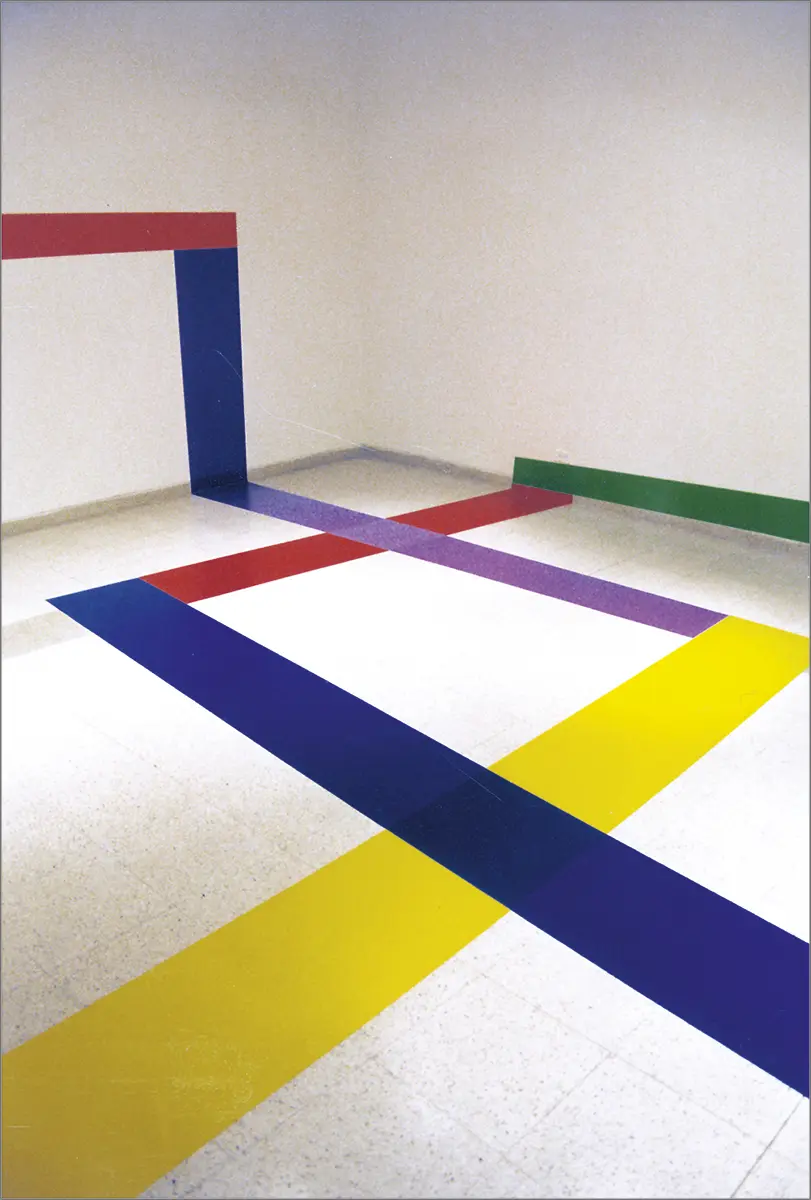
The strongest tension originated in the end walls, where the patterns were more intricate, while, the lines on the side walls created a subtler weave, with a more relaxed and fluid appearance that interacted with the space’s elongated geometry. From a distance, this interlocking design appeared to have been created with flat-color paints, so that at first glance the reference to painting was unavoidable; the grid structure —not as much the colors themselves— reminded us of Mondrian, a rather exciting effect given that one of Mondrian’s goals was to achieve a “total art” that expanded over “real” space. Yet Olano’s intervention suggested that the piece be interpreted as a kind of “painting,” with architectural space functioning as a canvas so that the movement of our body through the room is what activated the interplay of two-dimensional intersections and tensions, created through precision, control, and sensibility.
José Ignacio Roca has noted the proximity of her project to minimalist art. Indeed, Olano’s spatial interventions emerge from a direct dialog with the specific location and with the viewer’s perception, so that a close relationship is established between the viewer’s body and the elements that transform this space creating a plastic experience that, in the specific case of Intersections, allowed us to live space in its elasticity, in its varied tensions. To move through the room was to participate in a fascinating game, and to be surprised by the precise elaboration of Olano’s piece. It was evidently a painstaking construction of tensions on the basis of the orthogonal structure of the space.
As Carlos Arturo Fernández has said: “Beatriz Olano is essentially, radically an artist —not a painter, sculptor, or architect. With extraordinary discipline and coherence, she unfolds before us new territories of experience. Without false aestheticisms, she invites us to travel in them, not in the interest of transmitting exterior concepts but with the intuition of the new dimensions of the real that the direct experience of her spaces can display for us."1
NOTE
1. Carlos Arturo Fernández Uribe, in Obras de Beatriz Olano, catalog, Medellin.
MARTA RODRÍGUEZ