
Daniel Senise’s paintings are impacting due to a double enigma. Large architectural spaces impose themselves on the viewer, generating a strange silence that for agoraphobes might seem threatening.
The other element, no less enigmatic, is the way Senise has been painting his pictures, making up processes that are different from the customary way of using brushes.
The pictorial space created by Senise is full of hues and textures obtained by priming the canvas and soaking it with a coloration that seems to disappear in the air.
The collage has been one of art’s greatest inventions. From the cloth, it turned into the ready-made, and it has been evolving alongside the new technologies ever since.
In these paintings, the systematic breakdown of the surface creates a special feeling of immaterialness —something that could be related to a sense of spirituality without becoming mystical.
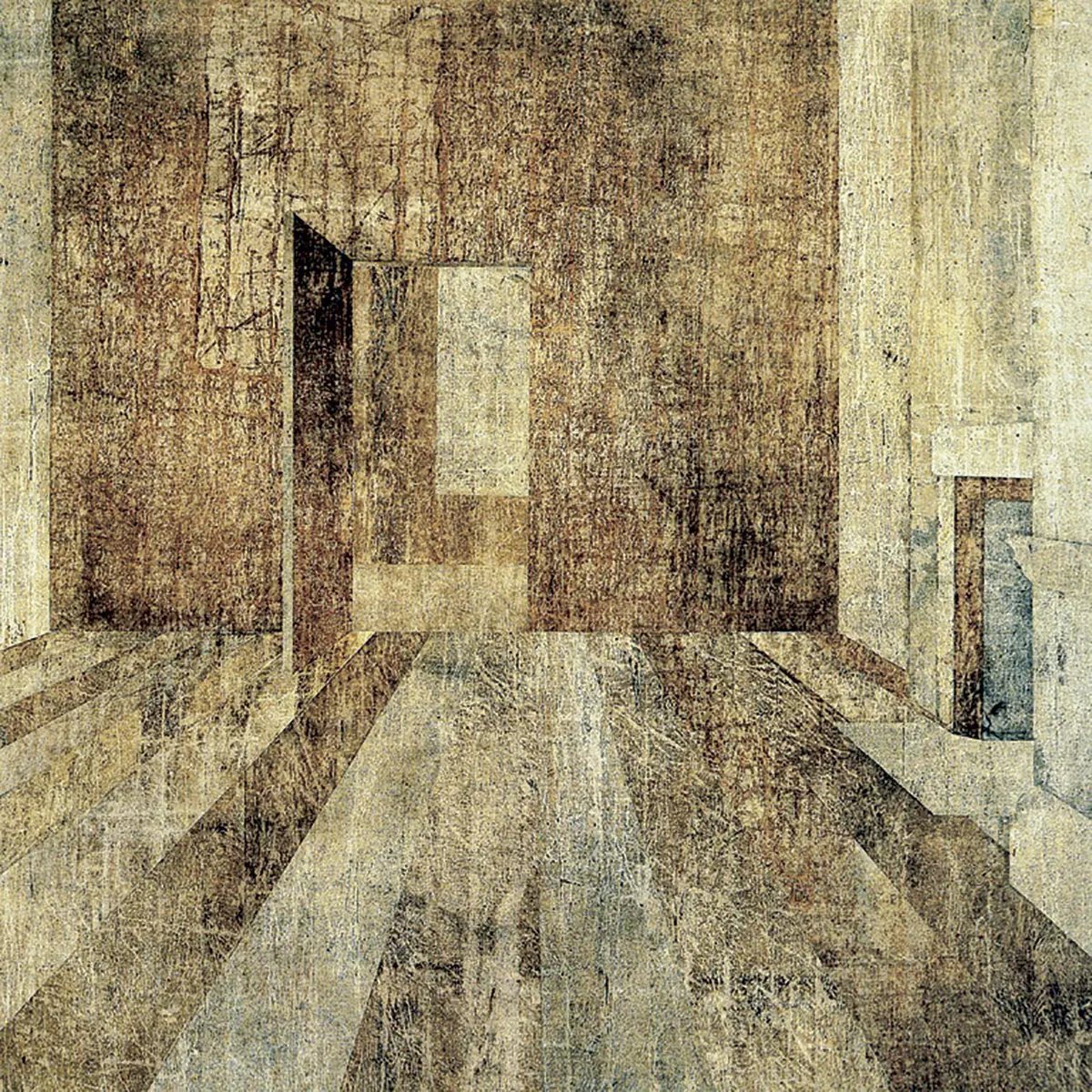
This surprising element is produced by the pictorial surface’s rich tonalities, which confirm the painting’s plane as the only truth.
These are contemporary paintings, deeply rooted in our times. But despite the space’s ambiguity, Senise seems to place himself very closely to those Renaissance artists whose highest aim was to capture the depth of real space.
To be able to gaze at Senise’s work’s apparent simplicity with the same ease that any field of depth allows us becomes a complex thing. We perceive, almost inadvertently, that plane and depth are not in opposition; on the contrary, they articulate each other quite eloquently.
From there, we have that infinite rain of silence and harmony. To dwell in the absence of human beings dramatizes the spectator’s perception. By standing before one of the paintings, he or she will become the only true human presence.
At the moment of solving the dilemma of real space, what really interests Senise is architecture and the representation of wooden floors. His paintings have been previously painted and then cut into strips that later were pasted onto the wood’s support.
Huntington Hartford Museum is a great frontal plane made of wooden strips, and from its center, the museum’s image in perspective arises almost imperceptibly.
The culture of whatever is truly flat is also the painting’s true identity has its origins in Malevich. But it was Carl Andre who turned that concept into a monument to negativity, rejecting all traits commonly associated with the nature of sculpture.
For Senise, the floor, as it was for Jackson Pollock, is the field where thought becomes action.
With a certain degree of optimism, Senise moves a step forward, takes from architecture its glorious perspective and its imposing silence, and delves into another type of spatial “meaning.”
What’s evident in many contemporary artists is the use of unexpected methods of constructing images or redefining supports. To discover new processes of representing painting becomes more and more exciting.
But this notion is not exclusive to our times. Degas said that a painting was a series of operations, the calculation of a particular type of math.
EUGENIO ESPINOZA