Eduardo Médici presented two exhibitions recently in Buenos Aires: one of paintings at Galería Rubbers and a second one, of digitally-intervened photographs, at Arte x Arte. These shows complement each other optimally to signal a turn in his oeuvre while maintaining, as always, a strong coherence with his previous work —which, as we have pointed out somewhere else, has always posed an astonishingly profound problematic.
At first glance, the show at Rubbers could come as a surprise for observers of Médici’s career, representing as it does a change of climate. But as soon as we start focusing on the paintings, we will notice that the circles of greater or lesser definition, brought together or pulled apart by color or value, float in an infinite space that does not operate as the objectified transposition of an ideal absolute, but as a menacing Nothingness from which the circles’ light centers seem to emerge and disappear.
Points that describe shadows, which in turn distance them from total space or fuse them to it, are distributed in compositions that are symmetrically or asymmetrically balanced. These enigmatic points seem more related to time than space. For Médici, time relates to precariousness, decay, and the anxiety of death —individual death or death of an “I” who, in this particular moment in history, is struggling for a permanence that seems destined to disappear. The same ‘I’ that disappears into anonymity in Saramago’s Todos os nomes and in Pessoa’s heteronyms, and which becomes a numbered badge or a blurry portrait in Médici’s own So Much Time, So Much Death, 1995.
In the early 1980s, in works like Something’s Happening on Your Face, a kind of floating magma was transformed into a human face. Now the movement is in the opposite direction: faces and bodies, which in Médici’s painting have always had such a dramatic, heartbreaking presence, have become floating, free, and distant entities. This is a transit from obscene bodies to raw spirituality.
Referring to life’s unlimited inconclusiveness, Claudio Magris has quoted Nietzsche’s “anarchy of atoms, the perception of the smallest and most fleeting things that break all unity and hierarchy.” A silence accompanies them, a time of waiting, where words do not seem to exist. These suspended points generate a pause on the face of what cannot be said.
These circles had already appeared in Médici’s previous work, in his photographs of the late 1990s, when small emulsion losses or failures were registered on the portraits. In that period, as exemplified in the painting presented for the Constantini Prize, his points related to the gaze, describing a horizontal sequence on each side of the eyes.
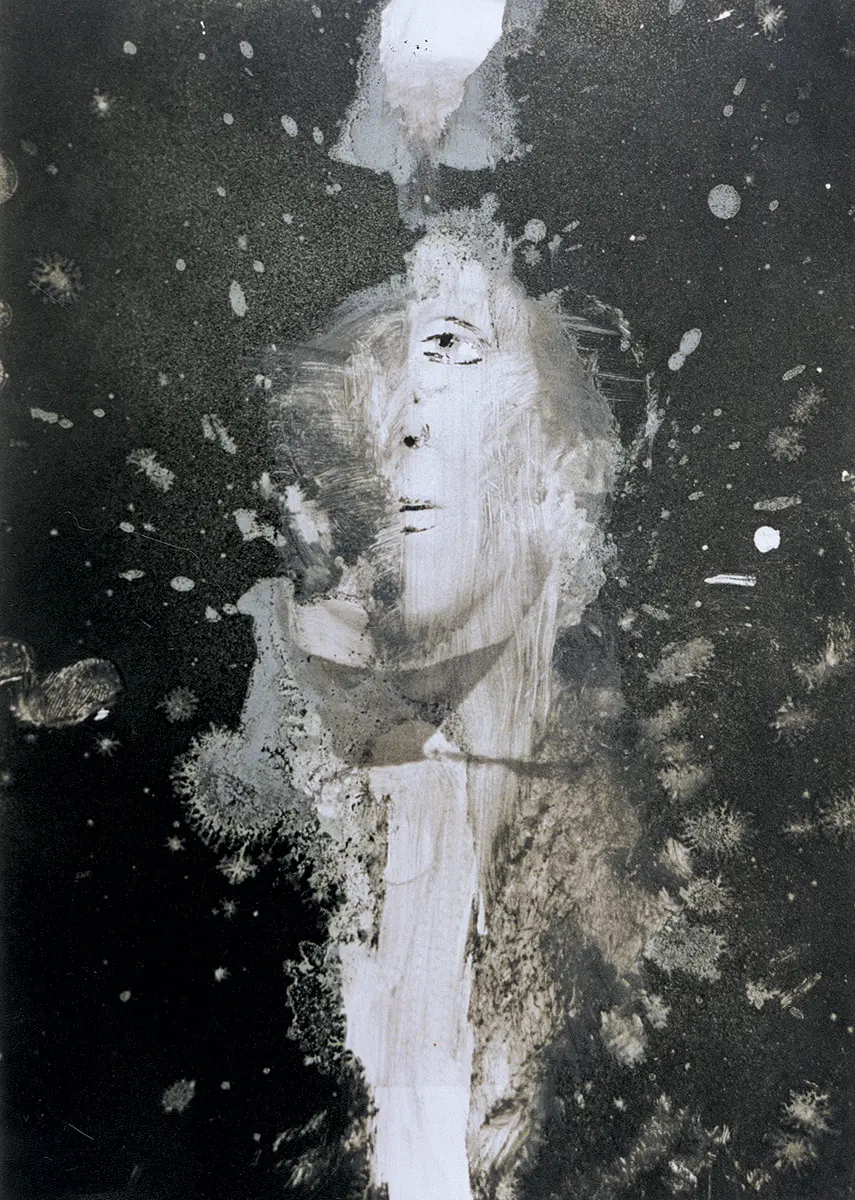
Following that line, the show at Arte x Arte offers nine large-format photographs with interventions by the artist. The ideas of silence and waiting to articulate this show with the one at Rubbers.
There are only traces, inklings of faces; the emphasis is on the gaze. The show is titled Restos, rastros, rostros (Remains, Traces, Faces).
There is also a large face drawn almost imperceptibly on a wall, on which the artist projects transparencies of other faces (never the same). A contemporary, touching language for the metaphor of our permanent miscommunication and misencounter with the Other.
There is also a series of small photographs intervened with painting, and another series with the image covered by acrylic and slight coats of white paint, scratched off in places; like a Möbius strip, these point out the ambiguity of ambiguity itself. After the first level of veiling, we read in one of the boxes, with some difficulty, the word "No," and the word “Yes” in another box. As the viewer moves, his perception of these words and their context, intuited rather than seen, changes.
A poetic writing, posited as experience. Extremes of the negative and the positive, conjoined in the search for meaning. A reflection on the fallacy of substitution in a world of simulacra. Is there a territory beyond words? Perhaps what is being pointed out is “the risk and danger of language” of which Badiou speaks.
These two come from different directions and converge in the attempt to poetically puncture the impenetrability, the silence of the real.
NELLY PERAZO