
Images of the American landscape have long formed part of the national psyche of the United States. From the Hudson River School’s paintings of uncultivated, natural wilderness, to romantic representations of the nation’s westward territorial expansion—the landscape has often represented the idea of the nation and its people. Ernesto Pujol’s latest installation of photographs and sculptural objects, American Fields, 2001-2002, takes a fresh look at this traditional genre and provides a cool and seductive commentary on the ways in which the environment is altered and controlled through human contact.
Academically trained in his youth as a landscape painter, Pujol has returned to the genre by exploring the countryside near Allentown, Pennsylvania in the heart of the Lehigh Valley. According to the artist, his recent shift in subject matter closes a chapter on prior explorations of the human body: The Body and Illness (1998), The Body and Faith (1999-2000), and The Body and Time (2001).1 Interestingly, in his latest work, Pujol departs from his previous emphasis on autobiographical experience, to focus instead on a more outward-looking and universal subject—the environment.
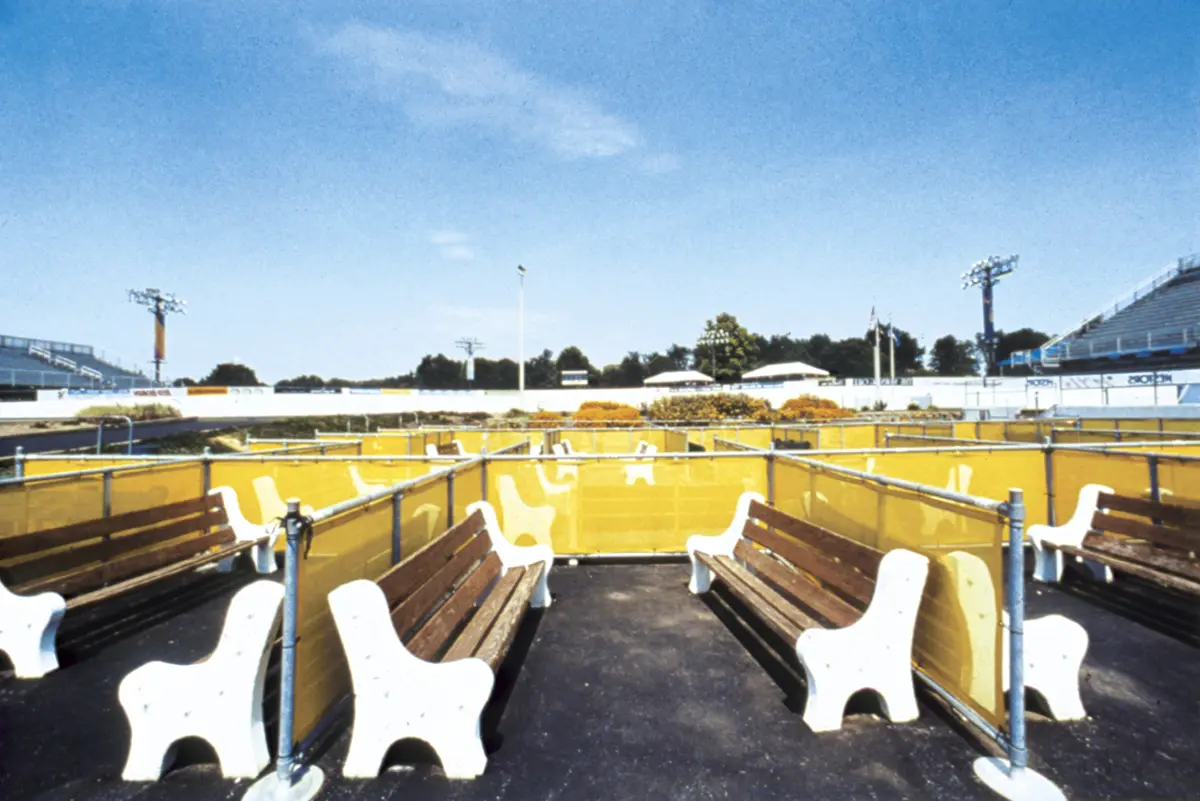
The installation brings together six large photographs of cornfields, and six photographs of a high-tech, bicycle racetrack built in the middle of the agricultural countryside. In the center of the room, Pujol has placed a metal chair and a small wooden table on which cast aluminum corncobs rest. The photographs are visually appealing; the lush greens and blues of the farmland and sky, and the primary yellows and crisp whites of the velodrome are pleasing to the eye. They appear as serene images of contemporary landscapes, and yet the human presence is noticeably missing from these settings. Ultimately, there is something disconcerting and troubling about the stillness of the scenery and the lack of life in these panoramic views.
The velodrome, a banked elliptical track made for high-speed racing, is a modern facility created to test physical endurance and measure human excellence. Its graceful geometric shape and concrete construction clearly demarcate interior and exterior space and define a prescribed path for the riders—one from which they cannot deviate. This strict organization, like the network of grids in which the cornfields are laid out, divides space in a systematic and controlled way. Pujol’s selections of landscapes, although formally appealing, are understated metaphors for the idea of control, a recognized theme in Pujol’s earlier works that dealt with societal conventions and cultural prescriptions for human behavior.
In the photograph, White Boundary, Pujol returns to the subject of “whiteness” and the ways in which Anglo-Saxon American culture has been indexed as normative and without ethnicity. The work addresses ideas such as nationalism and isolationism, inclusion and exclusion, as well as middle America’s response to “otherness."2 A white barricade stands in the foreground, and in the background, an American flag is visible along with corporate sponsorship advertisements and brand name logos, evocative of how sports have become an industry in the U.S. The image reflects a larger issue within the American landscape about equality and opportunity within our borders, and the many internal and unspoken boundaries that have yet to be resolved.
As always, the ideas behind Pujol’s work are not immediately apparent; concepts are implied and his views are insinuated. His imagery is not aggressively confrontational but instead operates on a more thoughtful and seductive level. American Fields invites us to think about the effects of intervention on the environment and the ways in which even seemingly innocuous farmlands, for example, can alter the land through the use of artificial chemicals and the genetic engineering of crops. So too with the velodrome, a massive commercial structure that imposes itself on the natural setting of the valley. Pujol’s appreciation for the landscape is apparent, and his desire to explore the genre from a contemporary perspective is interesting as it focuses attention on the uses of our natural resources within the last century and the ways in which a nation can still be read through its landscape.
NOTES
1. Author’s email correspondence with Ernesto Pujol, October 2002.
2. Ibid.
CHARMAINE PICARD