
Hugo Bastidas conceives transcendent visions through a muted palette of cream, charcoal, and brown oils on linen. Each painting captures a scene that is vaguely familiar but is made to seem extraordinary through his rendering. Inching Along, 2002, for example, depicts a glimpse of the cramped shacks that multiply and expand along the outskirts of burgeoning cities. Bastidas provides a cropped overhead perspective of the corrugated metal roofs. Each roof abuts the next in an abstract pattern of squares created by the juxtaposition of reflected sunlight and the shadows pooled beneath the roofs and along the crowded road that splices the urban sprawl. Bastidas bears witness to man’s destruction by depicting the shacks as the “fingers” of civilization strangling the natural world.
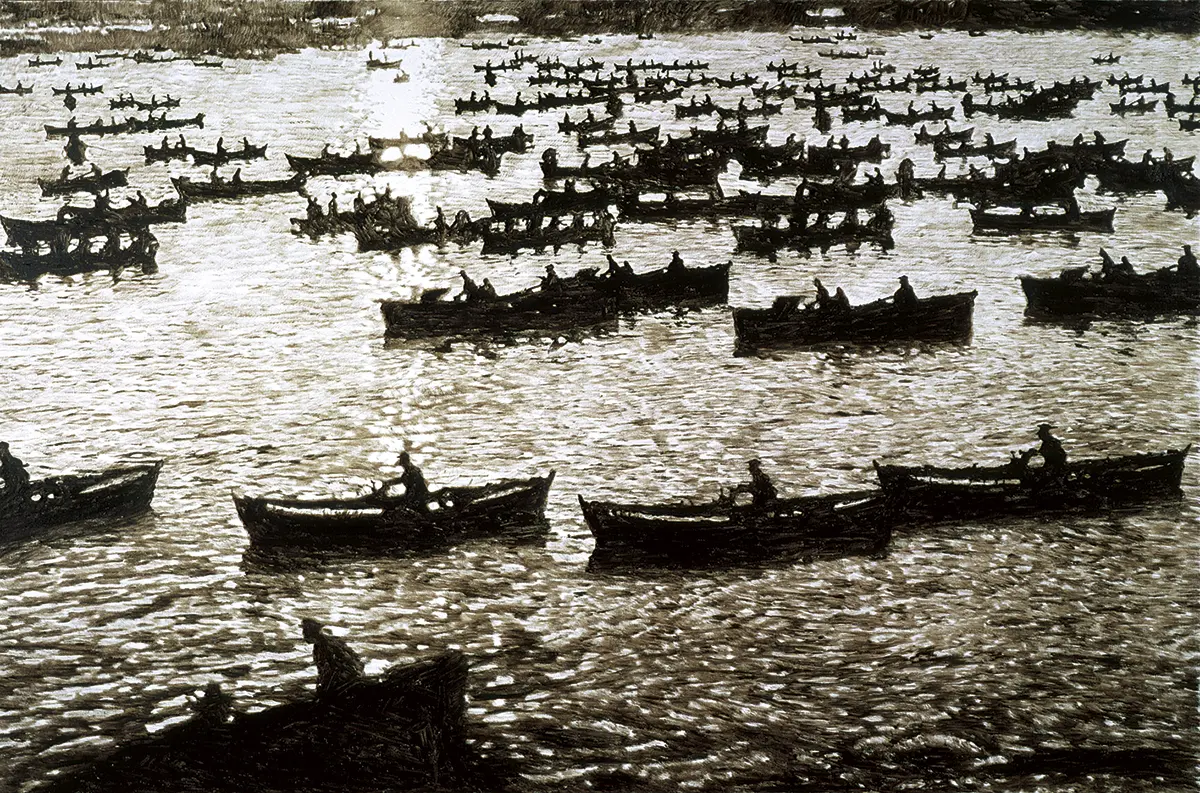
Although the artist’s social themes engage the viewer, one is drawn as much by the means Bastidas employs to render his scenes, as by the subjects he addresses. The Ecuadorian-born, New Jersey-based artist’s spare palette of light versus dark hues, and laborious details recalls the delicate intricacy of a fastidious drawing, but one enlivened by the tactile presence of pigment on canvas. For example, in an exhibition highlight, Overboard, 2002, Bastidas mines the dramatic possibilities of shadowed silhouettes against the radiance of a setting sun. This mesmerizing scene captures countless working fishermen in identical, long slender boats sitting upon the waters; their forms are described in inky tones against the brilliant reflection of the sunset that illuminates the current. Bastidas’s short brushstrokes convey the texture and movement of the water lapping against the boats, as well as the solid presence of each fisherman and the vessel in which he works. The artist’s contrasting pigments and commendable technique make this a magical scene.
The remarkable detail of Bastidas’s panoramic landscapes (such as Pale Reflections, 2002, in which a castle is reflected in the water before it; and Tip of the Iceberg, 2002, in which two men stand before this monumental formation) resonates in Scarecrows, 2002. This painting portrays a vast cornfield dotted by three haunting scarecrows that stand in the undulating expanse. Above the endless field of cornstalks, the sky is an atmospheric mass of gray, broken by a dark, turbulent swath that suggests an impending storm. It is a quietly unnerving painting created in response to the Enron scandal, in which the scarecrows represent fallen executives. Having said this, Scarecrows resonates less for its contemporary symbolism than for its timeless vision, the desolate but beautiful setting punctuated by the straw men with their torn clothes trailing in the wind and their sightless faces staring beyond us. It is no wonder that during Bastidas’s career, the forty-six-year-old artist has received major awards and wide acclaim; his paintings portray images ripe for contemplation with a technical fluency that commands our attention.
MARY SCHNEIDER ENRÍQUEZ