
IN-VISIBLE is among the curatorial projects that incorporate the renovating, polemic spirit of Cuba’s artistic landscape, to reveal an art whose discursive strategies delve into the less-explored regions of a Christian thematic. The project is the brainchild of three young artists: David Sardiñas, Alexander Guerra, and José Miguel Díaz—Mayimbe.1 The group’s intention is to approach religion without resorting to popular Catholic iconography, which is very distant from the group members’ Protestant condition. This exhibit, a result of the thorough research the artists undertook while studying at the Instituto Superior del Arte (ISA), guided them through the creation of a different visual effect based on the use of air, fire, light, and water —elements with strong symbolic connotations.
The gap they have opened from all figurative referents has allowed them to establish a curatorial relation between their multiple proposals, while at the same time generating a polysemous discourse engaged in a free exchange with someone as omnipresent as God. Here we are not talking about creating a new Christian art and its lithurgic-ceremonial functions. We’re referring to the singular artistic production related to religion as seen through the artists’ mystical experience. IN-VISIBLE presents us with an art that retreats into the most intimate spaces, showing us its creators’ existential conflicts and their philosophical and cosmogonic beliefs.
The relationship between the sacred and the artistic is seen primarily at the sensory level, through the creation of atmospheres by juxtaposing different odors and treating incidental light, sometimes projecting it onto their own works. The atmospheres provide an axiologically meaningful link between the different poetics created. The museographic criterion used didn’t provide a hierarchy of a determined artistic creation. Rather, it segmented the show into three nuclei in order to present each proposal independently, without being detrimental to the project’s general appreciation.
Mayimbe’s discourse makes use of the morphological qualities of pneumaticity and the etymological meaning of pneuma. In Greek stoic doctrine, according to anthropologist Ernst Cassirer, the pneuma “enters everything (…) it’s universal breath communicating all things."2 In this regard, the air contained in Mayimbe’s pneumatic bodies identifies itself with God and becomes divine breath, granting life and spirit to a lifeless form. His philosophical view of the world arises from the concept of pneuma, the animator of everything, even the mundane and vulgar aspects of the artist’s industrial ligaments. His proposal arises from one of The Bible’s key verses: “Y creó Dios al hombre a su imagen, a imagen de Dios lo creó"3 (So God created man in his own image, in the image of God created he him). Each time that Mayimbe assembles a piece, he metaphorically repeats the Creation’s rites, appropriating God’s special gift for granting vital life to all things.
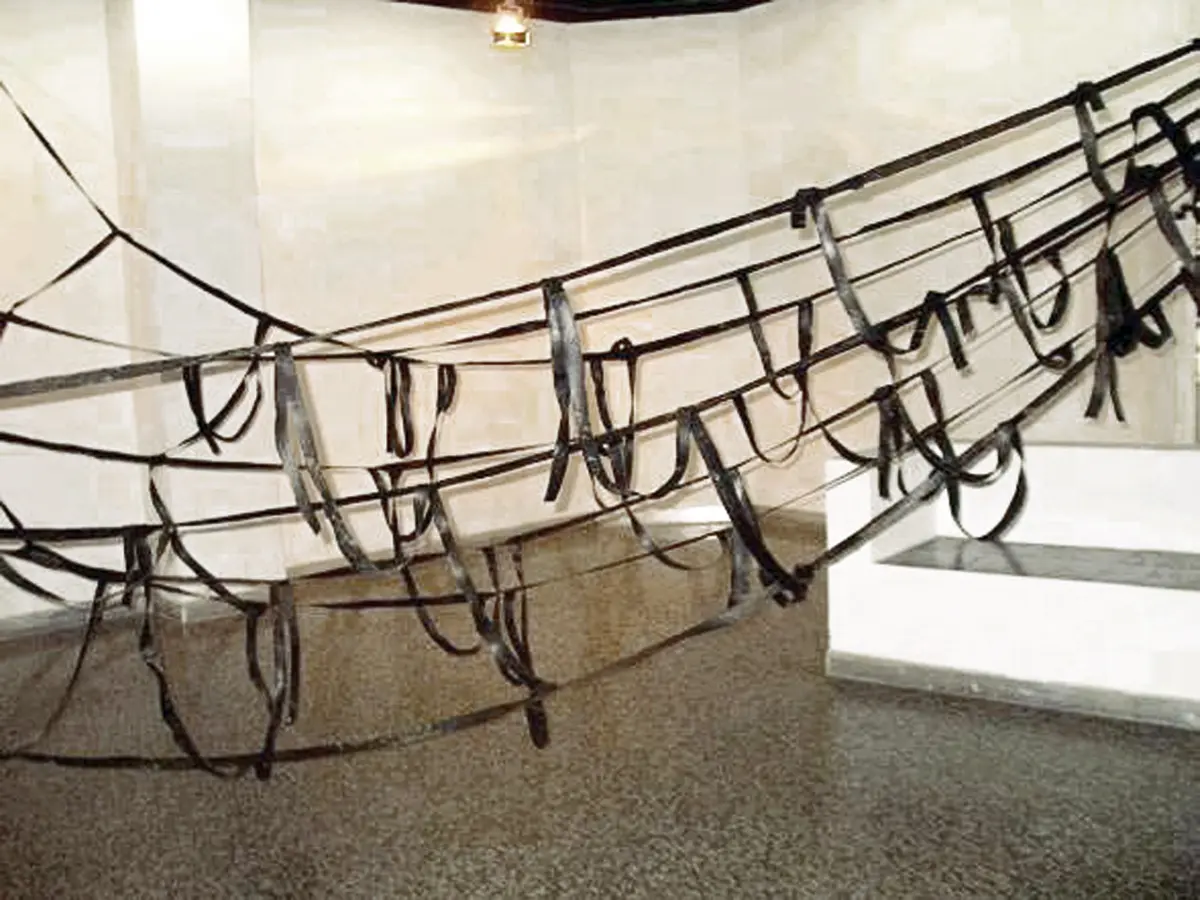
The Bible is an undisputed source for his work. It has not only become a document for study, but also a workbook to jot down his reflections, highlight certain passages, and draft his drawing projects. In this show, the installations made from pieces of recycled inner tubes, have printed on them those passages from St. John’s Gospel alluding to the verb made flesh. The sacred word becomes an important visual and conceptual referent expressing the relationship between the artist and the evangelical Christian.
But Mayimbe not only departs from his experience as a religious person but also as a social being. The personal preoccupations expressed in his works synthesize and reflect human conflict. The presence of numerous sandals alludes to humanity’s constant peregrination. La red (The Net), the installation located in the first hall, talks precisely of the pesca milagrosa, or miraculous catch performed every day by humankind in order to subsist. The installation’s “joints” of inner tubes are like life’s bumps, its hardships, maybe its temptations. For José Miguel Díaz, the fisherman —inside a net or a society, and subjected to its laws— is always at risk, not only in terms of dying but also in the revelation of his sinful nature.
In IN-VISIBLE, Mayimbe also uses video as an expressive-artistic support. The sequence of monochrome images repeat endlessly the same action: the artist breathing in, holding his breath, and exhaling. Recycling the oxygen translated into divine breath, Mayimbe assumes the functions of a pneumatic body. The constant epidermic renovation, transformation, and metamorphosing provided by the breathing exercise becomes a vital practice for him and his fellow human beings. That way, as Mayimbe himself said, “we drink from life’s punch to move the eternal cycle of life.”
For Alexander Guerra, God is the structure of all things; that’s why his works are monumental iron assemblies. The metal is used in double relations: hardness-strength and malleability-flexibility. This way the artist presents his vision of God —intransigent and strict, but also capable of showing compassion or piety. He also presents God as a great organism. With this intention in mind, formally speaking the works, exhibited on the second and third-floor halls, are designed as huge circulatory systems. Veins and capillaries constitute the sculptured objects, among which we see elements as important as the hand, a symbol of pain —Christ crucified— and the cross, Christianity’s allegorical image. At the museographic level, the work’s organic feel is established by a central piece —a seven-pronged candelabra, suggesting the presence of Jehovah— where all remaining works begin.
The use of candles in Guerra’s sculpture takes us back to the image of fire as a purifying symbol. The candles project a play of shadows onto the walls and the floor, visually complementing the sculptures. According to the artist, this creates a sort of "cardiac rhythm that breaks the traditional stasis of sculpture," which in turn makes it impossible to appreciate one piece without reference to the others, since the work’s lines are constantly crisscrossing to build new structures.
One of the most meaningful pieces in the show is a sculpture in the form of a ladder —which reminds us of Jacob’s—, an element that links the Earth and the heavenly realm, working as an intermediary between God and Man. The object’s nature is hybrid: it is also a recliner and a candleholder, and it includes incense. It functions as a juncture between the organic structures and the censers. This is an installation that summarizes Guerra’s work up to this point. These minimally designed works hang from ropes like pendulums or plumbs, and they suggest once more the idea of God as a builder of all things. The mix of resinous substances leaking out of these works turns the physical space into the space of liturgy, a space directly related to a religious cult’s ceremonies. The different aromas become a unifying element, giving the show a homogeneous atmosphere.
The censers, a place of mandatory transit, intervene in the space somewhat aggressively with their oscillating movement, forcing spectators to become more aware of their wandering through the gallery and inviting them to interact with the words —even become part of them. The artist is interested in bringing his works closer to the public, in the same way as “in Protestant theology, God comes to meet us.”
These pieces are all made of discarded materials that Guerra recycles. He reuses them to create different objects. He is not interested in recycling as an accumulation of refuse, such as it is seen in some contemporary artworks, nor as a large dumpster; he seeks to create distilled objects, objects with a careful finish, in which the marks of the passage of time can still be appreciated. His pieces remain corroded, they are never presented with a "perfect polish; instead, as the artist says, they always appear as structures in process."
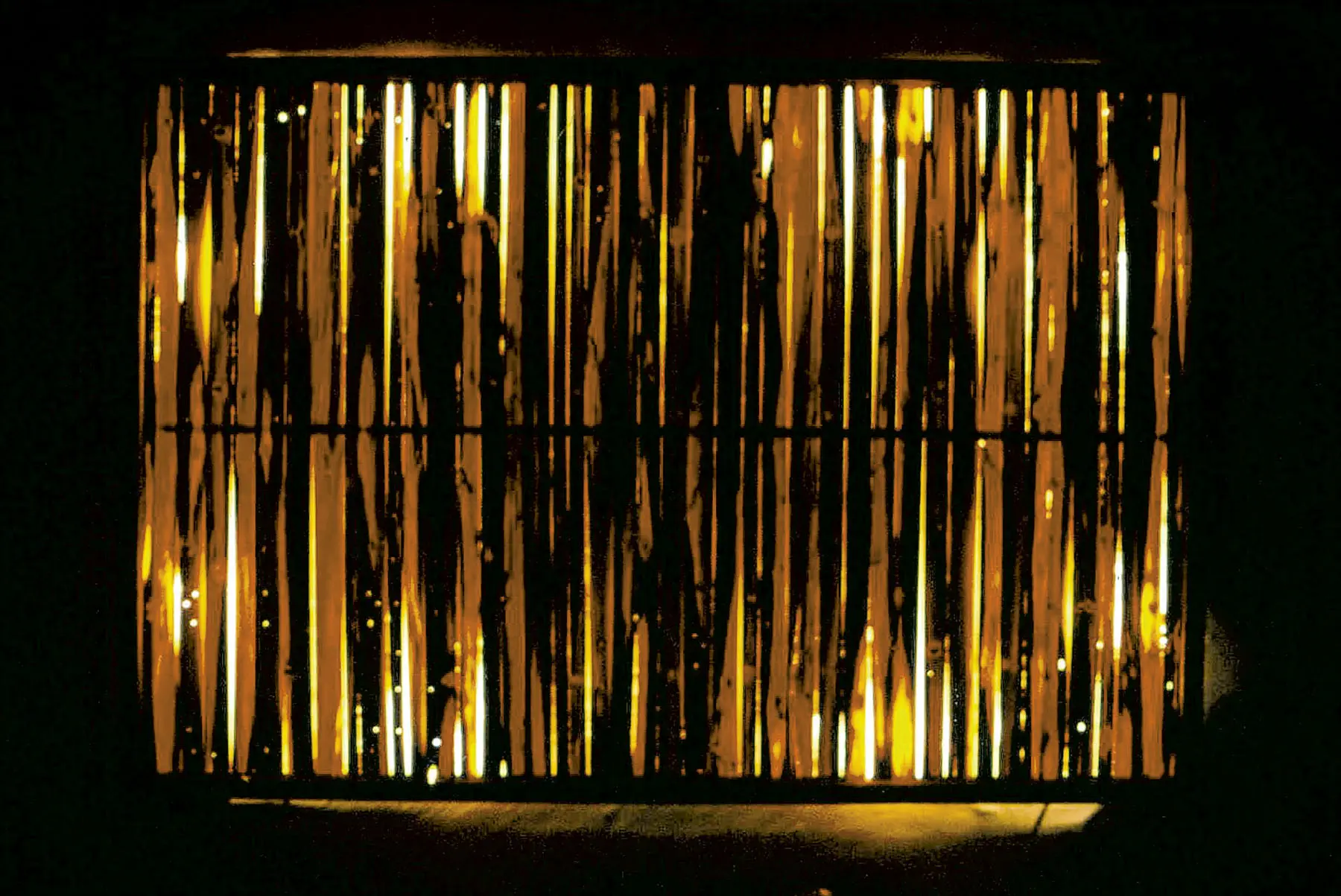
David Sardiñas’s installation, made with thin sheets of pinewood, occupies the show’s fourth room. Instead of a minimalist montage, Sardiñas opted for a more multifarious design, transforming this section of the gallery into a kind of warehouse or carpenter’s workshop apparently devoid of internal logic, where things were placed haphazardly. More than showing an individual work, the artist was interested in the creation of an intimate space, a space of spiritual contrition. To achieve this, he left the room in shadows, with light coming only from small bulbs inside each piece. He also left wood shavings in small mounds throughout the room, and the wooden aroma created for the visitor a singularly sacred atmosphere.
Sardiñas establishes an identity, a parallel between wood and humankind. Just as wood fibers are transformed, visually, by light —the spirit of God—, Christianity marked two epochs for humanity, and, according to its ideology, also a rebirth.
The central piece in this part of the show, a sarcophagus, signals an important turn in Sardiñas’s artistic production. Sardiñas’s production has been characterized by works that referred to architectural elements (columns, windows, stained glass), which, like the work exhibited here resembling a large wall of delicate wooden sheets, were built on the basis of straight lines and pure geometric elements. In the sarcophagus, however, forms are softened to delineate a human body filled with water. The sarcophagus, the emblem of death, is illuminated and contains this generative and purifying liquid, thus transforming it into a fertile uterus that guarantees the continuity between life, death, and resurrection. It becomes part of a dialectic that continually crosses the border between opposing fields, to tell us about their possible connection.
With metaphoric language and plural artistic discourses, and through symbolism and the senses, IN-VISIBLE brings us closer to each artist’s Christian-Protestant beliefs. The spirit of God is made perceivable at a plastic level in the lines and the abstract forms of the works, never visually defined, always in transformation, in unfinished process…
NOTES:
1. These three artists form the collective called Dupp (Desde una pragmática pedagógica [From a Pedagogic Pragmatism]), created in Havana in 1997. Their work focuses on topics largely untreated by Cuban art, but they also intervene in public spaces.
2. Cassirer, Ernst, Antropología filosófica, p.45. México: Fondo de Cultura Económica, 1963, 3rd ed.
3. "Génesis" 1:27, p. 5, La Santa Biblia. México: Sociedades Bíblicas Unidas, 1995.
DARYS VÁZQUEZ AGUIAR