
The platonic maxim that “to know is to remember” is perhaps the most appropriate description of the psychological, methodological, and even formal fundamentals of Inés Tolentino’s work. A Dominican artist with European roots resettled in Paris, Tolentino has turned memory and perception into a meeting place for cross-cutting cultural references, personal history, biography, myth, and daily life. Memories and antimemories fly through her intimate poetic universe, made with fragments of remembrances saved from time as it passes, which the artist reconfigures in compositions that, while utilizing resources from painting and drawing, are closer in their general system to the collage —not only in their formal aspects but also in their psychology.
But memory is not only accumulative; it also discriminates, gives meaning to, and sacralizes the past, fundamentally incorporating it into the present. Memories and antimemories, always within the widest fields of irony and double meaning, are art’s privileged instrument, the basic tool of knowledge realized through images charged with epistemological value. At any rate, it is the memory of immigrants we are dealing with, that memory which assumes the name of its origin as a dual perspective, the perspective of its birth and its current point of view. This is why it is commonly said that one doesn’t truly know one’s own country and culture until they have been confronted, through the experience of traveling, with the virtues and vices of other countries, and other cultures.
In Tolentino’s early drawings, child-like figures were always present, as was a child-like gaze, but these were not merely sentimental references but, in essence, ironic ones: they brought into relief the absurdities and malformations of the adult world. The sketch-like freedom of the tracing carries a meaning similar to that of those Boltanski photographs where the sensitivity to the ephemeral and its documentary-poetic value express what Barthes thought was the “funerary” vocation, commemorative of what really existed, of this art in particular and of art in general.
But it is not only intrahistory, the personal and the intimate, that fuels the artist’s imagination and supports her iconographic repertoire. It is intertwined with the collective, with allusions to 20th-century Dominican history, to the dictatorship of Rafael Leonidas Trujillo, to the culture of servitude, to racial discrimination and the persecution and killing of Haitians, to the anecdotes of public life. Tolentino’s iconography incorporates elements of bestiary and Baconian portraits, images that resemble pictograms, halfway figurative icons, and abstraction or writing. Ultimately, there is a wide-ranging questioning of today’s world and Western culture, created from the perspective of white bourgeois males erected, inadequately, as the measure of all things.
Tolentino’s contemporary Babel uses the symbolism of the tower confusion of tongues, and also the idea of baroque accumulation, in allusion to consumer society and to the hypertrophy of linguistic communication, the accumulation of signs and the excess of information that characterizes our times without generating a greater understanding.
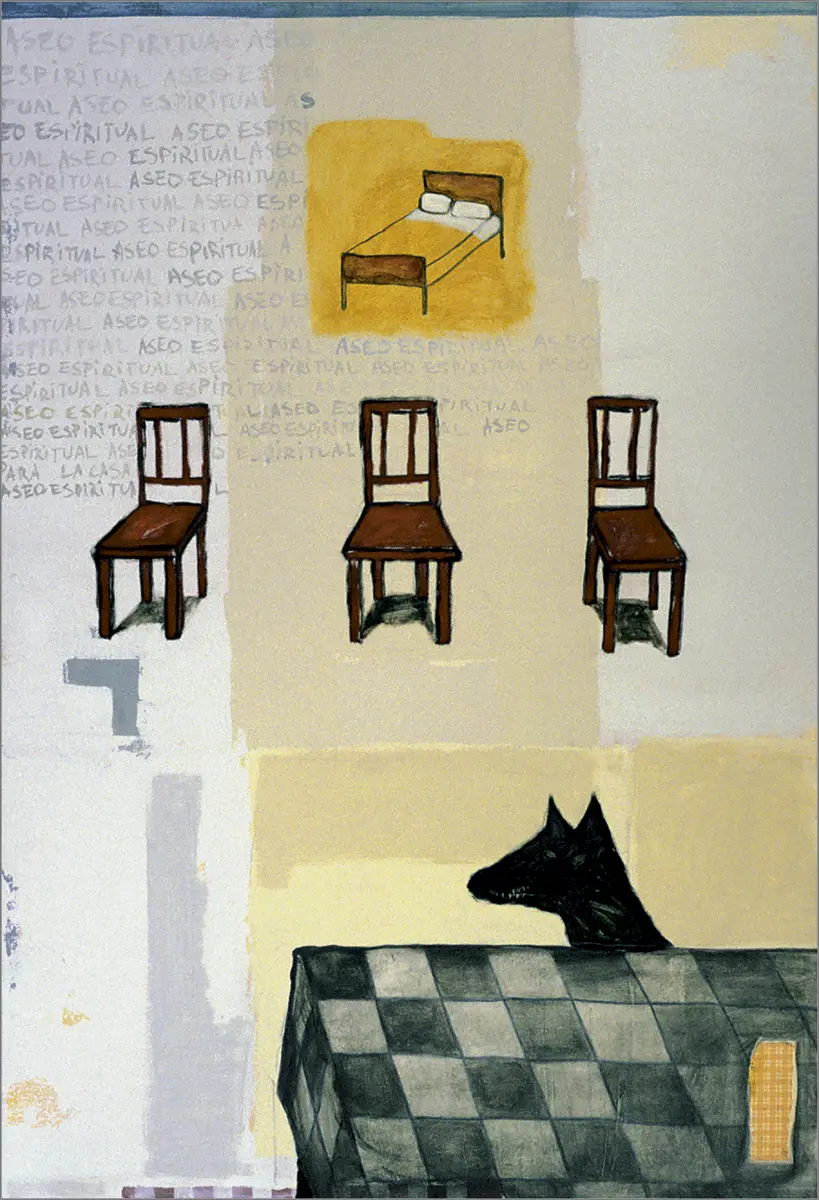
Tolentino’s most recent show, Imágenes de archivo (Archive Images), presented in July 2002 at Santo Domingo’s Museum of Contemporary Art, again turns back to memory as a resource for the creative imagination, more than as an inopportune depository of unconnected remembrances. Appropriating the view of the historian who, like Jacques LeGoff, knows of the feelings of orphanhood that afflict individuals and peoples deprived of their historical memory, Tolentino turns remembrance into the most effective tool for accessing the archetypal sources of the every day; she also adopts the perspective of the anthropologist and of deep-psychology. Any collective or unconscious, Lévi-Strauss would have said, keeps as a reserve the memory of its origins, so that it is them that creates the scene for and gives substance to our daily, conscious life, setting in motion the forces that move it.
Carl Gustav Jung’s own definition of his archetype's “patterns of behavior” applies perfectly to the complex everyday rituals we find in a typical Dominican household, such as those related to personal hygiene. Dominican’s migratory obsession, the dialectic of flight and return, and the mythologies of travel which exist, with variations, from pre-Columbian times to contemporary Dominican literature and art, are revealed as part of a mythical ritual of salvation. This theme reappears, in several versions, linked to the myth of paradise and the ecological guilt derived from the destruction of the island’s natural riches, in Tolentino’s series on national parks.
All of this in the context of a progressive depuration of the images, which are increasingly pictographic, closer to symbols, to hieroglyphs, to writing, so that essences and archetypes are presented as the final product of a phenomenology of the anecdote, of every day, where, like in the best fantastic literature, the transcendent enters unexpectedly.
The serial character of the composition, the expressive immediacy of primary colors such as yellow and vermilion, aside from black and white, joins forces with compositions in which space is increasingly more open and the drawing is freer, more cursive, and bolder. In an art world such as that of the Dominican Republic, overtaken in large part by modes of expression like installation and photography, the option for painting and drawing is also an option for a return to the sources of art, a commemoration of origins that finds in them the necessary nutrients for the future.
LAURA GIL FIALLO