
João Modé’s (Resende, Rio de Janeiro, 1961) first intervention on the building that houses the Ágora exhibition space can be seen from any of the nearby corners. A dark-yellow canvas serves as support for a series of delicate line drawings in red, while at the same time playing the part of an improvised tent to cover the entrance to the gallery. Both the material and the way it is tied bring immediately to mind those stalls one finds in any Brazilian city’s street markets. We are protected, even before entering the gallery, by that rectangle of color and by the tree canopies; an orangish light surrounds us, indicating we are entering a differentiated space. If we look up to the tent, instead of forward towards the gallery, we’ll see that the painted, bifurcated lines are joined by the shadows that some nearby branches project on the canvas’ surface.
Inside, next to the door (open wide, all the way against the wall), a raw-wood catwalk rises some 40 cm above the cement floor on a multitude of stilts. If we climb on the catwalk and advance, listening to the sound of our own steps, it will take us towards the end of the room; part of the show will pass by, softly inaccessible, to our left. The floor underneath is slanted so that near the end it meets the catwalk; at this point, we descend and find ourselves right in front of Modé’s third and last intervention on architecture.
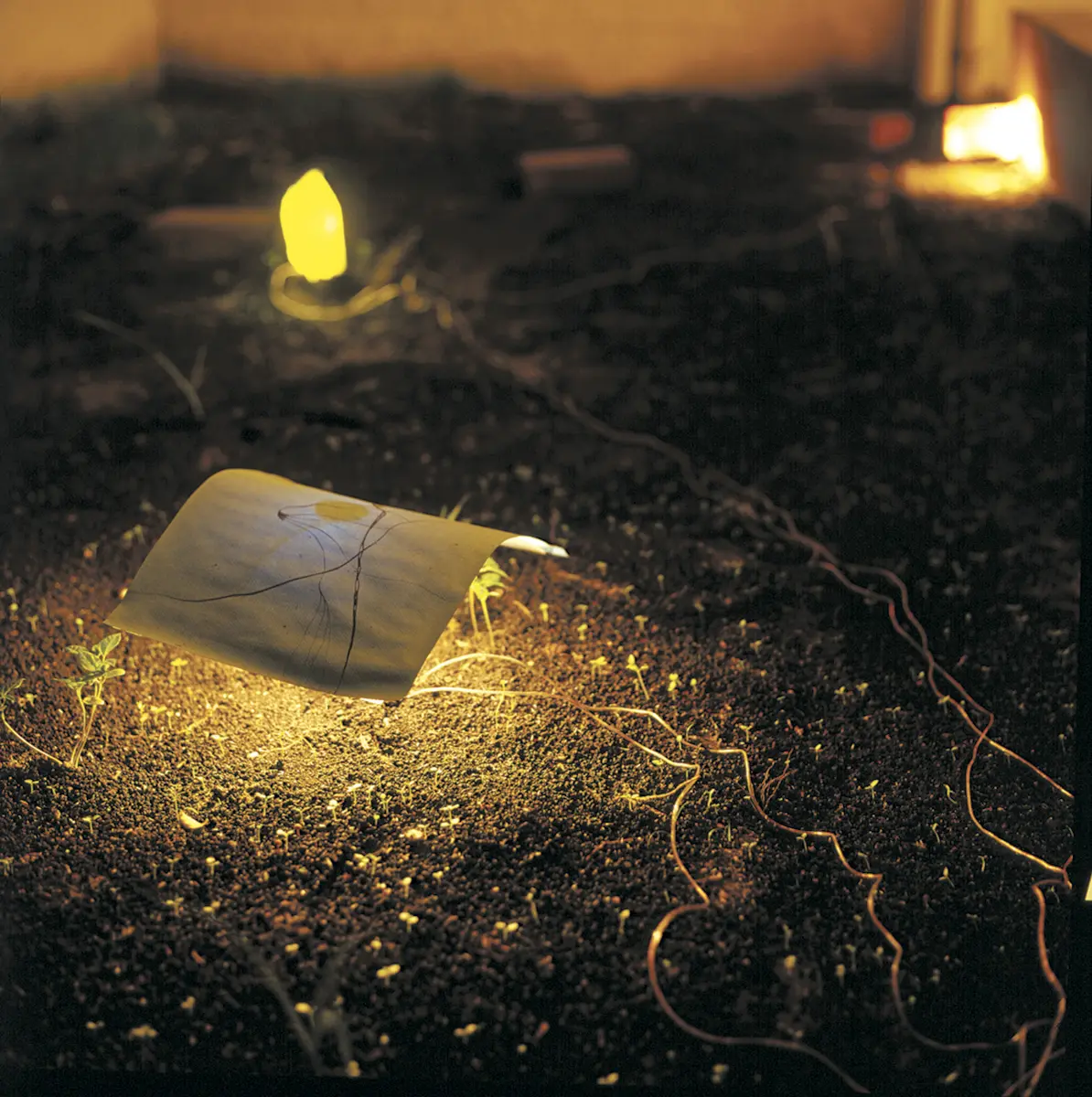
In an action that is either contrary or complementary to the one he operated on the building’s outside front, here the artist has stripped the fiberglass roof that covered the enclosed patio. The space is thus opened, and the segment of the floor under it is bathed by sunlight rain, and all the natural elements. Modé replaced the gray stones that covered the patio with darkly colored fertilized soil, and on this ground, he placed some lit lamps and papers with drawings that resembled those on the canvas we encountered initially. The artist watered the soil, and plants started to grow: the patio was transformed into a garden. Several days after the show’s opening, Modé used some birdseed to draw on the ground, and later, after heavy rain fell, the birdseed germinated and the new plants joined the garden. This is what later visitors found. Early visitors had seen an ice swan swimming in a small white tub on top of the wall that separated the gallery from the garden; the swan melted and became water for the soil.
Starting at the unequal cement plane that levels the whole gallery area, we can backtrack and study more comfortably the works we had only passed by before. Threads and fragments of wool, white and colored, hang from the ceiling near the center of the room. Initially, the only clues for the combinations that the visitors built during the show were some braidings and knots, with interventions or adjustments strewn around by the artist. Again, the bifurcating lines repeat the logic of those drawings we saw from above in the garden or from below in the gallery’s front. Here the lines cross space vertically or in intricate diagonals.
One final piece waits for us near the exit A sequence of transparencies, the film unspooled and uncut, extends over a structure that, in turn, backlights it. Leaning on the shelf that supports this sequence of small images, a magnifying glass invites us to see them in more detail, one by one or in pairs. Photographs of clouds, landscapes, peacocks, tree roots bursting through the ground. Beautiful images, magazine clippings, quick glances that in isolation perhaps would not transcend the boundaries of their own simplicity. It is the sequence in which they are presented without fancy effects, as they were seen and recorded, that gives them the power to bring us in and remind us that we all have moments like that and that we have them often.
Upon arriving, color and light; on entering, the suspended catwalk, the direction, the imposed rhythm; towards the back, soil and water and all that results from their encounter; in the middle, lines and the unfinished drawing that incites the hands to search for new solutions; before exiting, the investigation of a narrative in images, and the new meaning we find for them. At each of these moments, at each of these glances and steps, a new stimulus. Pure stimulus.
CARLA ZACCAGNINI