
As early as 1974, the perspicacious critic Marta Traba could see that the increasing influx of American goods would ineluctably alter everyday life in Latin America and, by extension, the art produced in the region. Writing about Alejandro Obregón, she claimed that by “leaving out the problems of sex, pornography, the billboard, the traumas of Coca-Cola and Elvis Presley, the optical experiences of LSD, and the games found in amusement parks, his paintings are automatically excluded from the contemporary game.” Of course, in light of the truly unfathomable and unregulated flow of American products and “cultural” trends into Latin America in the last quarter century, it is amusing to think that Elvis and Coke once had real traumatic potential. These days practically anything available in the United States is available throughout the hemisphere. This does not mean that everyone has access to these American imports, but rather, that the quotidian experiences of a large segment of the population have been altered by their presence. The change comes not so much from the availability of Disney toys and Tommy jeans or the ubiquity of Hollywood products, but from the schizoid coexistence of these things with a social environment that does not correspond, and is not reflected in them. In other words, while the things that Latin Americans are increasingly identifying with and consuming have changed, the social landscape they inhabit has not, or at least in many aspects, it has not changed at the same speed. The trauma and rupture are internal, and intimately bound to and hidden by the narratives of economic development that guide current international relations, official history, and political thinking.
It is this divided reality, this forced union of glossy things and sit-com lives with a landscape of continuing economic inequity and political demagoguery and violence, that José Antonio Hernández-Díez (Caracas, 1964) has been attempting to articulate for a decade. José Antonio Hernández-Díez, a survey exhibition curated by Dan Cameron and Gerardo Mosquera of the New Museum in New York, and currently on display at the Palm Beach Institute of Contemporary Art, demonstrates that this endeavor has never relied on simplistic political posturing or anything resembling the pseudo-anthropological efforts which have garnered so much institutional and critical support lately. Instead, Hernández-Díez has manufactured a series of objects that balance seemingly incompatible couplings: conceptual intricacy and visceral effect; vernacular forms and high-end production; mundane materials and progressive technologies; and the signifiers of youth culture and domestic life, and the traces of political instability leaves behind. He has maintained an active and evolving exchange between incommensurable things by grafting the signs of one reality over objects that belong to another. In a series of skateboards from the mid-nineties, for instance, the inane paint jobs that one would expect to find on them had been exchanged for images of hooded youngsters, possibly rioting students, or guerilla or sicarios. The local specificities of Latin America’s contemporary social drama erupted through and exploded the innocuous narratives of skateboarding culture. Suddenly, Tony Hawk’s domain had been contaminated by the immediate reality that encroaches on those who ride his boards through the potholed streets of Caracas. In the process, the vagaries of everyday life came to stand as a negative testament to the official line on economic prosperity and globalization.
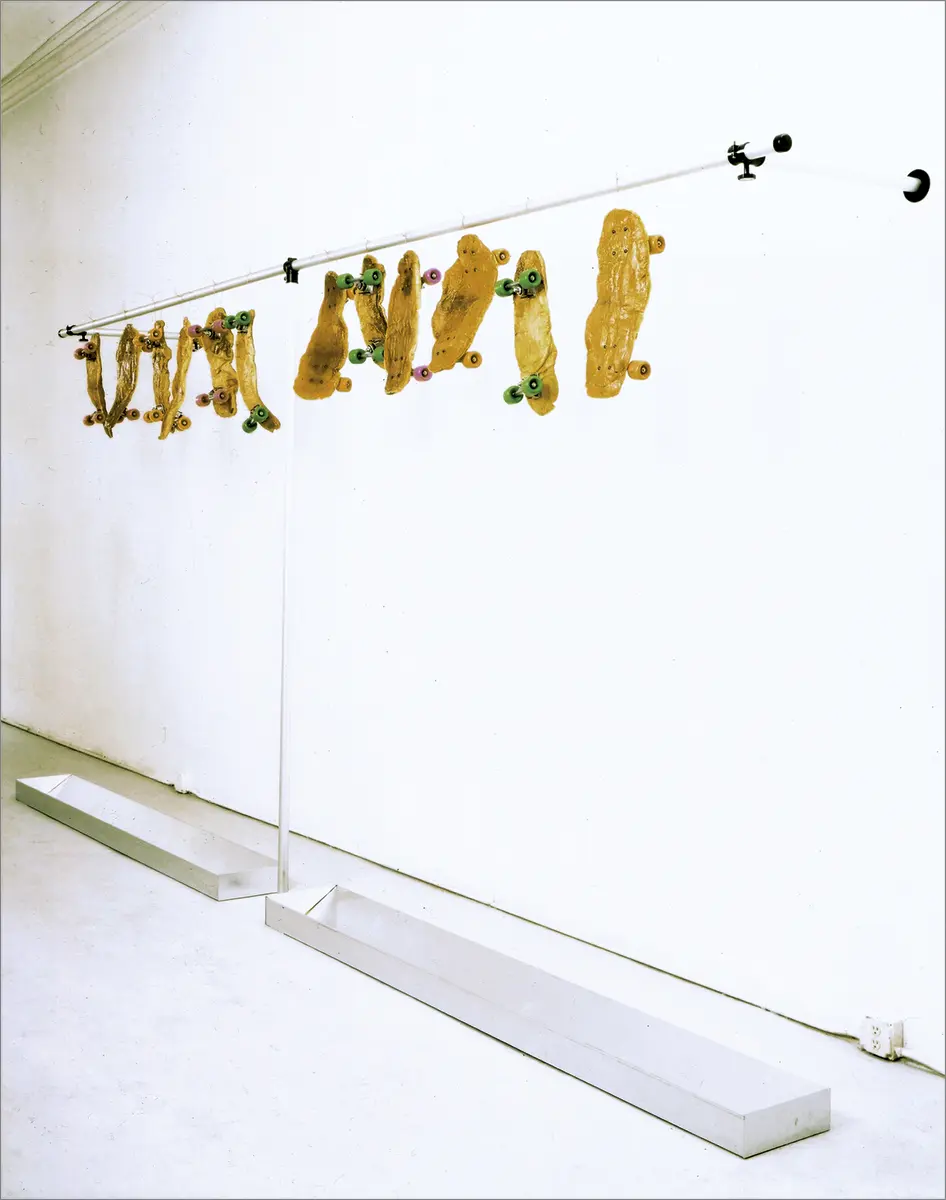
La Hermandad (The Brotherhood, 1994), also employs the skateboard but in a disarmingly surprising way. This piece is comprised of a drying rack on which a set of skateboards made out of deep-fried pig skin hang and three monitors on which their lifecycle is portrayed. In the first video, we see a board coming into existence in a vat of scalding oil; in the second, it is cruising down a sidewalk; and in the last, it is violently devoured by a pack of mongrel stray dogs. Persuaded by this lifecycle narrative and the gnarled and fleshy texture of the boards, it is no great leap in logic to understand them as metaphors for bodies, in particular for bodies under duress, assailed by the contradictions around them. These boards offer us the visceral architecture of flesh turned inside out. It is as if the skin has revealed the secret insides it protects. And these insides, it turns out, are not very different from what is around them, a difficult world bejeweled with pristine objects—like the beautiful fluorescent wheels clamped to these boards—that belong to another field of experience. It turns out to be a body undifferentiated from its environment, and hence, inexorably destined to mirror the strange collision of realities for which this environment is the stage.
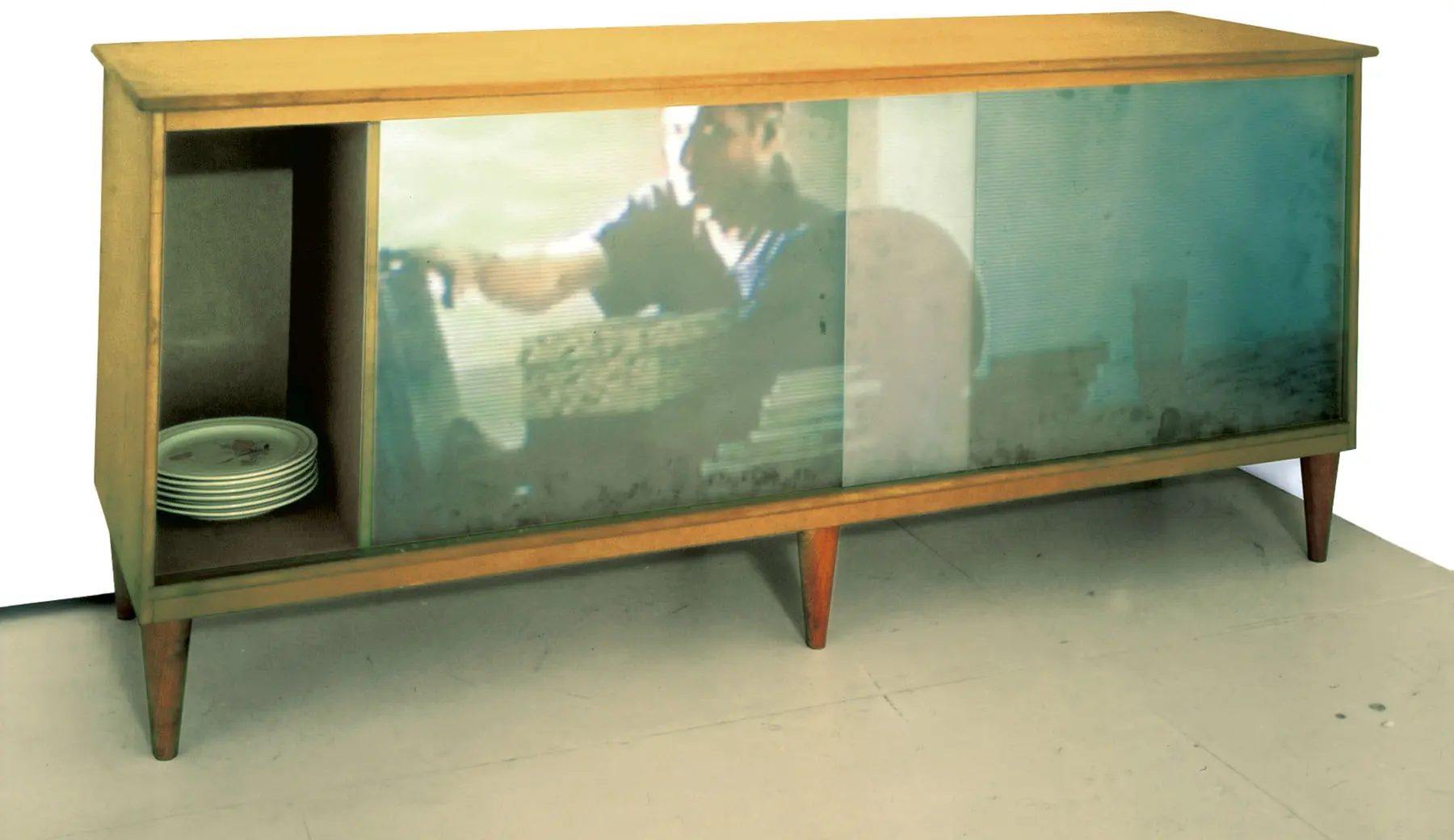
If a number of Hernández-Díez’s works interrogate youth culture and its accouterments, just as many concern themselves with domestic objects. El Ceibo, 1999, is a wooden sideboard with glass doors and some plates, on which a video of the artist patiently packing and moving plates is projected. Bereft of climactic incidents, the video manages to maintain a steady poetic rhythm. It exploits the weirdly fertile Beckettian nonsense of stressless repetition. And it does so with such skill that it quickly becomes obvious that we are in the realm of impasse, of inarticulation. El Ceibo tentatively externalizes something beyond what it can disclose directly: that a contaminated reality can be an interruption to current certainties. It is, in a roundabout way, an essay on the assiduous labor of cognitively mapping the real.
Lacking a signature style, oscillating in tone, and maintaining a critical edge while affecting a flippant hipness, Hernández-Díez has hammered out an exciting way of working. Everything is risked, every time. But this process has also led to some low points. The canniness of Vas P’al Cielo y Vas Llorando, 1992, or the oversized plastic spoon in Untitled, 2000, cannot measure up to the referential complexity achieved by the gigantic acrylic nails in Soledad Miranda, 1998, or the immense battery pack lids in Untitled, 1998.
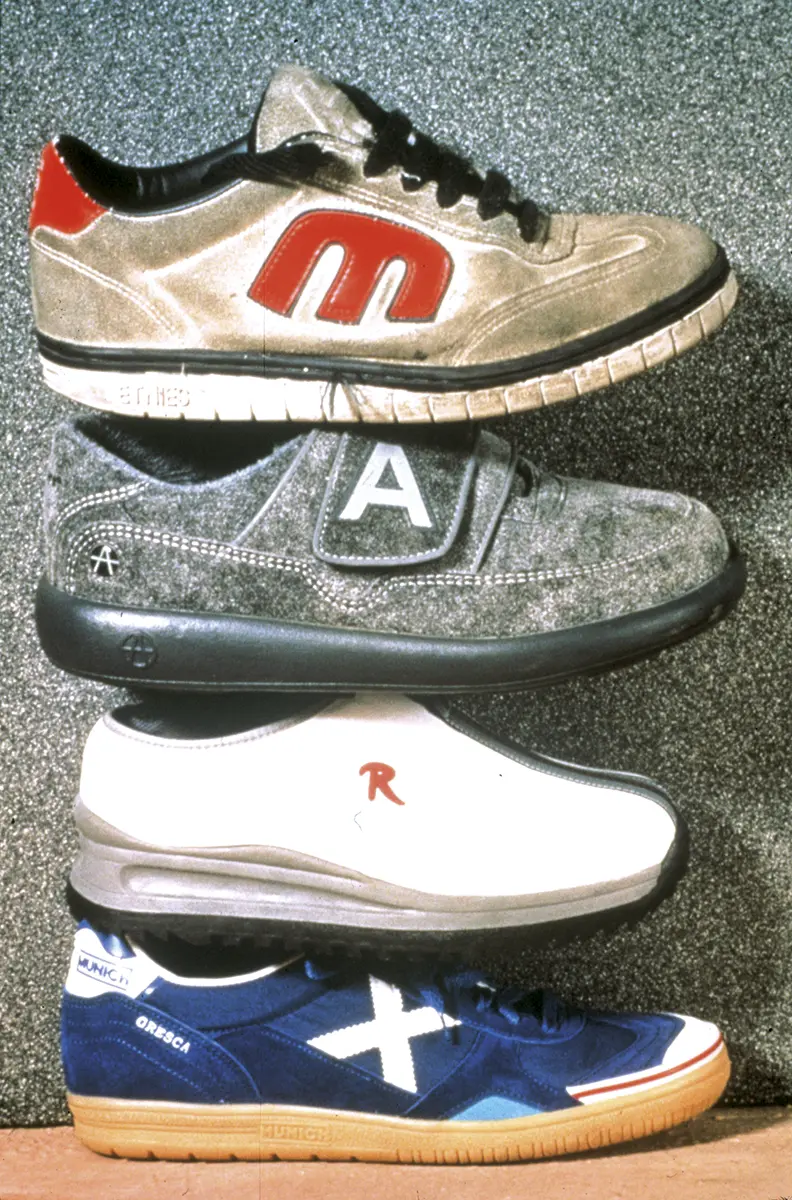
The untitled pieces, characterized by astonishingly large bite marks on MDF, originally shown at the 1996 São Paulo Biennial pale next to Hernández-Díez's new photographs of popular and trendy sneakers. Stacked in groups so that their logos spell out the name of a revered Western thinker —Marx, Kant, etc.— these photos are an abbreviated notation on how it is that our organizational narratives and points of reference can be depleted of significance by corporate culture and its products. In a quiet way, however, they leave open the possibility that traffic runs both ways, that maybe if the circumstances are right, the weight of these names can somehow begin to inform vernacular culture.
Beyond the discrepancies between individual sculptures, what gives Hernández-Díez’s work its relevance, is a desire to partake in the cognitive remapping necessary in a changing continent, and to do so from a position that shuns neutrality. He forces the viewer to broach questions concerning the complications globalization places on the formation of subjectivity and community. He impedes this historical moment, and the abject condition of the divided reality in which so many of its agents and actors are immersed, from taking place unobserved. His goal, it seems, is to pit the local specificities of quotidian life against the increasingly guarded records of history so that all saccharine and impoverished accounts of our current situation find a biting counter-narrative tucked away somewhere in the folds of the culture.
GEAN MORENO
Artist, art critic, and curator, based in Miami, Florida.