
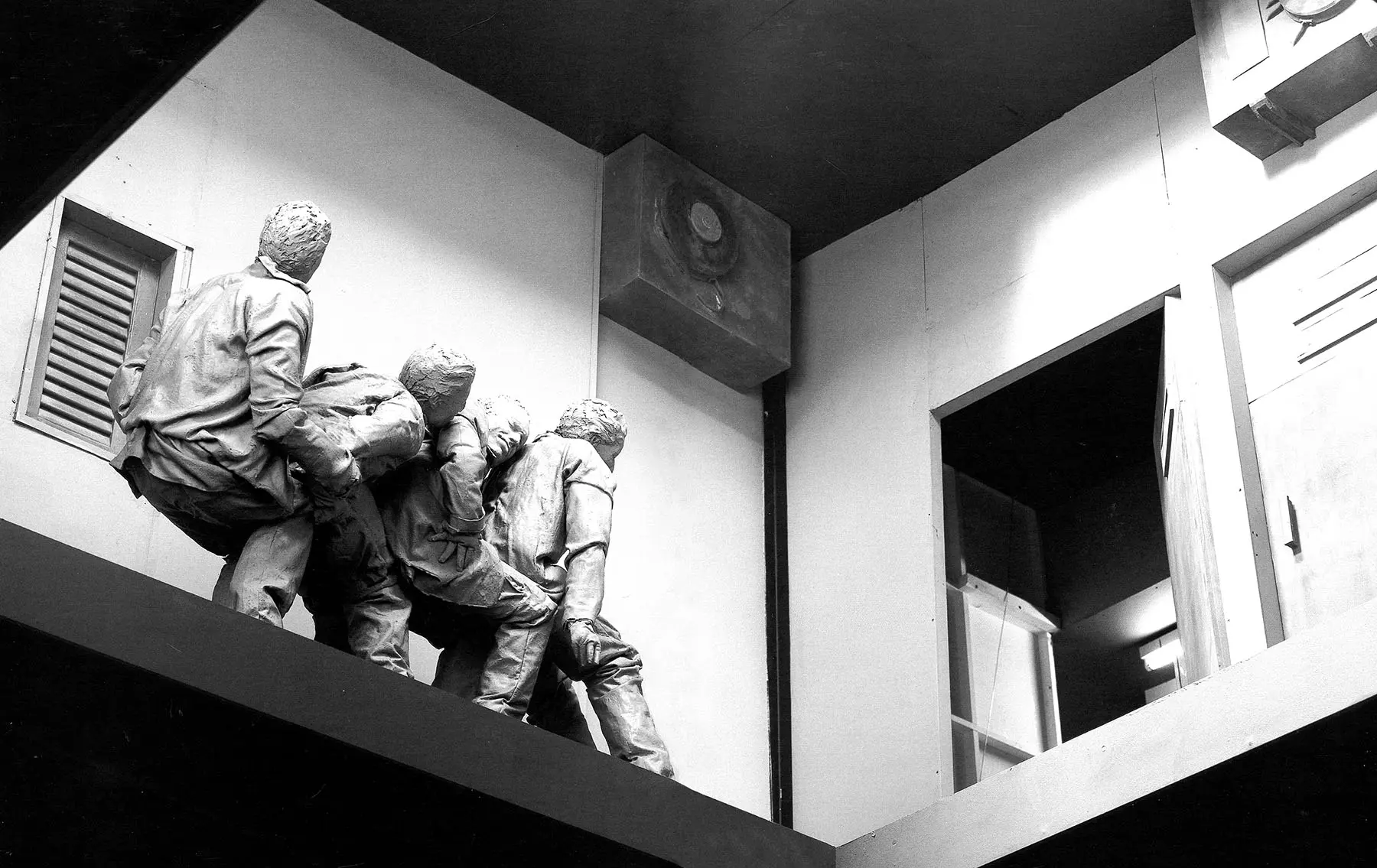
Juan Muñoz has disembarked, after his death, at the Hirshhorn Museum with an outstanding retrospective1. As it was expected the exhibition points in all directions of his varied and diverse work. Ad it is because of such diversity that I have preferred to occupy myself by referring in the first place to the last word that Muñoz produced while still alive and which seals his oeuvre, even though it is not and could not be included in the mentioned retrospective. Such is the case with Double Bind, Juan Muñoz’s extraordinary installation that remained open in the Turbine Hall of London’s Tate Modern from June 2001 to March 2002. It sums up his oeuvre because Muñoz died unexpectedly at fifty-three years of age while this show was running, thus stripping him definitively of the possibility of advancing his work, extending it, and eventually diversifying it with the adoption of other directions and other media. There is now a tombstone over his work, as there is over the artist’s remains, and if it should be modified in the future, it will have to be done exclusively through the interminable hermeneutic work to which history and art criticism currently subject the art of the past. The art that for them is always past. But there is another reason, equally effective, for showing that Double Bind neatly sums up Muñoz’s entire oeuvre. It is that during the two decades that his irruption and unfurling lasted, both art and artist remained invariably faithful to certain objectives, to certain media, to certain resources that are the same as those that achieved dazzling fullness in the installation at the Tate Modern. Juan Muñoz, unlike Francis Picabia or, even closer to us, Sigmar Polke, remained throughout his artistic career faithful to himself and to a single formal strategy which he exclusively subjected to tactical variations and to distinct degrees of complexity. In Double Bind, we naturally find Juan Muñoz’s fundamental aim of recovering the human figure, which for contemporary art, as for sculpture itself, seemed like a decisively lost cause. And, together with that double conflictive recovery, that of the “millions of stories that we have not allowed ourselves to tell during the last ten years because of our suspicions about the conditions of expression. The doors are opening wide [...] but I do not know how many of us will go into that territory."2 There is also his attempt to resolve in contemporary terms the problem of statue collections, in terms that were not those expressionistic terms of Georg Baselitz nor the naturalistic terms of George Segal or Karin Sander, but rather those of an impromptu actualization of the lessons of Medardo Rosso, who discovered personification prior to sculptural personalization of the human figure.3 Specifically, his human figures always underscore his theatrical nature, even if at first they look like replicas of a dwarf or, as they would later become, ballerinas that, instead of dancing on their legs, dance on a semi-sphere as if they were tops or figures that, although adults hold only their head, arms, and torso in the air because the rest of their body is enveloped by their own skin, like Indian or Eskimo babies. The “Chinese” who inhabit the final section of Muñoz’s work are also theatrical. As is Double Bind, its inclination for the “enigma of things” that surrealism, following Giorgio de Chirico, put into circulation with such enthusiasm in the ’20s and ‘30s. And in the case of Muñoz, as in that of de Chirico, it obviously affects the human figures included in his work in such a noteworthy fashion.
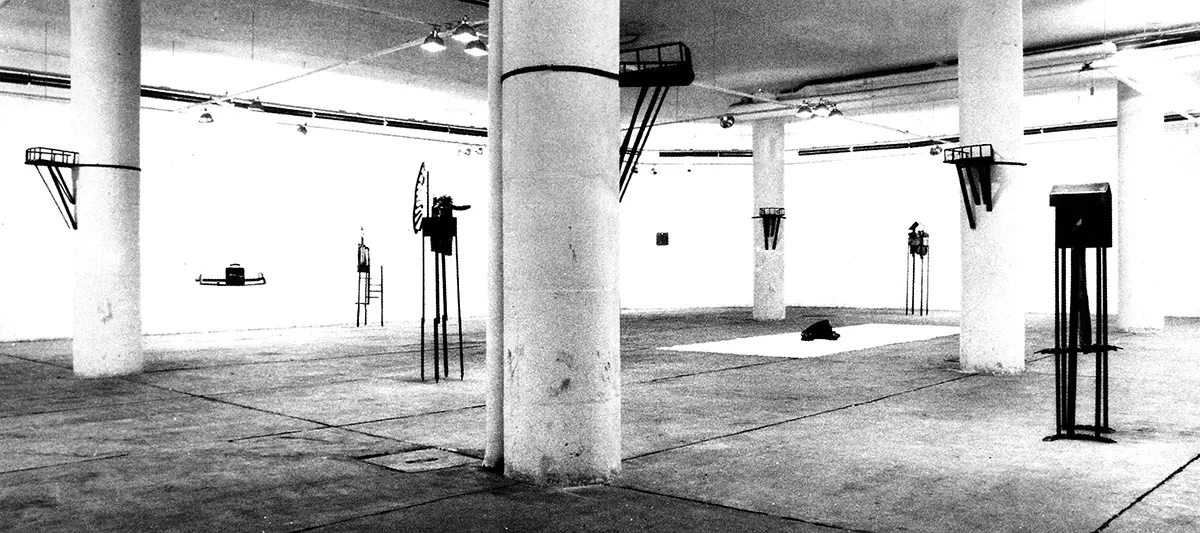
And I say “included” because from the beginning of his work, from that first exhibition under the ironic title of Últimos trabajos (Latest works) was carried out in 1984 at Madrid’s Galería Fernando Vijande, Muñoz was always concerned with placing the figures of his unique group of statues, assigning them well-defined positions or locations, contrary to the tendency of modern sculpture which is susceptible to occupying any point in empty and indeterminate space—Cartesian space, in short—of equally modern architecture. Muñoz’s work carefully determines the form, the gestures, and the look of his human figures as well as their placement, always resolved with obvious deliberation and meticulousness, even in Conversation Piece, one of the works from his series Temas de conversación (Conversation topics), located since 1994 in the Irish Museum of Modern Art of Dublin. There the most important challenge was the smooth, nude enormity of an inner patio that, more than a patio, looked like a Renaissance square, a challenge that Muñoz was able to resolve by distributing the four groups of figures that comprise the work in such a way that they not only establish a relationship, an effective dialogue with the environment, but they also take possession of it and they clearly reorder it as a function of their inexcusable presence, which does not seem fortuitous but rather necessary, and which is not found in fleetingness, but in the “eternity” that equally reclaims for its presence the entire architecture of the museum.
This preoccupation with placing and locating gives all of Muñoz’s work an architectonic dimension that I once called “scenographic,” against his opposition to that label of his work, repeated one last time in a dialogue that I had with James Lingwood in May 2001.4 But in spite of that adverse opinion, even in spite of the fact that Muñoz’s continuous and fertile interest in architecture even led him to the point of writing such a beautiful and stimulating book on architecture as Segment,5 in spite, I repeat, of this aversion, today I insist on the label of “scenographic” because I am still convinced that Muñoz’s rejection of this term is one of those psychiatric double negatives on which, according to his own statement, he based the title of his installation at the Tate Modern—Double Bind.6
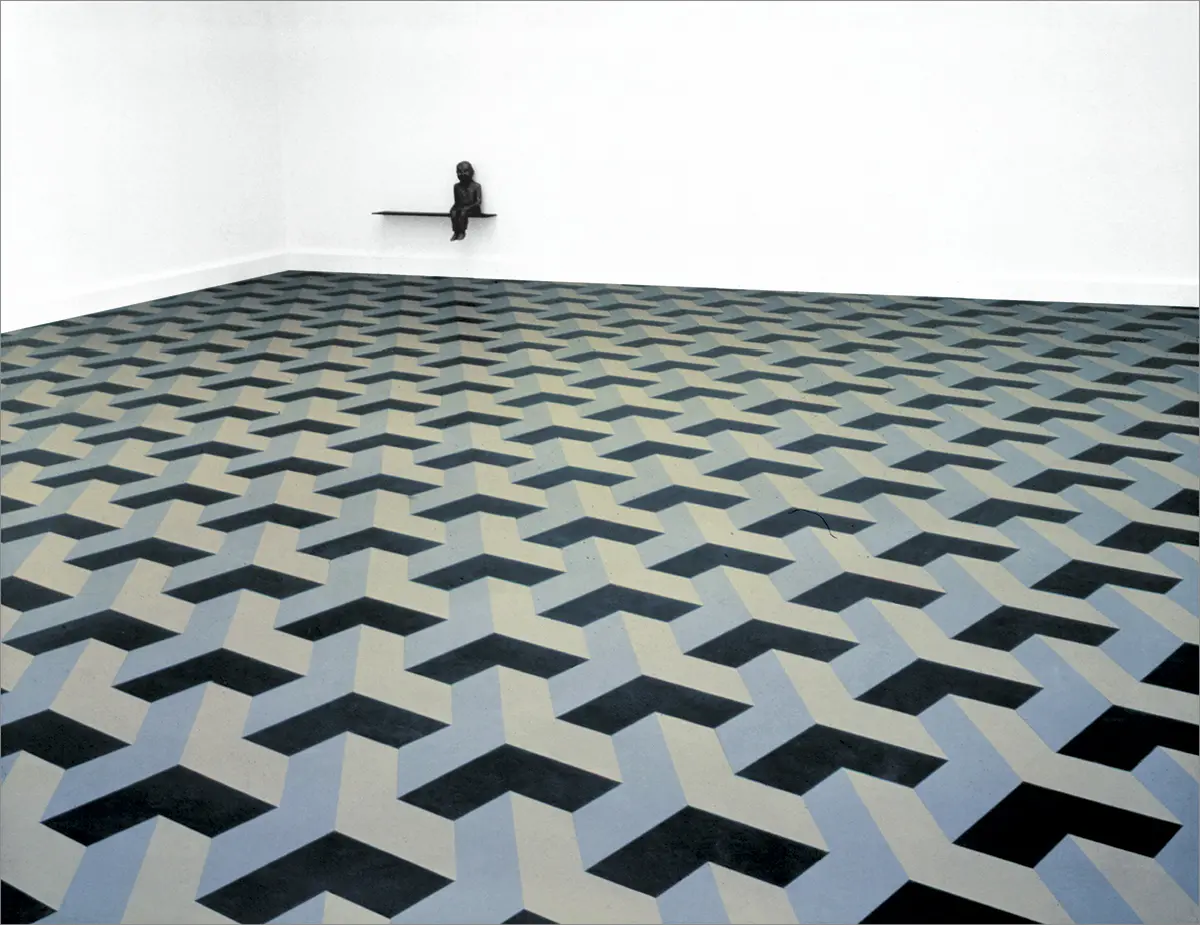
I believe that the first of the two negations that Muñoz made of the scenographic nature of his work concerns the realm in which the work itself unfolded, independent of the opinions that he expressed about them before or a posteriori. A realm that obviously is not the aforementioned Cartesian space of modernity, nor a place, the irreducible and non-transferable locus to which he attempted to subject himself in architecture to the critical regionalism theorized and defended by the British historian Kenneth Frampton. And in which emblematic works by Richard Long, Walter de Maria, and James Turrell are rooted. I can only label it as theatrical on account of its nature as an open scene and, at the same time, determined by the resources characteristic of staging: scenography, characters, tragic, comic, or dramatic stories, the spectators and their expectant, moved, and accomplice-like waiting. Muñoz’s second denial, the one that doubles or duplicates his negation of the scene, is precisely that of the resources that make it possible and that play a crucial role in his most important works. I think that in order to demonstrate this, two examples will suffice. The first is The Waste Land, the work with a title identical to that of the most famous of T.S. Eliot’s poems, which Muñoz created in 1989 in the Galería Marga Paz of Madrid, and which consisted of the sculpture of a dwarf dressed in modern clothing, and whose face and mocking smile evoked those of some jester of the Hapsburg Court. A dwarf seated on a wall with a trompe l’oeil pavement at his feet that, although flat and effectively comprised of different colored rhombuses, looked three-dimensional and made of an ordered unfurling of cubes. What did we have there? A buffoon sitting in the corner of an (im)possible palace, before or after unleashing a piece of his buffoonery? A parodic version of Mr. J. Alfred Prufrock, that “man without attributes,” who instead of confronting the devastation of the Earth by modernity denounced through poetry, confronted an illusory game of rhombuses and cubes, as unfinished and especially as indecisive as his own destiny? It was impossible to decide then as it is impossible to decide now, and I can only evoke it aided by the photographs of the period. But what is clear, on the other hand, is that the dwarf, the wall, and the pavement comprised a scene in which, one more time “forever,” one of those thousands of stories was represented that, according to Muñoz, the artists of his generation did not dare to tell on account of the suspicions that they themselves threw “on the conditions of expression.” Silent stories, stories of an inept mime who could not make himself sufficiently understood with his gestures, unfinished or, rather, fragmented stories that who knows when they begin or when they end, spinning interminably in their incurable incompleteness in the sealed bottle of the fables whose transparent glass shows them and at the same time makes them inaccessible.
So, there we had the stories of the dwarf, but if we cannot even know if they are tragic, comic, or dramatic, why label them as theatrical? Well, because although we do not know their genre, those improbable stories of the dwarf are staged, and not in a place or simple space. And they are interpreted by someone who is not an individual but rather a character who, from his irreducible immobility, acts, interprets a story that is reduced to the unfolding of a few, radically insufficient, bodily gestures. These stories of the dwarf evoke the video installation by Bruce Nauman in which a clown opens the same door again and again and again so that the same bucket of water falls on his head.
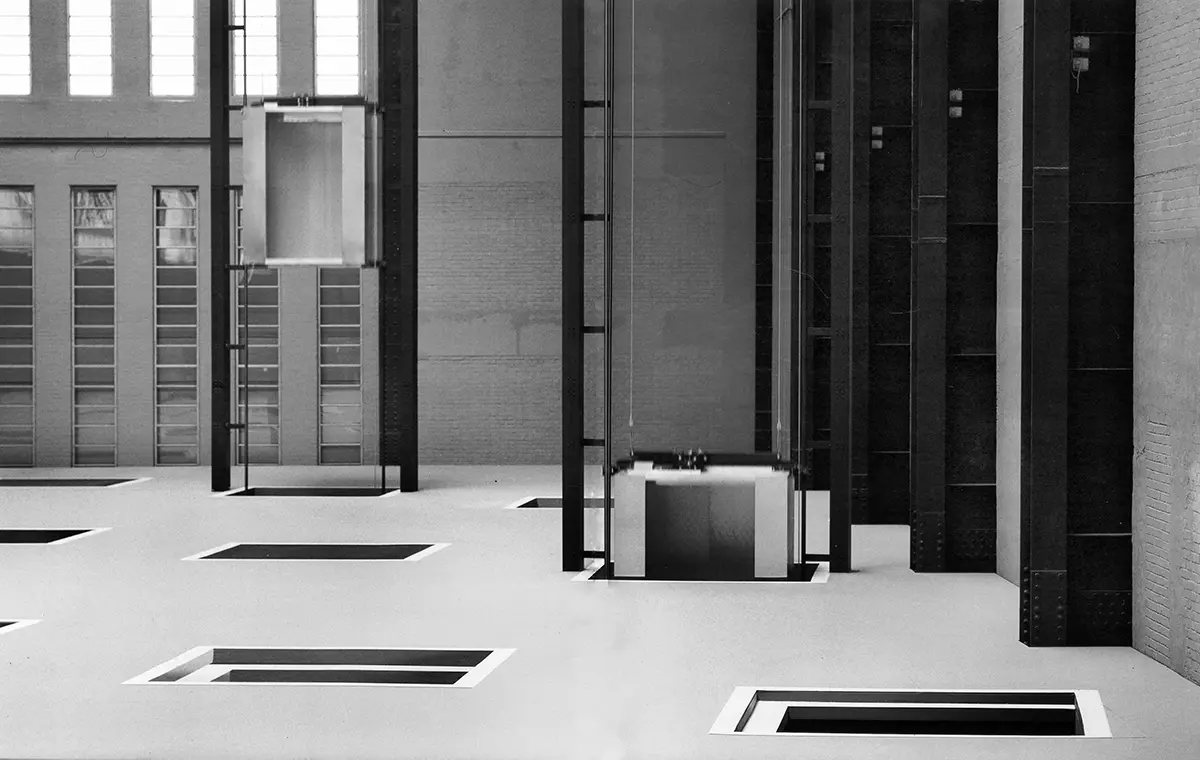
The second example is precisely Double Bind, the installation at the Tate Modern, executed by Juan Muñoz twelve years after The Waste Land. Let us say that, first and foremost, it is an authentic tour de force, a cyclopean work that superimposes the legendary figure of the titan over the fragile humanity of its author. Let us add that it deals with one of the best and largest contemporary examples of ephemeral architecture. Let us describe it, beginning with the description of its location: the Tate Modern, which is the center of a museum of contemporary art conceived as an extension of the classic Tate Britain and located in the building that was a large central thermoelectric plant, renovated a couple of years ago by the Swiss architecture firm Herzog et De Meuron. The design of the Swiss architects respected the basic lines of the volume and the facades of the original building, as well as the arrangement of the Turbine Hall which they nevertheless emptied completely in order to turn it into a gigantic vestibule of more than one hundred meters long and forty meters wide and another forty meters high. The ceiling of this room, sustained by a framework of columns and metal beams, is flat, and the floor is flat; on the east and west sides there is a ramp that connects with one of the public accesses to the museum. And between the flat floor and the ramp, underscoring the border between both, there is a suspended bridge that acts as an observation platform.
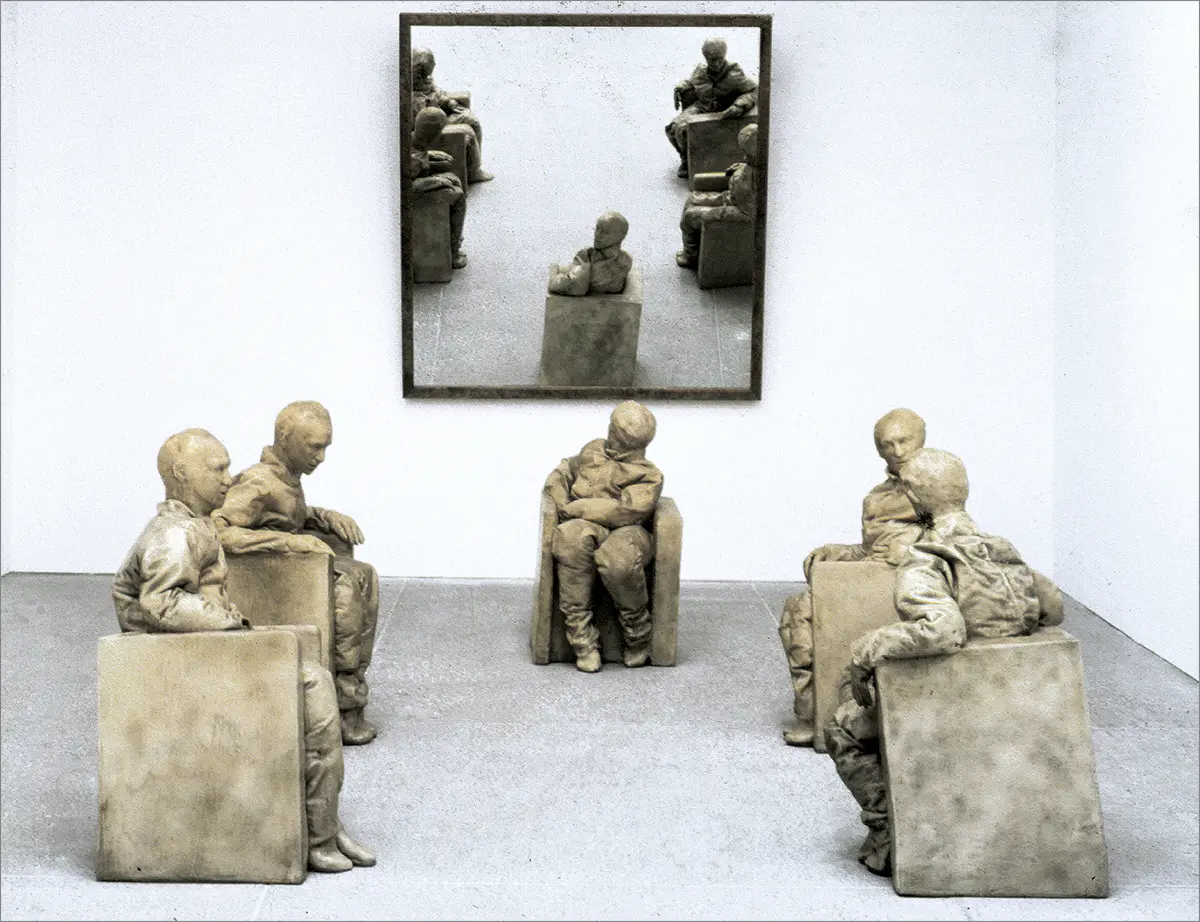
In the show with which the Tate Modern was inaugurated in 2000, Louise Bourgeoise responded to the enormous challenge of the Turbine Hall by introducing some of her largest pieces, including one of her gigantic spiders, and by constructing a large metallic fortified tower that simultaneously functioned as an observation deck. But Juan Muñoz went much further than the French artist because what he did with his work was to modify profoundly the architecture of this hall, splitting it in two. He left the west side, where the ramp was, intact, and on the east side, he built a mezzanine at the height of the observation deck, which cut the original height of the hall and opened the way for two floors barely connected by two elevators with a metallic body and transparent doors that, completely empty and with different rhythms, went up and down without stopping, accompanied by the dull buzzing of its motors. The result was that if you went to the Turbine Hall from the north entrance of the museum, you would end up on the observation deck and find yourself before a great hall, illuminated and empty, whose railings blocked your passage. And you would see the elevators going up and down and, over the cream-colored rug that covered the floor, you would see some square runners painted in such a way that they looked like two steps that went down to the darkness of a hole.
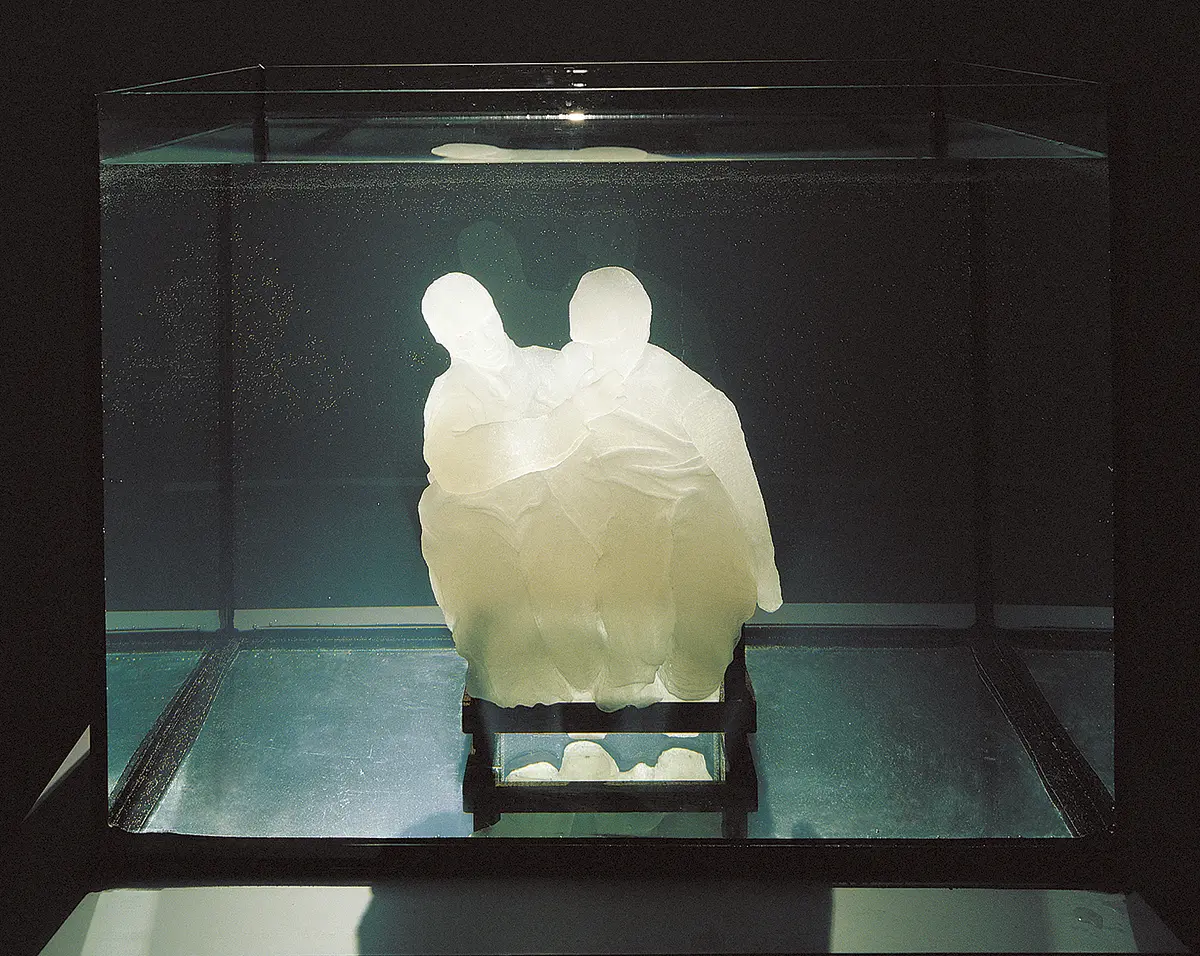
But if you arrived through the museum’s west entrance and went down to the end over the ramp of the Turbine Hall, what you would find was a deep, low, and dark hall where you could see the elevators and the metallic cages that encased them, and the motors that moved them, while on the ceiling that was painted black, you would discover some square holes, one after another. And they were not simple holes, but rather the scale model of the inner patios of the apartment buildings, twenty-four in all. The size of all of them was the same, as was their gray matte tone and their opening to the sky, which was not really the sky but precisely the flat ceiling of the hall, seen through the square holes that framed the rugs placed on the floor of the hall above, the high, illuminated hall. But the scenes and scenographies represented in each of these small patios were different, as were the characters that took part in them, which were nevertheless, in all cases, human figures made of synthetic resin and painted in different shades of matte gray. It is impossible to reconstruct here, in the brevity of this article, all those scenes. Suffice it to say that they evoke the life, at once common and domestic, that the inhabitants of the residential units in the slums of the big cities all share, especially those of Asia, Bangkok, Singapore, and Hong Kong, visited by Juan Muñoz in the preparatory phase of this work, and which are theatrical, decidedly theatrical. They are stagings of the anonymity that unfold silently and multitudinously in the non-places of postmodernity.
NOTES
1. The traveling show was organized by the Hirshhorn Museum in association with the Art Institute of Chicago and it will tour Los Angeles, Chicago, and Houston.
2. Cited in James Lingwood, "Homenaje a Juan Muñoz,” El País , 2 Sep. 2001. In this article, the art critic and British curator also recalls that “Juan and I met when I was working in the Institute of Contemporary Arts (ICA) of London at the end of the ‘80s. He presented several sculptures in one of the galleries, several extraordinary [...] sculptures. But what I remember most was his extraordinary defense in a conference full of the typical hostility about the future of sculpture by young British artists—Damien Hirst, Michael Landy, Gary Hume, and others whom I did not know and whose work I had just discovered.
3. I am aware that this distinction may seem idle, but it is the only one that I have been able to develop with the goal of characterizing what Muñoz has done with human figures that are not personalized as in classic sculpture, but rather personified, that is, not turned into concrete individuals, but into typical characters of a theater-like that of cruelty by Antonin Artaud, the absurd by Samuel Beckett, and even of the triadic ballets of Oskar Schlemmer; they are foreign, strange, untimely.
4. “I’m not interested in scenography. It is a sculpture that includes other sculptures that include other sculptures, and several viewpoints.” Juan Muñoz, Double Bind (London: Tate Publishing, 2001) 71.
5. Signature was published in 1990 by the Centre d’art Contemporain of Geneva, Switzerland, and aside from its intrinsic quality and its sage references to Vitruvius, Alberti, Milizia, and Etienne-Louis Boullée, it has the added interest that the principal motive of his reflections is the posa, an ephemeral construction that the natives of Zurite, a lost town high in the Peruvian Andes, build with wooden planks, aluminum tiles, and cords in a corner of the town square with the only apparent aim of burning it afterward.
6. See Irene Hernández Velasco, “Juan Muñoz transforma la Tate Modern en un espejismo barroco,” El Mundo, 12 Jun. 2001.
CARLOS JIMÉNEZ
Writer and art critic. Author of Extraños en el paraíso. Ojeadas al arte de los 80 and of Los rostros de Medusa. Estudios sobre la retórica fotográfica. Professor at the Universidad del Valle, Cali, Colombia.