
At the Latin American House in Paris, Argentine artist Leandro Berra, based in the French capital since 1981, presented for the first time a large selection of sculptures and installations dealing with a specific theme that has long occupied him. Self-exploration and self-search, introspection, ontology. In Berra, the fundamental questions famously expressed as “Who are we, where do we come from, and where are we going?” have undergone a thorough process of reflection, and have come to be the stage for the relationship between the multiplicity and the oneness of the self. The works presented in this show bear concrete and intense witness to this process.
The title chosen by Berra in order to contextualize his show, de un yo plural y de una sola sombra ("of a plural I and of a single shadow"), already offers clues as to how complex, or rather how lucid, his view of himself and his relationship with the world is; this content only thickens as we acknowledge that as “viewers” we influence the work with our gaze, which is neither stable nor neutral, and which makes the observed object relative in its size, its shape, its mass, and its energy. This is to say, our gaze influences the object’s “own state” (Severo Sarduy), that “real presence” of which George Steiner spoke, the beating heart of any work of art.
The themes of time, doubleness, and mirrors are central here, in this group of sculptures and installations where the dialectic of the face-to-face reigns supreme. Leandro Berra launches into his exploration of the individual and his feelings (hate, love, suffering, compassion, vanity…) from the vantage point of the mutual incommunication of beings and the inevitability of questioning in which doubt is the active matrix. As the artist himself confirms, the materialization of this questioning, more metaphysical and ontological than cultural —and, one could add, psychoanalytical— translates into a dialogue of opposition and conceptual construction between matter and logos, between wood and photography, between the old and the modern, within any kind of conceptual and formal framework that relates to both the philosophical and the spiritual aspects of the yin and yang. The problematic of the double, of the other and the others within the self, is a universal myth present in all cultures, and also in literature. Berra can perhaps identify with Victor Hugo’s idea, cited by Gilbert Durand in Anthropological Structures of the Imaginary, that “…something unexpected within one’s own self is that we must look outwardly. There we find a terrible chiaroscuro… this is more than the image, it is the simulacrum, and in the simulacrum lives the specter… And leaning over this well we can see the abyss, within a narrow circle the immense world."1
To look into one’s own depths, as a catharsis in order to train our gaze upon the world, is the path chosen by Berra. Yet, humor and tenderness are not absent in this discourse of interrogations and confrontations through which a common man or a common woman come to occupy center stage, as stereotypes in which the “archaism” of the technique serves to evacuate feeling in exchange for the search for a possible identification, a possible familiarity. These sculptures, or rather, these polychrome bas-reliefs are neutral characters, even if they are metaphoric alter egos. They are also supremely tangible in formal realism, with their prominent and exaggerated features (popping eyes, long noses, large mouths), like some sort of caricature of anxiety crudely carved in wood. For Berra, analysis is made possible by “tools.”
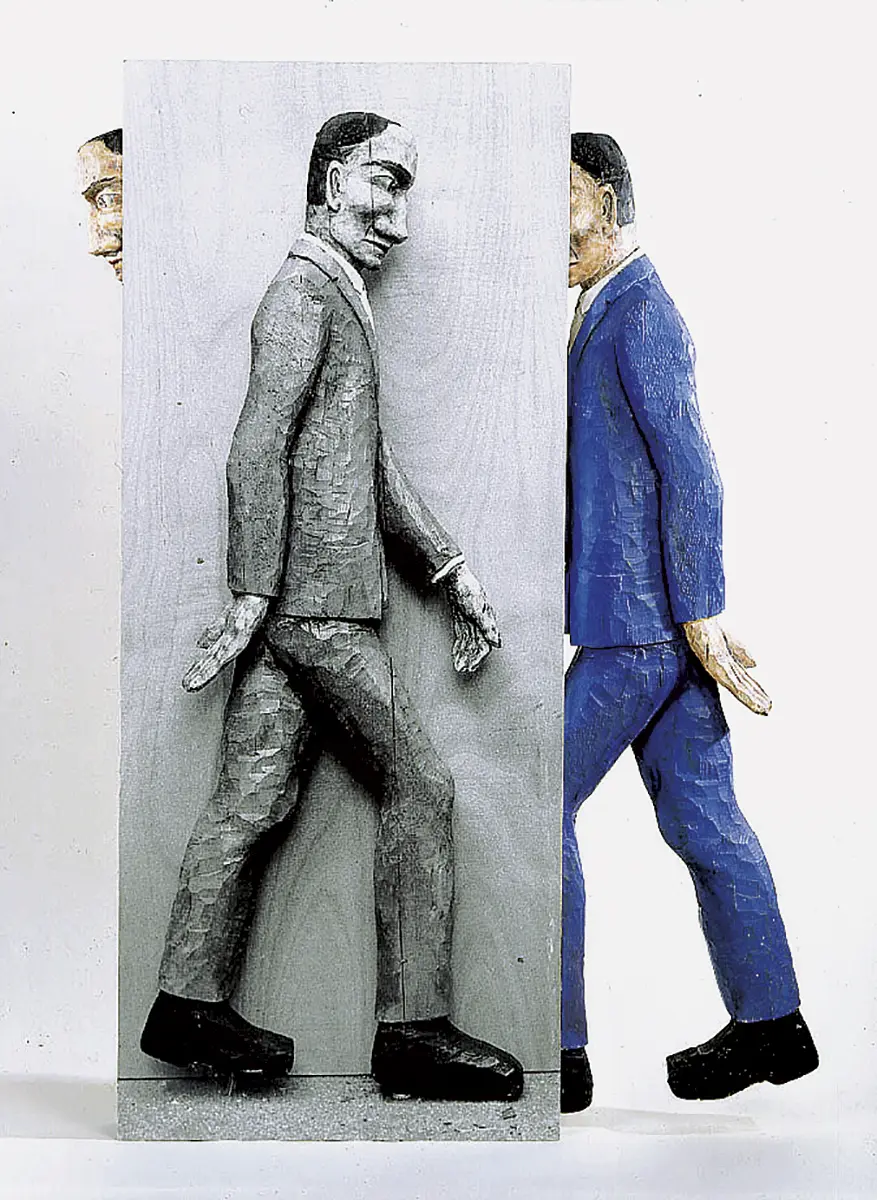
The first confrontation surprising us here is that expressed as a relationship of contrary forces, between the knotty, expressionistic carved-wood sculptures and the smooth-surfaced photographs. The method is simple but highly symbolic: Berra makes a sculpture and then takes a photograph of the piece. It’s the first challenge between two techniques, between two aesthetics. A relationship between the one’s density and the other’s lightness, between the black-and-white and color. Differences overcome unity. Berra’s double is not the Romantic’s disquieting double, that malefic “Other” that drives us to madness or to death. Berra’s double is an “Other” in search of the multiple “I”s, those of the “shadow” and of the subconscious, in order to find itself. The link established between these false doubles, these somewhat narcissistic alter egos, crystallizes in a symbolic text placed sometimes by the artist between the two figures and which explains the union, the relationship between them, to formulate in a more general manner the idea Berra is trying to develop with his piece. Such is the case with Romeo and Juliet, polychrome wood, FB B&W photograph, 195 x 270, and photograph on tracing paper of one page from Shakespeare’s works, 2002; or with Edipo rey, polychrome wood, FB B&W photograph, photograph on tracing paper of the carved wood’s laser DNA sequence, and photograph on tracing paper of a page from Sophocles’ Oedipus Rex, 2002.
Sometimes, serving as “passage” between the two characters is an object that links them physically or virtually. For instance, the hourglass in How Time Passes…, 1997, polychrome wood, FB B&W photograph, or, since the light also comes indirectly, the candle placed behind But the flame is not always the same, polychrome wood, B&W photograph on tracing paper.
Leandro Berra is primarily interested in the relationship between science and art. he invokes scientific knowledge by introducing in his works photographs of DNA sequences but wonders about its relative validity by opposing it to the “truth” of art. Several of his works express this exploration, for instance, Feminine and Masculine, or his two self-portraits under the title Intimate Portrait of a Stays, which consist of ID-type photographs taken at several points between 1981 and 2001 for the process of obtaining his carte de séjour (residence permit) in France, to which Berra sticks graphs of his genetic profile obtained following specific computer identification systems.
Especially moving is the portrait of a friend of the artist, who disappeared by Argentina’s Military Junta in 1978, whose image was reconstructed from oral descriptions by Berra, based on his own recollections, using the city of Paris’ Forensic Medicine Database. This piece becomes the paradigm of Berra’s sensitive reflection about this no man’s land, of that in-between of memory and of science in which he is interested as a human being and as an artist.
NOTE
1. Victor Hugo, in Contemplation suprême, “Post-scriptum To My Life”.
CHRISTINE FRÉROT