
Leonel Luna (Buenos Aires, 1965) is perhaps the one artist whose work —exhibited at that showcase that is the ArteBA 2002 gallery fair— took on Argentina’s precipitous economic decline, which multiplied the number of the country’s poor and triggered a round of street protests. In July 2002, Luna presented a digital recreation of The Conquest of the Desert, an emblematic painting of national hero Juan Manuel Blanes. Luna replaced the General’s figure with his own in an equally equestrian pose, and the troops around him with images of Argentina’s new social actors, belonging to the “picketer” movement —unemployed protesters who, along with their families, have obstructed transit in important routes, bridges, and avenues, or who simply picket government buildings in order to call attention to their plight.
One anti-ALCA slogan, painted on a wall in the Old Palermo neighborhood, Their opulence is our exclusion, is the point of departure for Luna’s recent show at Galería Luisa Pedrouzo. By bringing this sharp phrase into an art gallery, the artist reflects at once on the artistic experience and the experience of the everyday. These works abound in references to current events, to history, and to Argentina’s art circuit. Luna builds a space charged with symbolic references and explores national and international questions about Argentina’s tragedy. The work does not offer answers —it doesn’t even try. Maintaining its distance from both solemnity and realism, it weaves a tapestry of illusion and reality.
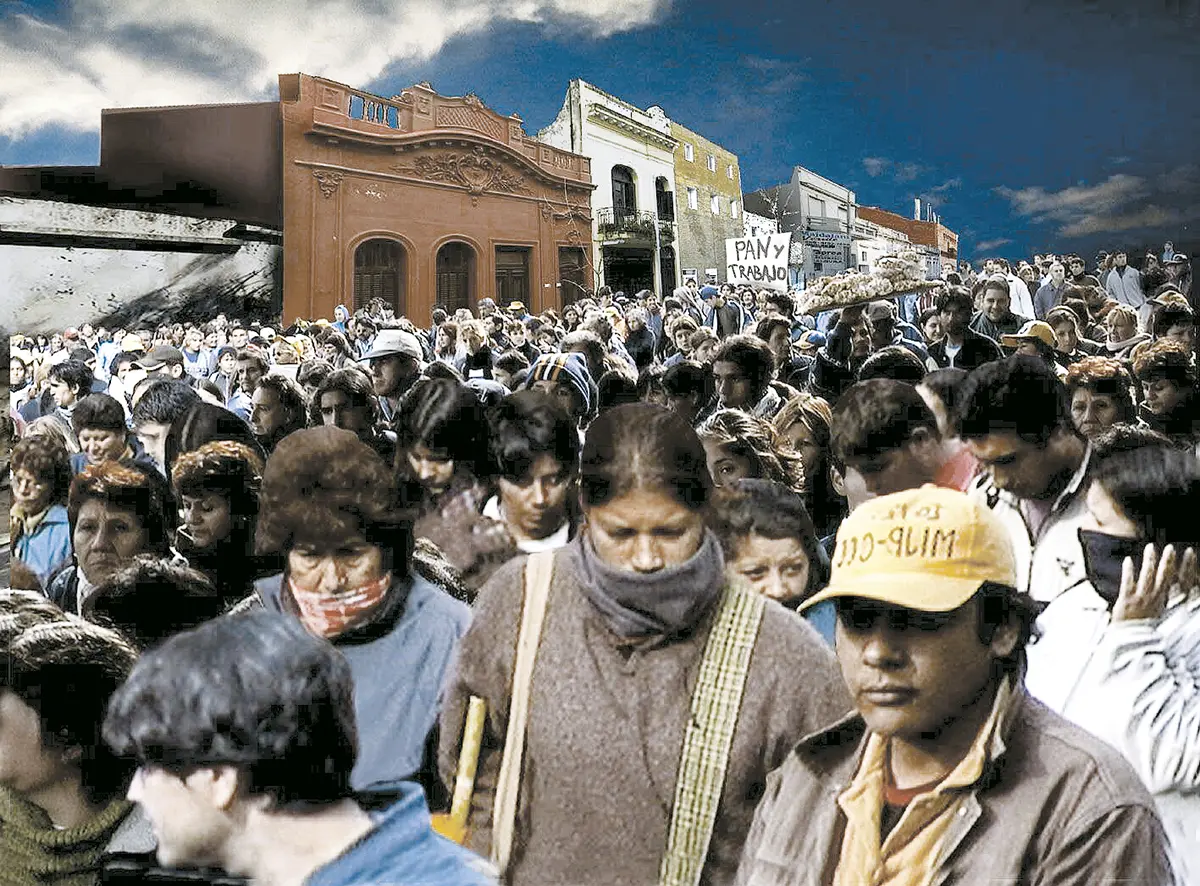
The pieces shown in Their opulence is our exclusion are the result of Luna’s way of playing with the idea of representation. “The conditions of representation underlie imagination itself. Imagination substitutes reality, and together they create an image that, as an idea or as a figure, retains and recreates our own myths,” the artist says.
In this series, Luna used photographs —shot by himself or taken from published sources— and digital technology as tools for his project, as illustrations for his ideas, rather than for self-indulgent exercises in technique. Luna’s images —printed on vinyl— appear as the product of a playful, curious, and committed mind.
In this case, he composes new doubly pre-existing images, principally from historical Argentinean paintings depicting the crisis of the 1930s, as well as Juanito Laguna and Ramona Montiel, two urban-marginal characters created by Antonio Berni in the 1960s.
Luna’s composition reproduces what found in his source materials, which moved between social criticism and a metaphysical atmosphere. But the character who now stands in the garbage dump with a faraway look in its eyes is no longer Juanito Laguna, the town boy, but artist and poet Fernanda Laguna. The alleyway that leads into the Factories is almost identical to the one described by Horacio March in his 1933 work, but the protesters are new. Similarly, the masses of people in Luna’s recreation of Berni’s 1934 Rally belong squarely in 2002, as indicated by the slogans in their vests and caps. In his version of Berni’s Ramona’s Dream, the seamstress is represented as a prostitute, while the main character in Cecilia’s Dream is a carefree, semi-naked young woman who reclines on a bed in the same pose as before, only now we distinguish, on the wall behind her, paintings by Jorge Macchi and Fabio Kacero, Luna’s contemporaries. Are these private clues in classic, well-known paintings?
Too many internal jokes in the treatment of a serious issue? In fact, humor is deployed in order to deconstruct archetypes, to separate political commentary from cliché, and to infuse these works with a renewed humanism as they explore different states of the soul, the fury and befuddlement, the struggles, the persistence of the excluded. Luna is an excellent observer, someone who does not leave anything to chance, and he is capable of communicating with an unusual intensity.
Perhaps Luna’s working periods in Mexico, Ecuador, and Costa Rica contributed to developing the ease with which the artists move in and out of self-referentiality. Luna, who began exhibiting his work in the mid-80s, is well-versed in the history of Argentinean art, and he knows what he is after. It is not by chance that he was among the promoters of TRAMA, a space for active exchange between artists.
There is, we know, an art of the streets that deals with the new social landscape and hasn’t reached yet the commercial or institutional circuits. In Argentina’s new situation, the cultural field will have to rethink how, why, and for whom it produces and thinks; this goes also for the art world, which in the last decade (when the country lived as if, indeed, one peso equaled one dollar) accumulated intellectual opportunities and global experiences that could be now parlayed into the necessary introspection. Leonel Luna’s provocative show moves precisely in that direction.
VICTORIA VERLICHAK