The organic minutiae that mark the fortuitous passage of everyday life—the course of ants, accumulated dust, dirt, the imprint of wasp wings, dried tomato seeds, flower petals, seeds, and incense burns—gave way to a new poetic vocabulary in Rivane Neuenschwander’s first solo museum exhibition in Brazil. At first glance, following the organic minimalism that characterized her work throughout the ’90s, one might anticipate a less organic and more industrial and urban serial conceptualism. Eight out of the nine works (all from 2002) created especially for this exhibition contain an element of serial configuration that is a departure from a recent conceptual concern with site-specific work. Apart from any reference to institutional critique, however, the new works are still imbued with the artist’s intimately analyzed repertoire of material repetition, and the innately ephemeral condition of natural existence. Composed mainly of installations, they manifest a new point in Rivane’s artistic trajectory.
The intelligence with which this plastic transition materialized and was presented at the Museu de Arte da Pampulha, demonstrated the harmonious understanding of the Museum’s new program that is directed toward the exhibition of work created specifically for this challenging, circular, glass-walled space, and was, to say the least, inspiring. The subjects Rivane explored in the new works included the poignant relationship between her life experience and the circumstances of her local upbringing (Love Lettering); the Museum’s topological context and structure (Chove Chuva [Rain Rains], Continente [Continent], Estudo para Lagoa [Study for a Lake], and Gambiarra [Stagelight/Trap]); the city’s landlocked geography (Imprópria Paisagem [Improper Landscape]); and urban memory, (BH). The artist welcomed collaboration not only in terms of the new curatorial program, by devising an entirely new body of site-specific work, but also with regard to the development of new projects in conjunction with other artists and the inclusion of the participant-turned-spectator in interactive works such as Sob Medida (Under Measure).
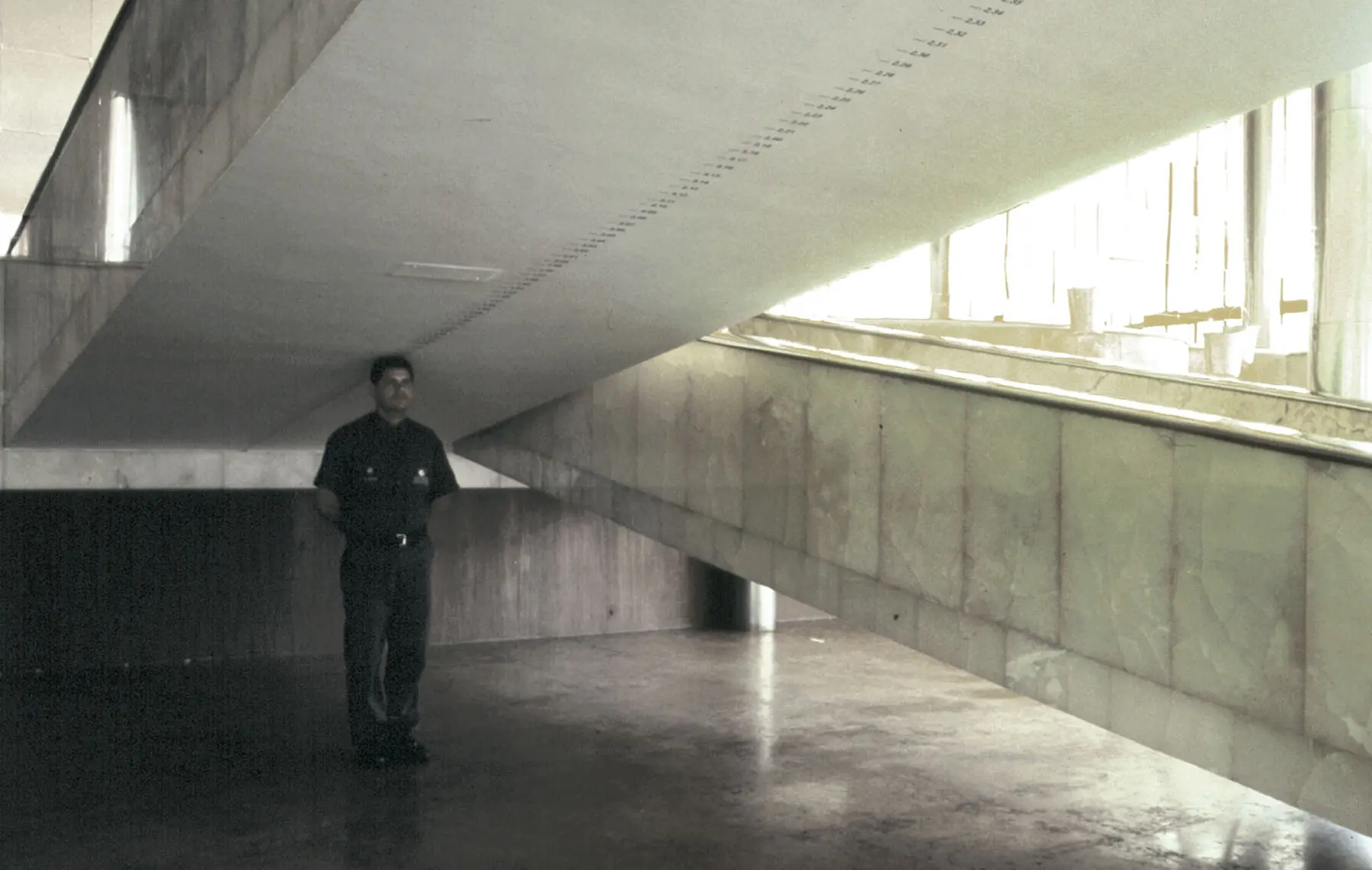
For example, she provides an ingenious architectural insight: underneath the distinctive Oscar Niemeyer ramps leading to the second floor of this jewel-box building, originally built in 1942 as a splendorous modernist Casino, a height measure, reminiscent of those drawn in children’s bedroom doorways was designed. By standing at a head level against the underside of the ramp the visitor’s height could be read. Gambiarra is another work installed in an intimate relationship with the architecture and plays with the visitor’s sense of perception. The title is a Portuguese word meaning both stage lights and “trap.” A light bulb hangs loosely in an oblique, somewhat hidden corner, illuminating a commonly neglected architectural interface. It is a touch of playful irony perhaps alluding to both the glamorous past of the Casino and, paradoxically, to a subtle intimacy rescued by Rivane from the private to the public sphere.
In BH, a series of photographs executed with Cao Guimarães, an artist also based in Belo Horizonte, the local spectator had the opportunity to recognize parts of his or her city in the images shot for the creation of an alphabet composed of found letters. These ranged from phone booths to street signs and dispersed litter, including scenes such as an old woman sitting inside a church holding a religious newspaper, which is folded and reveals only the letter “O” of its name; or a package of the Brazilian beer “Skol” crumpled inside a litter bag, concealing all letters with the exception of the last “L”. It is important to note here the social context of the Museum; although not so far from the mainstream art capitals of São Paulo and Rio de Janeiro in Brazil, MAP in Belo Horizonte caters mainly to a public with a relatively limited exposure to contemporary art. Thus, for this local community, BH is certainly no less than a clue-finding homage to the modern city. A similar element of image recognition coupled with a straight reference to the artist’s homeland can be found in Imprópria Paisagem, a series of appropriated seascapes painted by popular painters and friends, which Rivane interfered with by erasing the boats portrayed in the original pictures. These small paintings were displayed side by side on the floor near the entrance, each one facing its own “missing boat,” which was re-created by Rivane with origami-type paper boats. By isolating the object that connects man to the sea, Rivane draws attention to local longing for the distant sea, and perhaps also to the artificial nature of the surrounding Pampulha lake. In this respect, showing the paintings on the floor was an ingenious and almost humorous touch. If the region’s lake is artificial, and the walls of the Museum are essentially non-existent, thus these paintings are “hung” on the floor and the boats “float” on concrete.
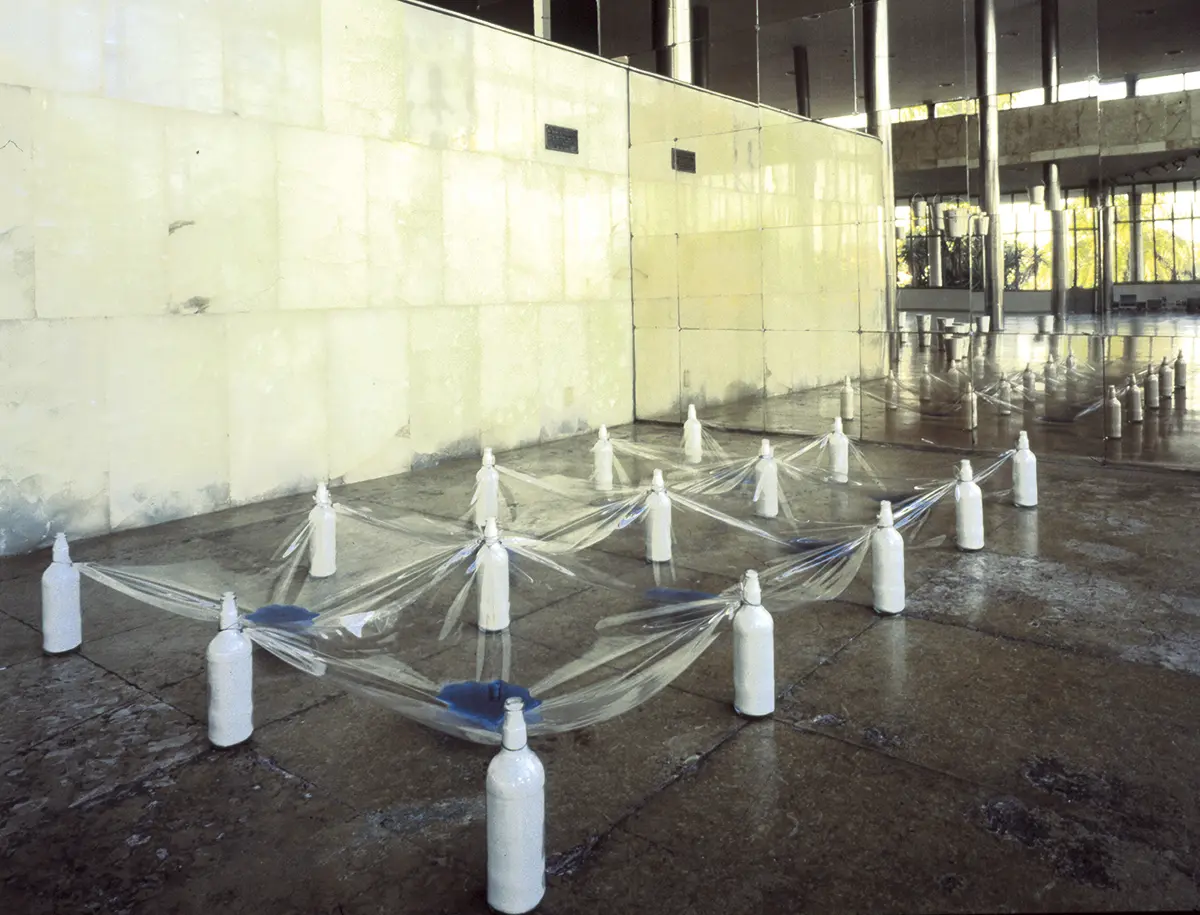
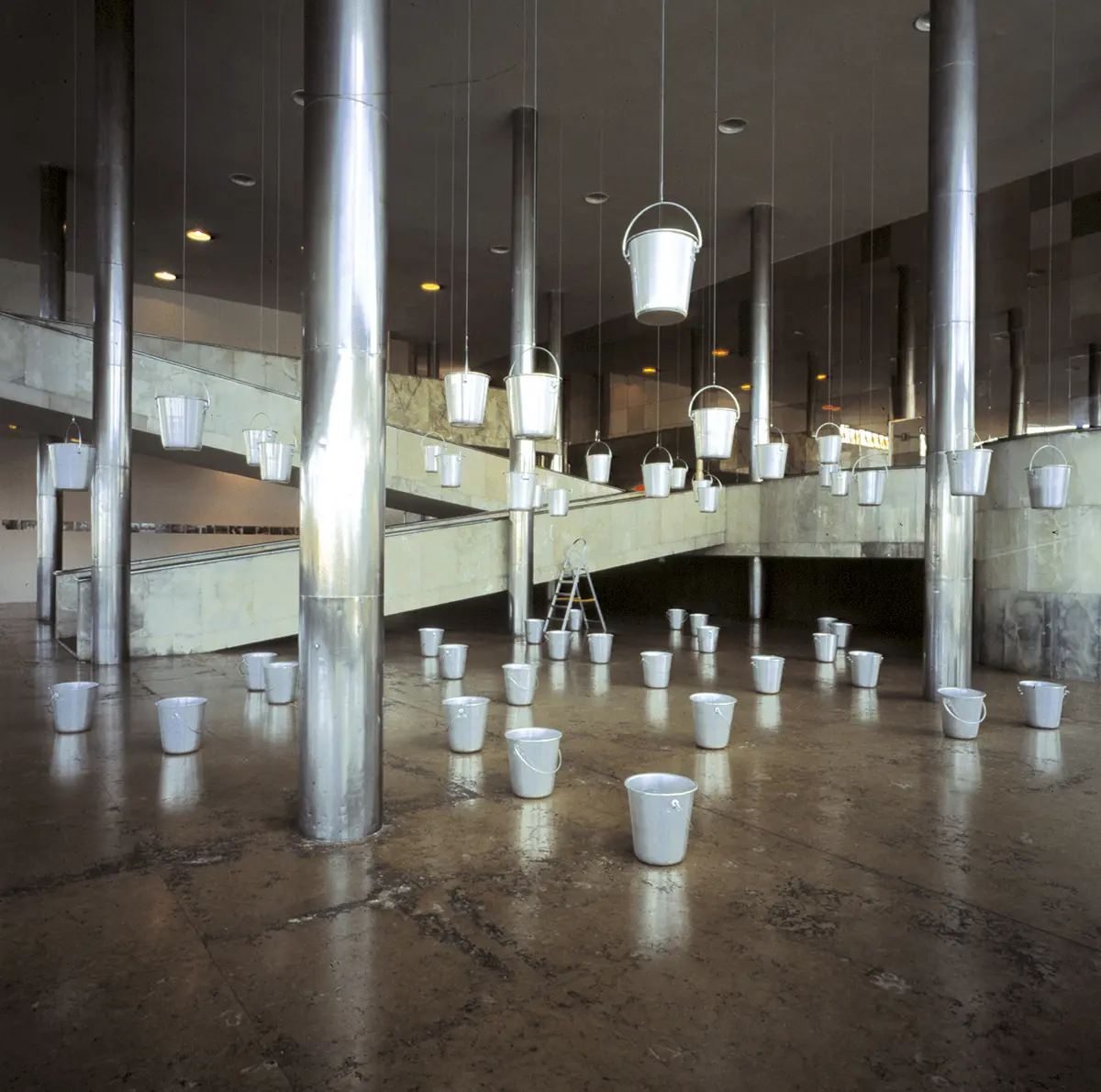
The four works directly related to water were displayed near the entrance of the Museum, and all of them allude to its geographic location and architectural context. Chove Chuva is composed of aluminum buckets hung from the ceiling and filled with water, simulating the not-uncommon precariousness of Brazilian rooftop construction and maintenance: water leakages, especially after storms. The buckets drip water until they empty and have to be filled again, thereby demanding continuous maintenance. An interesting dialogue was established between this work and the larger aluminum basins of Continente, placed inside the small lagoon in the Museum’s front garden. Their “activity” depended on the natural course of the weather as opposed to human interference. On the other hand, the sculptural structure Estudo para Lagoa, betrays a more formal awareness of internal and external topological spaces, as it echoes the shapes of both the Pampulha Lake and the grid of columns that supports the building.
There was a unique balance in this exhibition between concerns of the private and public spheres; whereas in previous works, the private and the public were often barely distinguishable (accounting for much of the works’ strength), this time the encounter is blunter, and the public also becomes a container or support for the private. If such a notion was explicit in Days Work (1998), exhibited at the XXIV São Paulo Bienal, where modules of self-adhesive tape attracted the dirt and dust of the surrounding atmosphere, in these new works the metaphor is diluted to come closer to the object of its meaning. That is, the distance between form and meaning has been reduced so that a third identity is extracted from this relationship. Such is the case with Calendário Achado (Julho) (Found Calendar [July]), for example. Here, both the printed bits of paper and receipts picked up from the streets, as well as the 31 aluminum tables, corresponding to each day of the month, where these scraps were displayed, function as public containers of private moments. Rivane seems to awaken the senses to inner life through the serial organization of random material signs, placed in a context akin to the experiences lived (and felt) daily by any person.
Love Lettering is perhaps the clearest example of this notion. Also, a collaborative work produced with scientist and fellow citizen Sérgio Neuenschwander, this 7-minute digital film brings us into the more nostalgic realm of the artist’s unfixed lifestyle. Over the last few years, Rivane has been between London, Texas, and Belo Horizonte, and this work reflects the fragmented consequence of a transitory life. She heightens this nostalgia but most importantly, re-contextualizes it within the history of the Casino-turned-Museum, by projecting the film inside the Museum’s dancehall. The translucent, illuminated glass floor sets the stage for a sensual cruise into the spectator’s heart. This journey is made sonorous through the beautifully choreographed fin flapping of redfish, oblivious to the words in a whiter paper attached to their tails with special surgical (harmless) glue. The softened primary colors that predominate on the screen and the email-type words isolated at the end of each fish’s tail—love, miss you, saudade, to, from—dancing in swerves of very slow-motion alongside both the music and silent pauses, were truly moving.
*All images illustrating this text are courtesy of Galería Fortes Vilaça, São Paulo, and Stephen Friedman Gallery, London.
VERÓNICA CORDEIRO
Artist and writer lives in São Paulo.