
In the history of art, there have been artists whose careers span a broad spectrum of artistic practice with an equal delving into a myriad of styles. Such diversity more often than not occurs early in an artist’s career, and indicates an exploratory zeal in the search for an artistic identity. Think of Picasso’s work leading up to that momentous date of 1907, the year Les Demoiselles d’Avignon was painted; or Duchamp’s early paintings culminating in the exquisite Nude Descending a Staircase of 1912, his abandonment of brush and canvas altogether, and subsequent paradigmatic shift to the readymade; or Rivera, before the Mexican Revolution in Paris, where he worked through a gamut of styles, some more successful than others. While the above-mentioned artists carved distinct, individual artistic niches and remained steadfast, other artists worked with a protean impulse against this tendency; one of these is the Brazilian artist Rubens Gerchman, as exemplified in his recent one-person exhibition titled Rubens Gerchman: Four Decades.
A contemporary of Hélio Oiticia, Gerchman emerged in the mid-1960s with a series of works influenced by North American Pop, French Lettrism to a degree, and Brazilian Concrete Poetry. Like other Latin American artists who engaged artistic tendencies from abroad, Gerchman’s work was highly differentiated from what was forming in North America. The differences between North and South American Pop were first noted by the Argentine critic Rafael Squirru in 1963: “The difference between artists in North and South America, [is that in] Latin America there is an extra-aesthetic accent present in the form of social and political commentary. In the United States, the accent is on the objects themselves.” The dissimilarities between North and South American Pop art, as articulated by Squirru, are evinced in one of Gerchman’s early works in the exhibition titled, Cartiera de Identidade, 1967, acrylic and silkscreen on paper.
Apart from the technique of silkscreen as the obvious formal link between Gerchman’s and Warhol’s painting, there is also a reference to Robert Indiana’s canonical Love painting with the appearance of the word vida in the right upper corner. Compositionally, this is in counterpoint to other words such as trabalho, and emigra, and a series of numbers alluding to a passport or some other type of government identification. These statements not only serve as the artist’s biographical markers, but also refer to Gerchman’s subtle infusion of the personal, and differ from Warhol’s desire for subjective distance through the process of silkscreen, where the artist’s hand is formally negated. Gerchman also employed textual strategies in the poem/object AR, 1967, a sculpture of the words for air, filled with cotton to signify clouds. Gerchman’s semiotic maneuvers are simple yet visually poetic and operate in registers that reside somewhere between the pictograph, the ideograph, and the logograph. Other works expand this semiotic modus operandi and provide evidence of an eclectic artist who has produced a prodigious body of work that traverses many styles. It is in Gerchman’s Homen a un Estrela Solitária, 1975, however, that his diverse formal and conceptual sensibilities seem to converge with a subversive, historical eye.
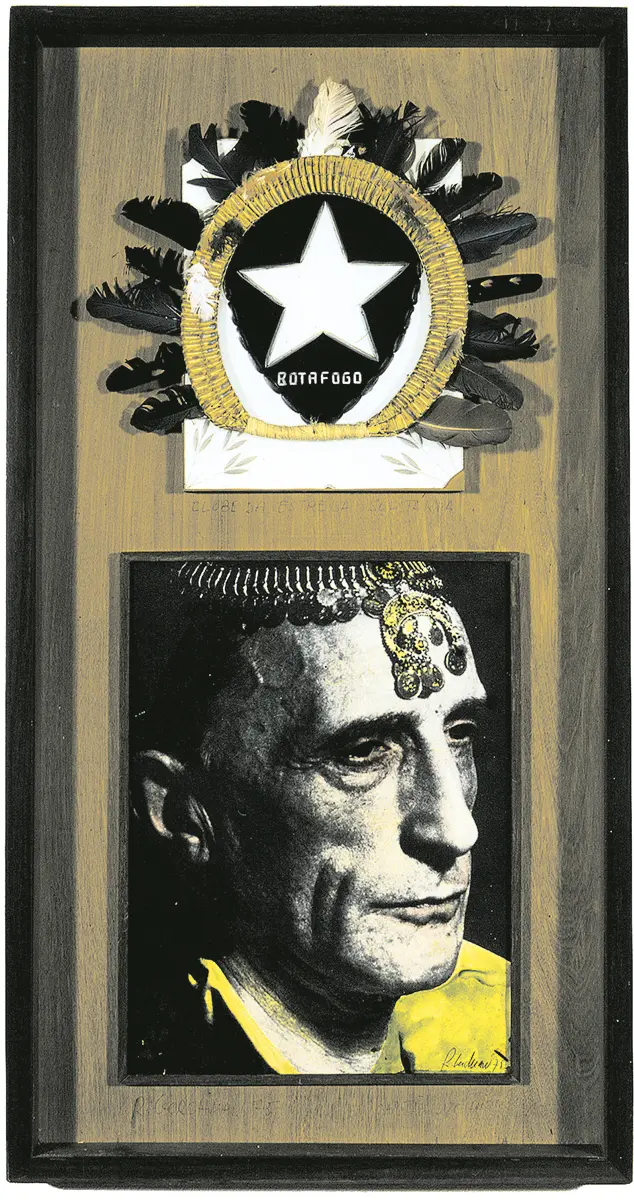
This two-dimensional, mixed-media work consists of a hand-colored photograph of Duchamp wearing some sort of kitschy headpiece. This is juxtaposed by an indigenous, feathered diadem with a star in the center, reminiscent of the famous Man Ray photograph of Duchamp’s head with the image of a star shaved on it. The colonialist subtext is quite clear, and the work is a testament to Gerchman’s poetic criticality. Overall, the exhibition was a good reintroduction to the work of an overlooked artist, though its presentation was slightly marred by a lack of organizational cohesion.
RAÚL ZAMUDIO