
It isn’t often that Galería Soledad Lorenzo veers its attention to artists who are outside the list of habitual guests. And it’s even less frequent when the artist is a foreigner, although it’s also true that Adriana Varejão’s work has enough fame and it’s in demand, so as to justify its inclusion —as a “collaboration”— in such a paradigmatic space.
For her second solo show in Spain (the first one was held in 1998, in this same gallery), Varejão has presented a series of works halfway between painting and sculpture, where she mixes two of the languages she resorts to most frequently: ceramic tiles and flesh. If before Varejão had worked in several installations where she included the motif of traditional Portuguese tiles, or had made genre paintings that hid behind their candor the muscles, blood, and entrails that they were made of, the ones she presents us today bet on the close relationship between both elements at the price of evidencing that they are strictly a pictorial representation, a trompe l’oeil. In these works, all is wood, cloth, oil, pure matter, and polyurethane flesh. The tiles have been painted skillfully on canvas or wood; even her repetitive decorations are far from the Portuguese tradition and are now bathroom tiles of any house or hotel. These images reproducing the paradigm of Western hygiene —clean, spotless bathrooms, like the ones found in any commercial for disinfectants or pine-scented oils— have been brutally fractured and lacerated to show us the flesh in its innards, a flesh that’s also juicy and opulent.
All the works, even those on the wall, acquire a special sculptoric quality, due to the thickness of their content, to the massiveness intrinsic in painting as part of the matter Varejão wants to convince us with.
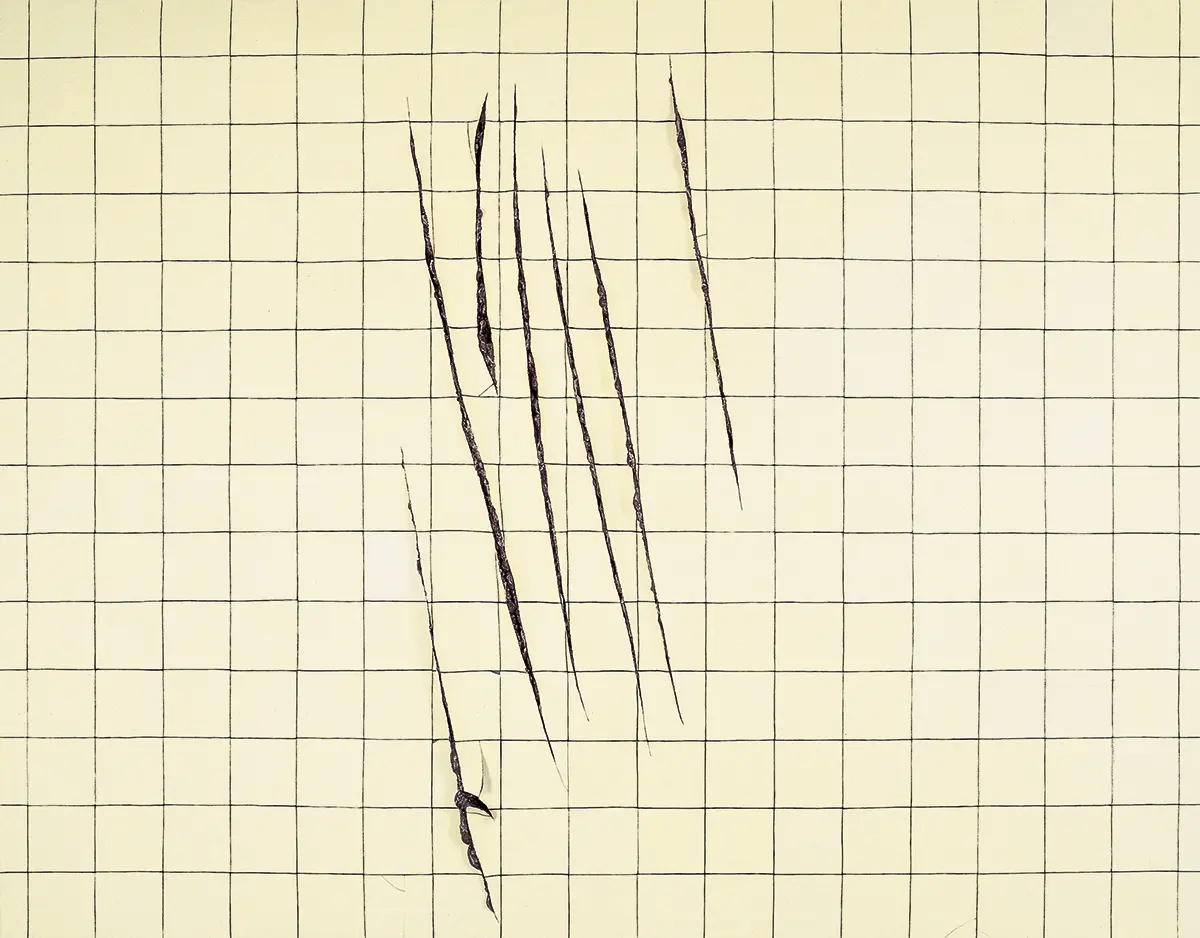
It seems like the artist has chosen consistently this metaphor of the body to comment on the old discussion in the pictorial tradition between body and mind, between abstract painting and matteric painting. What at the first moment functioned as an ironic marginal note, now seems to have taken a more intellectual turn toward the role of painting in contemporary art. Maybe that’s the reason why the exhibit’s most colorful paintings are the ones from the series Wall with Incisions à la Fontana. We have huge pieces of false yellow tile —a surprisingly minimalist tone for Varejão’s esthetics— that has been slashed in the manner of the Italian-Argentine artist. “Whereas Fontana, with a single slash, breaks the painting to transform it into sculpture, Varejão turns it into a body,” points out Gerardo Mosquera in the show’s catalog. “Where Fontana cuts, Varejão opens from the inside out.” The metaphor of “the painting’s flesh” is repeated. If Fontana showed us that behind the painting lies nothing, Varejão insists that there’s more paint behind it: effect, trick, trap.
The Happiness series closes the exhibit. It is a group of photographs in light boxes showing, once more, the theme of meat. This time she shows it as it is displayed for sale in a market. Pieces of beef, sausage, bacon, and other goodies are presented in the normal context of consumption, although there’s little discomfort in the images. In one of the photos, Varejão proposes that “happiness is acceptance without reality’s restrictions." In this case, it seems as if the photographed reality is less eloquent, not to mention effectist, than the trap of painting.
ISSA MARÍA BENÍTEZ DUEÑAS