
Ana Mendieta (1948-1985) is known for her early performance pieces, earth-body sculptures, and permanent sculptural objects produced from 1972 to 1985. She used her body or a measure of it to create an extensive corpus of work that was executed in nature, performative in character, rich in process, and multilayered in content. Her work consistently drew on sources as diverse as autobiography, transcultural myths, Catholic subjects, and Western and non-Western art, archaeology, and everyday life. Mendieta explored the shifting boundaries of several emerging genres: performance, body art, and installation art. Her work has contributed significantly to the art history of her time when performative actions were primary constituents of artistic practice.
Although a good deal has recently been written about Mendieta, her early artistic development at the University of Iowa is relatively unknown.1 This article highlights some of the artist’s early directions and experiments to better understand her subsequent work. Key moments in this developing formative stage extend from the fall of 1970, when Mendieta did her first performance work with Robert Wilson, through the spring and summer of 1974, when she executed her first body tracks, silhouette, and earth-body work. During those four years, Mendieta slowly shifted her practice from painting to multimedia/intermedia. She thrived in an atmosphere that encouraged experimentation, daring, and trial by error. Within four years, the emerging artist defined many of the parameters of her practice, created a language with which to express an art-life dialogue, and embraced the interdisciplinary aspects of performance. In establishing her artistic voice, Mendieta found the challenges of working outdoors in unusual places and situations most suitable to her serendipitous personality.
Mendieta’s conceptual shift from a graduate student in painting to multimedia began, perhaps unwittingly, in the fall of 1970 at the beginning of the academic year. She was introduced to two new programs—the Center for New Performing Art (CNPA) and the Multimedia Program—both of which had a lasting impact on her future development. Mendieta first became acquainted with the experimental programs through Hans Breder, who was a co-founder of the CNPA and the founder and director of the Multimedia Program.2 The CNPA initiated a singularly innovative interdisciplinary arts program that worked with faculty and students from Art (mostly Breder’s Multimedia Program), Creative Writing, Dance, Film and Television, Music, and Theater participated.3 Although Mendieta (who was Breder’s lover at that time) was never a CNPA fellow, she participated in many programs that were organized by Breder with students from his multimedia and intermedia classes.
The multimedia courses were oriented toward the production of nontraditional art objects and site-specific installation work. Students explored the uses of new media—including styrofoam, Plexiglas, and polyester—in combination with more conventional ones, producing innovative works such as Plexiglas constructions, structured canvas, painted sculpture, and light projection on sculpture. Students thus had the opportunity to create new art forms as extensions of painting and sculpture. Intermedia students came from different areas of studio art (painting, sculpture, photography), dance, theater, writing, music, and film. Students in those classes attempted to integrate aspects of their individual disciplines into the development of more conceptually oriented forms of expression, especially body art.
In the fall of 1970 Robert Wilson, the first artist in residence invited by the CNPA, produced Deafman Glance. The twenty-seven-year-old visionary director-writer gathered together a group of faculty, students (including Mendieta), Iowa City residents, and a few performers from New York City to create an experiential production that fused art and life. Wilson taught body movement and body awareness every day in a noncredit workshop that was attended by many of Breder’s intermedia and multimedia students. The workshop sessions became rehearsals for Deafman Glance and for Handbill, a second work he created during that semester. Mendieta was among the many students who trained throughout the fall in dance, movement, improvisation, and acting. During those months of intensive rehearsals, she internalized a host of lessons gleaned from Wilson’s intermedia performances that she incorporated into her later conceptual work.
In addition to Mendieta’s performances in Wilson’s two productions in the fall of 1970, she also began modeling for Breder’s body sculptures, something she did for several years from time to time. Her collaboration in his early ephemeral bodywork (documented on video) was her earliest participation in an art form that explored the body as sculptural material. The following spring, while Mendieta was painting and drawing in an expressionistic figurative style, she attended a series of workshops given by Willoughby Sharp, editor of Avalanche, an art magazine that heralded the new trends in bodywork.4 In Sharp’s lectures he showed slides, films, and videos of a group of conceptual artists, including Bruce Nauman, Dennis Oppenheim, Vito Acconci, and William Wegman, all of whom were just beginning to attract critical attention.

Mendieta came to a crossroads in her graduate career the following fall (1971) when she completed the studio work for her M.A. and began her first class in multimedia. Her final series of paintings and drawings were abstract images that responded very specifically to the Mesoamerican sources she had come to know firsthand in her Field Research in Archaeology course in San Juan Teotihuacán, Mexico.5 Mendieta’s multimedia work indicates her recent interest in abstraction as well as her willingness to experiment with foam instead of with the brush and canvas. Although she exhibited the “foam sculptures” in the student union toward the end of that term, she decided to abandon traditional as well as nontraditional painting and to pursue instead an M.F.A. in the Multimedia area.
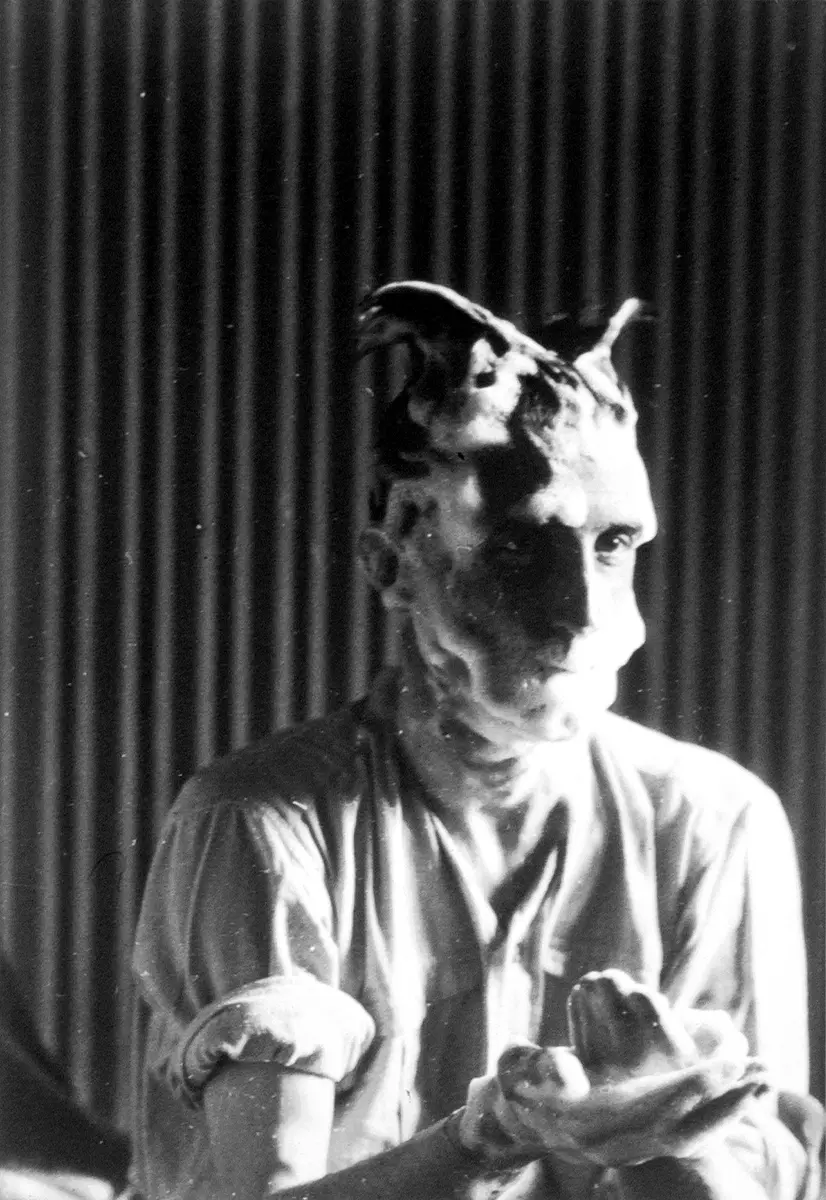
Thus she immersed herself in Breder’s classes for the next several years, producing a new body of work that explored the possibilities for identity change, remapping, reconfiguring, and re-presenting her physiognomy in different places and in response to diverse stimuli. In several performance-oriented pieces, she transformed her facial features, thereby recreating transgressive self-portraits. Some of the work responded to Marcel Duchamp’s performance pieces; others to specific works by contemporary artists, who in turn maintained a conversation with Duchamp. Mendieta’s dialogue with Duchamp is especially evident in Facial Cosmetic Variations (my descriptively titled Self-Portraits with Suds in Hair), a work that recalls Marcel Duchamp with Shaving Lather, a study for Monte Carlo Bond.6 In the 1924 shot, Man Ray photographed his friend Marcel Duchamp with shampoo in his hair and on his face.7 Mendieta’s theatrical reenactment of Duchamp’s performative piece features five 35mm color slides. In one of the shots, her hair is twisted in front of her forehead; in another, it is twisted on top of her head; in yet two others, her hair forms a weblike mass over her face.
Mendieta’s diverse facial distortions and masquerades are among the earliest examples of the artist’s excursions into body art. They were exercises grounded in the contemporary notions taking hold at the time of temporality, liminality, shifting identities, and sexuality, ideas that have continued to be explored by subsequent generations of artists. Mendieta’s Facial Cosmetic Variations (Self-Portraits with Suds in Hair) now prompt us to think of Janine Antoni’s Loving Care, 1992-1995. Antoni imitates everyday body rituals, replacing the artists’ traditional tools with her teeth, mouth, hair, and eyelashes. In the performance Loving Care, the artist mopped the gallery floor with her dye-soaked hair, conjuring images of the painting.
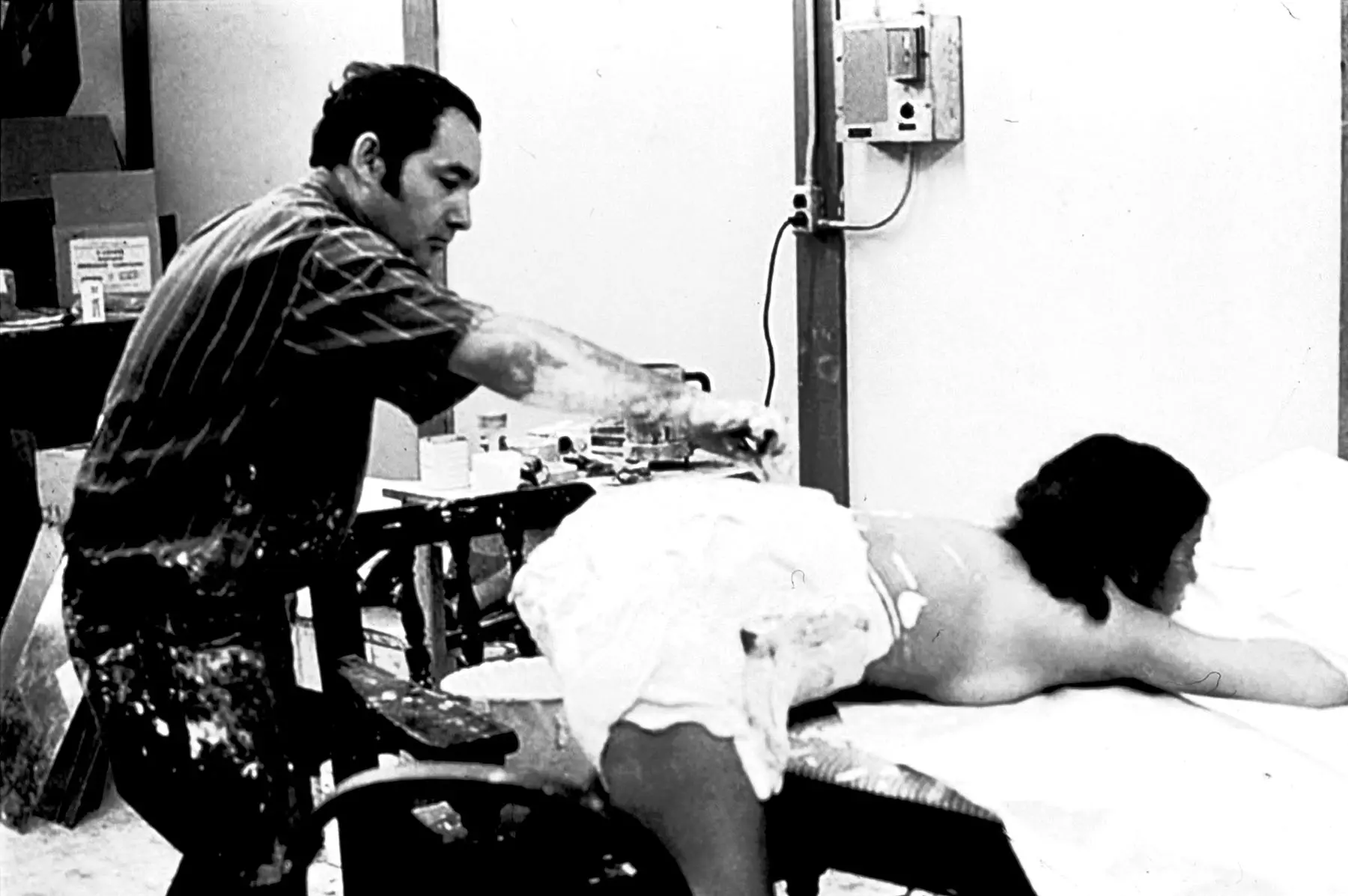
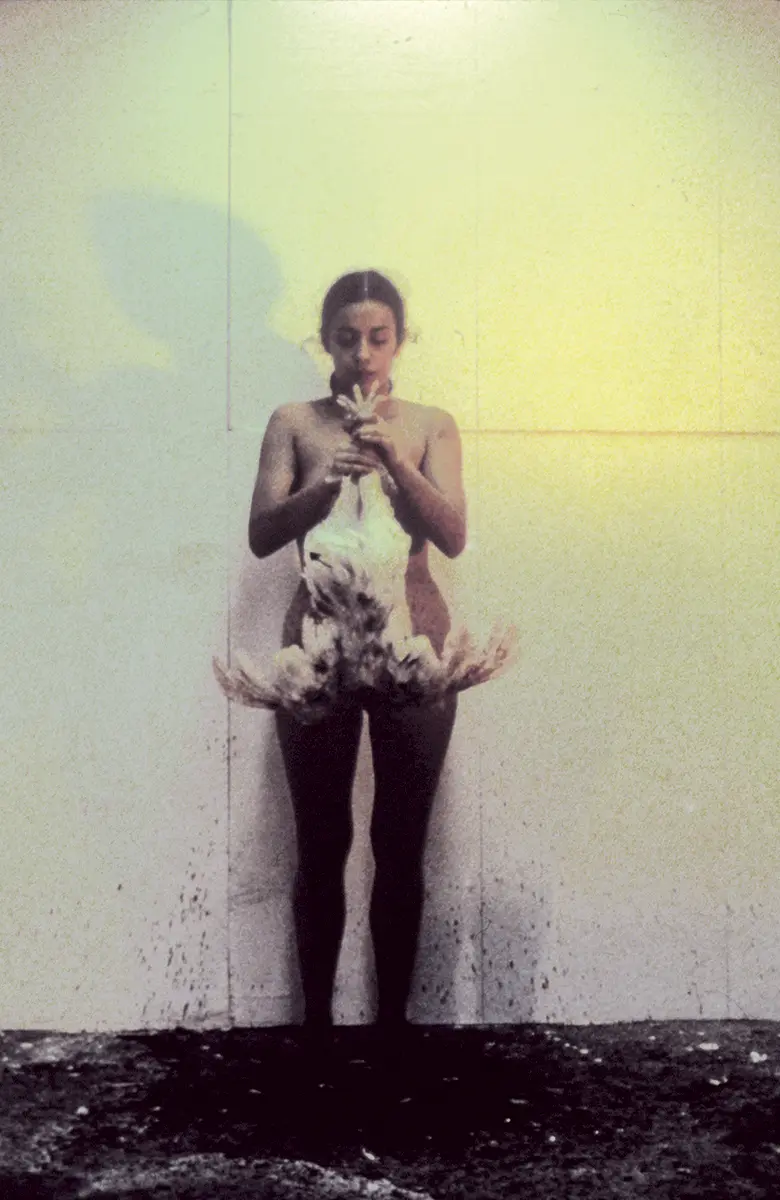
During this highly experimental period, Mendieta cast a broad net in considering both modernist and contemporary art historical sources. Chicken Piece, a now iconic work from this early period, illustrates this point. The short performance in the multimedia studio in front of her peers featured the artist holding a decapitated chicken in front of her body while its blood-spattered her as well as the surrounding area. At the end of the piece, which was captured in filmic and photographic documentation, her body resembled a surface similar to that of a Pollock canvas covered with splashes and squirts of paint. A number of Mendieta’s fellow students still recall having seen the piece or having heard about it afterward, for it was considered daring and dramatic. Although it was fairly common to perform in the nude in the Multimedia studio, it was not commonplace to present a work in which a live animal was killed and its blood used to cover the surface of a human body as if in expressionistic abandon. Chicken Piece is also significant because it was the first of Mendieta’s works to feature blood as well as to impart a ritualistic connotation. What instigated Mendieta’s use of blood and animals in performance? There seem to be several sources: a visiting CNPA artist had done an elaborate site-specific installation using cow’s blood (1970), and several graduate students had used a dead pigeon in a CNPA performance (1971). While these formal and conceptual directions may have given Mendieta food for thought, it was the ritualistic performances of the Viennese Actionists who most directly inspired Mendieta’s action.
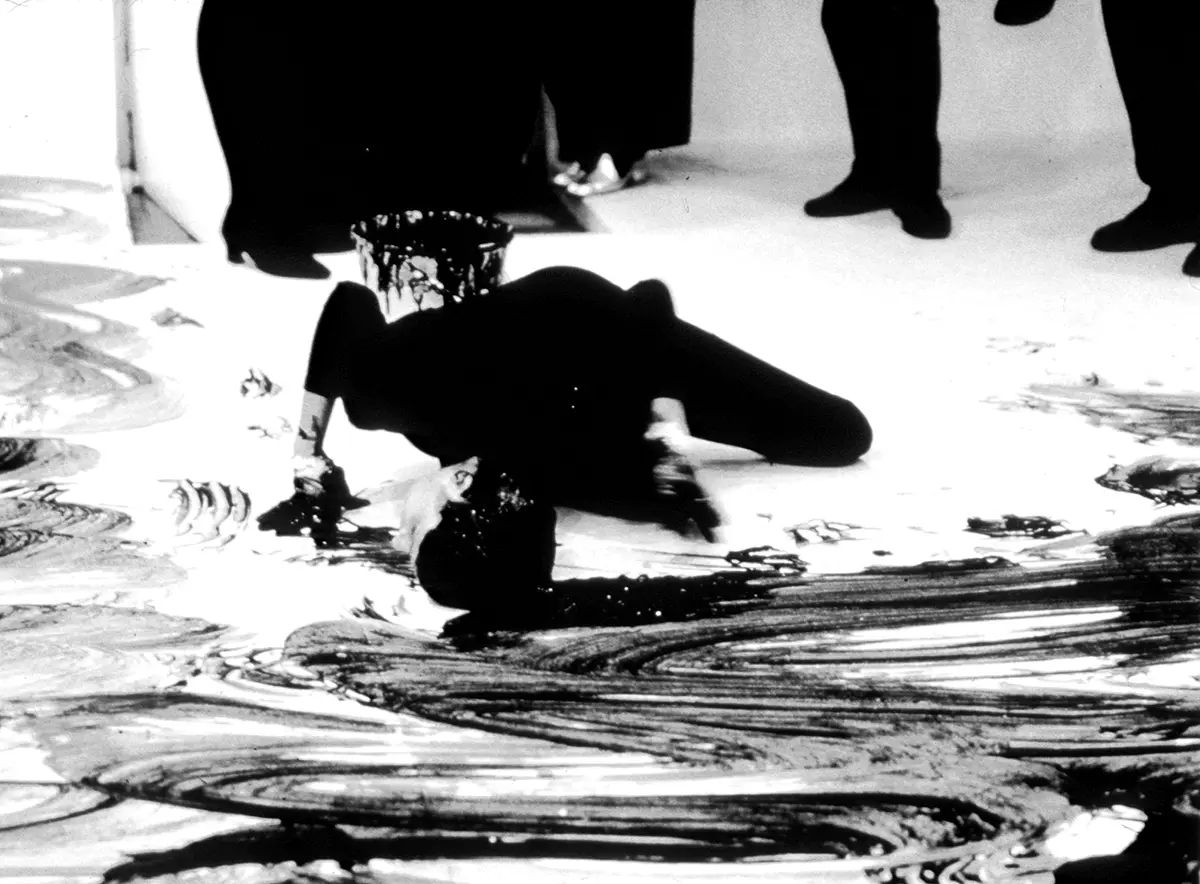
Mendieta learned about the Viennese Actionists through Breder, who showed his multimedia students a German book describing and illustrating some of the early performances of Hermann Nitsch, Gunter Brus, and Rudolf Schwarzkogler, radical artists who used blood and animals in their actions.8 Mendieta seems to have been interested in specific aspects of Nitsch’s 31st Action (Mary’s Conception), 1969, and Schwarzkogler’s Chicken Action. Although Mendieta’s performance drew on ritual and the use of a slain animal, she did not explore the pornographic, sadomasochistic, or virulently anti-Catholic rhetoric of Nitsch and Schwarzkogler’s work. In her hands, Chicken Piece imparted a distinctly individualistic resonance, incorporating minimalist body movements that would mark her subsequent work both in live performative pieces as well as in body landscape work.
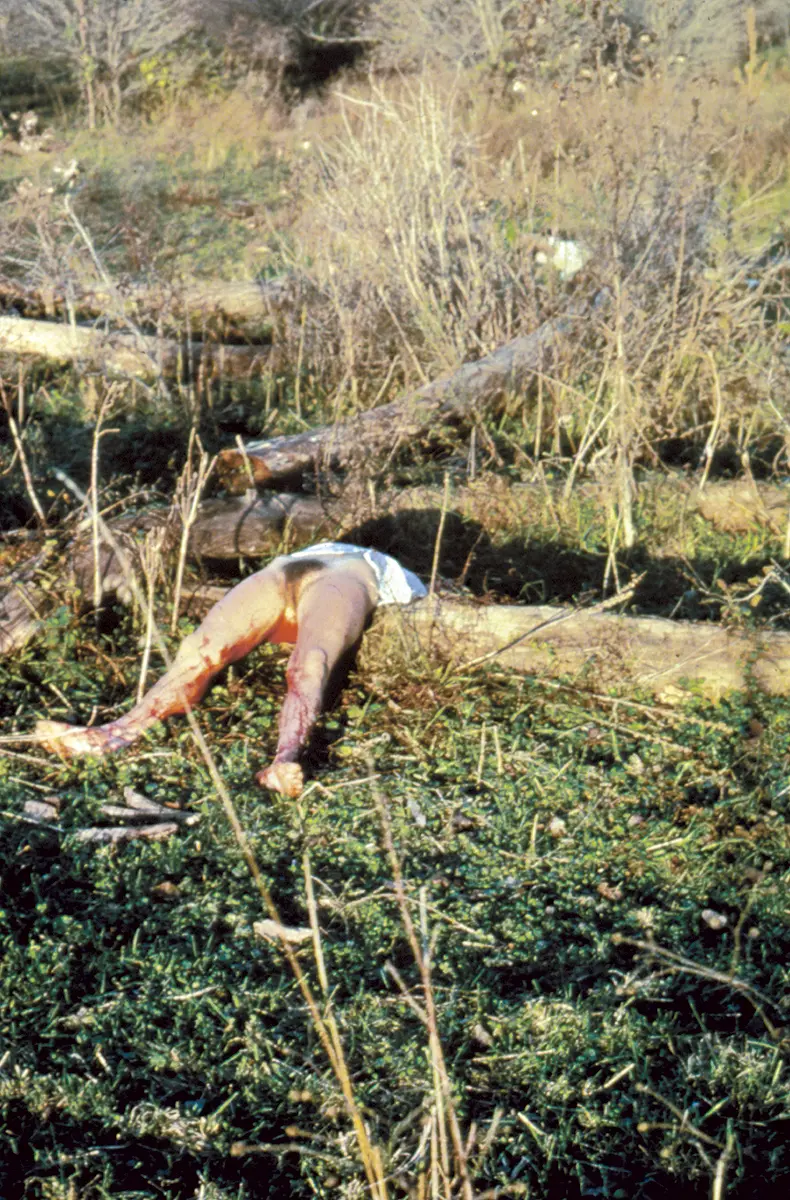
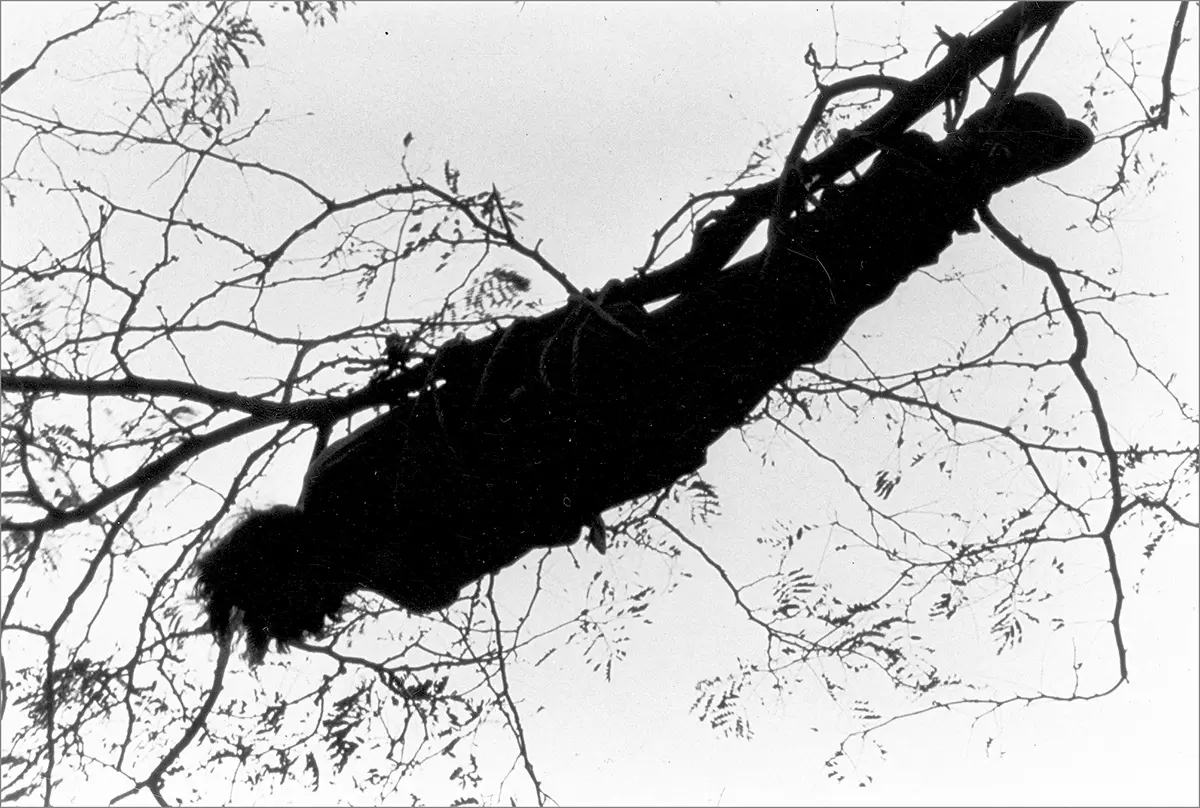
Throughout 1973 Mendieta explored two very different subjects. In Iowa, she addressed a campus rape-murder in a year-long series of installations and performances.9 In Oaxaca, Mexico, she did body pieces in archaeological monuments exploring Mesoamerican as well as Colonial Catholic beliefs. The series of works on the subject of violence and rape were produced both in public and in private. They included a performance in the artist’s apartment, where Mendieta staged the aftermath of a rape. When members of the Intermedia class entered the apartment, they found the artist tied to a table half nude, bloodied, and motionless. She remained that way for the duration of the performance. Mendieta also did a private performance of the rape-murder in a wooded area that no one witnessed. Equally self-engaged, intense, and confrontational, she performed the drama / tableau before the camera’s lens. She had parts of her body photographed as a police detective would have done when coming to the scene of a crime. Thus there were shots of her head, hands, and legs, and a very shocking one of her body in a spread-eagle fashion. If the thirty-six slides were printed in order, the spectator would sense the overwhelming emotion of discovering a horrendous crime. Upon further reflection, one is struck at hoWQw the view or position of the woman’s body (i.e., Mendieta’s) illustrated here depends on Duchamp’s view of the naked woman through a peephole in Étant donné. In a different context and in response to a different set of circumstances, Mendieta seems to be acknowledging Duchamp, whose work she admired for years.10 In addition to those two tableaux, another piece featured bloody clothes and bones strewn in an alleyway, suggesting the aftermath of a crime. Another piece contained references to the discarded evidence of a crime: a suitcase containing bloodied objects that Mendieta placed in a rock crevice in a public park. Both works depended upon the reactions of passersby to discover the objects and then figure out their meaning. Several of Mendieta’s peers were doing bodywork that was located in unusual places or that required the spectator to happen upon it, as if in a mystery. Charles Ray, for example, was in the multimedia class, when he did a body sculpture in which he was wrapped in rope and suspended from a tree on campus. He hung from the branches for several hours while some passersby discovered him. Ray’s piece had nothing to do with the problematic subject of rape; it was more an experiential piece that pushed the limits of the body as a sculptural site. Mendieta’s sensitive treatment of rape, however, remains a paradigm for contemporary artists such as Sue Coe and Cindy Sherman, who have subsequently explored this theme in their work.
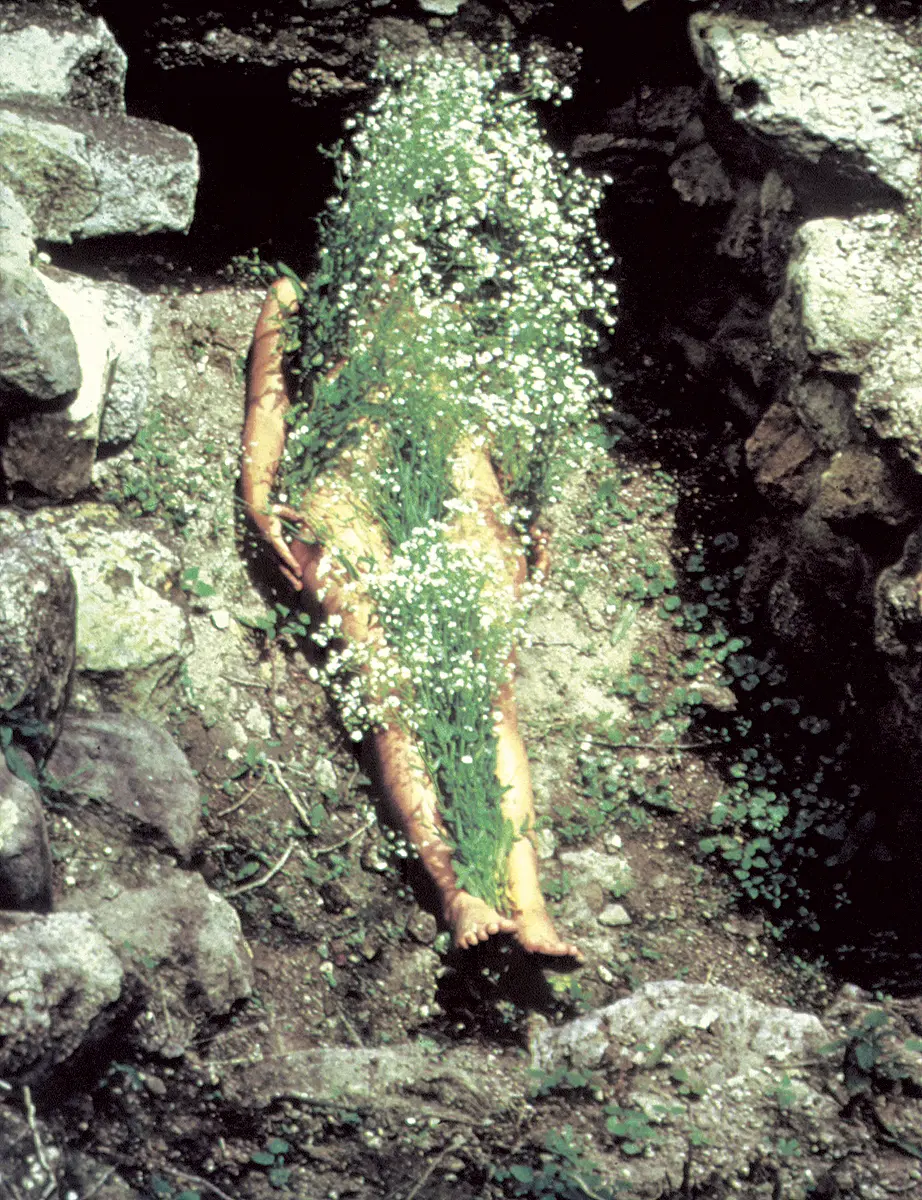
In the summer of 1973, Mendieta traveled to Oaxaca, Mexico with Breder and a small group of his Multimedia II students. Although she was already familiar with Mexican archaeology, mythology, and culture, she found Oaxaca a special place that exuded a sense of magic and religious aura reminding her of Cuba. She responded to the spiritual environment there by doing work relating to her interests in Precolumbian history as well as to her Roman Catholic background. Both Mendieta and Breder were interested in Oaxacan graveyards. Although Breder did a “tomb piece” with a model in a graveyard outside the town of Oaxaca, Mendieta had a different idea in mind, choosing a shallow grave near the archaeological site of Yagul. She lay nude in that grave with her arms down at her sides; Breder placed white flowers—purchased in a market—over her head, neck, chest, and the middle area of her torso and legs. He then photographed her from different angles while two students stood guard to warn her if anyone approached. Mendieta’s body symbolized the physical and cultural remains that marked the Oaxacan landscape. Her use of flowers on her body functioned as a sign of life. Through the syncretistic blending of symbols of life and death, Mendieta reenacts a Precolumbian belief that the soul or life force lives on in the afterlife. The artist’s Imagen de Yagul (Image from Yagul) represents an attempt to rechannel an ancient Mesoamerican belief through her contemporary body piece. She established her own connections with Precolumbian culture in her body performances similar to what she had attempted to do in her paintings of 1970-1972. Imagen de Yagul, however, was a pivotal piece: it looked back on earlier painterly directions and forward to conceptual work that would explore Precolumbian art and history for the remainder of her life.11
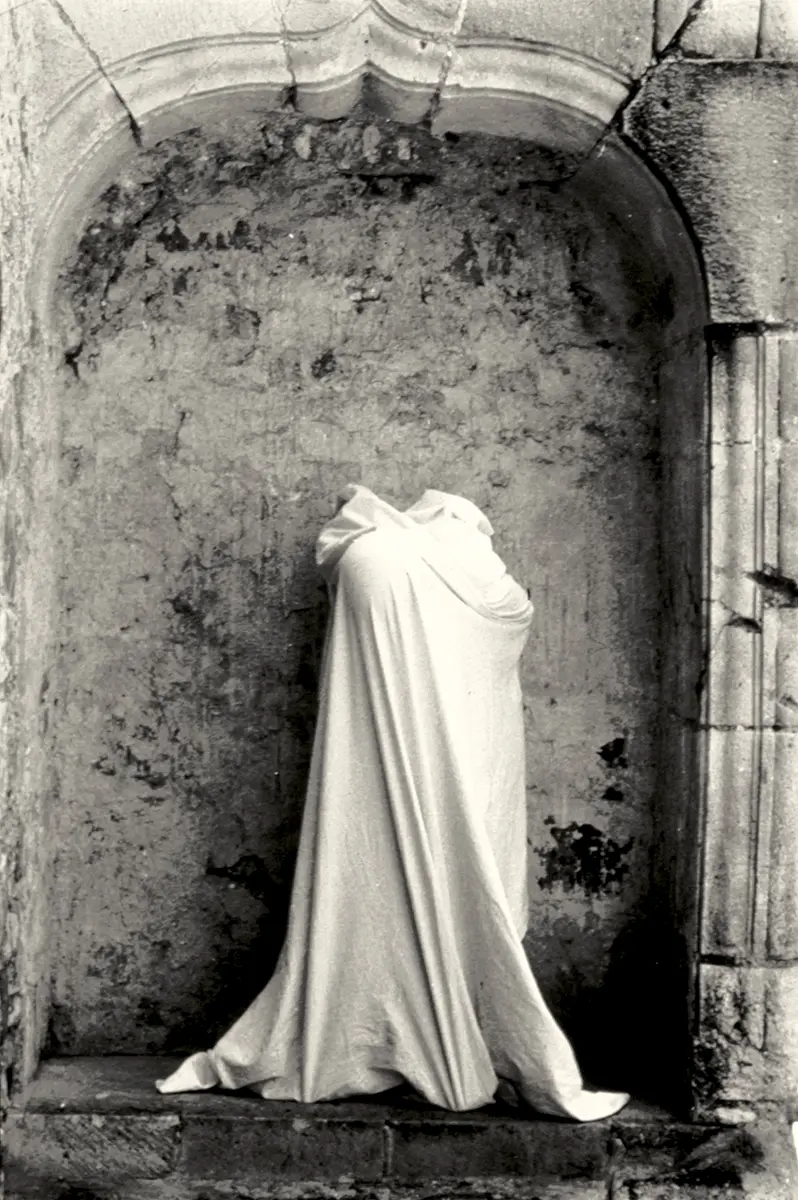
Aside from Mendieta’s interest in working in and around archaeological sites, she found equally compelling the idea of working in the sixteenth-century Dominican church complex in the village of Cuilapan, outside Oaxaca. The church complex, built over a Zapotec temple, is a national monument consisting of a church still in use, a monastery no longer in use, and an unfinished open-air chapel. Mendieta did a series of untitled works in a niche in the open-air courtyard of the church —the first of many over the next several years. In my descriptively titled “Body sculpture of the artist in a niche,” Mendieta covered herself with a bedsheet and posed in six different positions photographed by Breder. Her starting point for this religious body piece was the statues of holy figures—Christ, Mary, the saints, and angels—customarily draped in dark purple or black in Catholic churches during Holy Week. Impressed by the heightened display of religious emotion that she sensed in Oaxacan churches, Mendieta responded by creating a body sculpture that drew on Lenten traditions as well as her improvisational dance training in Wilson’s workshops (1970) and more recently in Elaine Summers’s dance and intermedia programs (spring 1973). Mendieta had developed a liminal language to bridge art and life by adapting sacred and secular forms in her performative bodywork.
By fall 1973 Mendieta had completed most of her required courses.12 However, she remained enrolled in the program for several years because it provided her with a larger artistic milieu, including the use of the multimedia studio where she often executed and presented her work to peers. In November 1973, Mendieta directed Freeze, a movement piece with fifth and sixth-grade children from one of her art classes at the Sabin school, as part of a CNPA performance. The idea for using students in a performance event no doubt came from Wil–son’s performances of Handbill and Deafman Glance in which he filled most of the roles with university students. In Mendieta’s piece, she periodically called out, “Freeze.” On command,d each child stopped and held his or her position for a brief time without moving. One of the ideas behind the piece was to capture a series of natural body movements while communicating the notion of the body as a sculptural form.
In her announcement for Freeze, Mendieta stated: “Time passing and change are undeniable aspects of the world around us. For the artist of our day, time has an increasingly higher dignity. Often artistic creation results in the production of art objects. However when a concern for time is primary, an experience, not an object may result. The 5th and 6th graders from Henry Sabin School participated in the creation of such an experience. Though the participants were young, the art ideas were not diluted.”
Mendieta summarized her ideas on art by suggesting that conventional definitions of art were being redefined, that art was not necessarily limited to the production of a static object but could be perceived as the experience itself. Thus Mendieta set forth her conceptual approach to artmaking—that time, process, and ephemerality are elements of artistic creation.13 The artist’s formative period—one which produced hallmark pieces—had come full circle.
Within the span of a few months, Mendieta performed Blood Sign #2, one of the first pieces in which the artist traced her outline in blood with her hands and arms to register the body’s afterimage. Within a couple of months, the artist further elaborated that action in Labyrinth Blood Imprint on the floor of the Palace of the Six Patios in Yagul. She had her silhouette traced with her arms outstretched and uplifted, creating a motif that would soon attract critical feminist attention. Also at Yagul, Mendieta did her first earth-body-work, Burial Pyramid, in which she slowly emerged from under the rocks while the camera filmed the short performance. She exhibited the kind of bravado that had made Chicken Piece and Rape so memorable. Within four years, Mendieta had discovered a personal idiom to embrace body sculpture, performance, and small-scale earthwork. She had begun to explore new terrains.
*In June of 2004, the exhibition, Earth/Body, Ana Mendieta, Sculpture and Performance 1972-1985, organized by Olga Viso will be presented at the Whitney Museum and will then travel to the Hirshhorn Museum and Sculpture Garden in Washington, DC., in September.
NOTES
1. The author’s doctoral dissertation, “Ana Mendieta: The Iowa Years, A Critical Study, 1969 through 1977” (The City University of New York, 1998) examines Mendieta’s early and middle production in Iowa, Mexico, and New York during the years she attended the University of Iowa, worked as an art teacher, and established herself as an artist.
2. Breder initiated a course called Intermedia in the Art Department in 1968. When it became an official degree program in the fall of 1970, he changed the name to the Multimedia Program, which offered courses in Multimedia I, II, and Intermedia, leading to M.A. and M.F.A. degrees. In 1994 the program was renamed the Intermedia and Video Program.
3. Funded by a five-year grant from the Rockefeller Foundation, the CNPA was formed as a unit within the College of Liberal Arts. It developed an extensive visiting artist program that included people in the arts from all over the country, established resident ensembles, provided laboratory-studio spaces for experimentation and performance, and presented productions in Iowa and throughout the United States.
4. For this seminal article, see Willoughby Sharp, “Body Works,” Avalanche (Fall 1970): 14-17.
5. Mendieta shot several slides of the Atlantean figures from Tula when she visited the archaeological site with Professor Thomas Charlton’s class in summer of 1971. That type of colossal monument, columnar in shape, is the source for the abstract idol image in the two paintings “Idol I” and “Idol II,” executed the following fall. For an analysis of the artist’s previously unidentified paintings, see Herzberg, “Ana Mendieta: The Iowa Years,” chap. 2.
6. Mendieta’s Facial Cosmetic Variations (“Self-Portraits with Suds in Hair”) were not published in her lifetime, but have come to recent critical attention because they were reproduced in the exhibition catalog Ana Mendieta (Galicia, Spain: Centro Gallego de Arte Contemporánea, 1996).
7. Monte Carlo Bond, 1924, is reproduced in Arturo Schwarz, Complete Works of Marcel Duchamp (New York: Harry Abrams, 1969), no. 280, p. 490. Mendieta as well as other students often consulted Schwarz’s book when attempting to inhabit the skin, so to speak, of Duchamp. Mendieta both quoted and paraphrased Schwarz in her “Thesis Statement” for Self-Portraits produced for her M.A. in the spring of 1972.
8. See Peter Gorsen’s “Zur Ästhetik der Aggression” in Sexuälsthetik zur Bürgenlichen Rezeption von Obszönität und Pornographie (Hamburg: Rowholt, 1972).
9. A nursing student was killed by another student in a bedroom in the coed dormitory in March 1973. For some two years the story of the young woman’s death, followed by the perpetrator’s subsequent trial and release, was reported in the media throughout the state.
10. I recently realized the basis for the conceptual point of departure when looking again at Étant donné at the Philadelphia Museum of Art. In sharing my views with Ricardo Viera, director and curator of the Lehigh University Art Galleries, he remarked that Mendieta often spoke to him in later years about her admiration for Duchamp as a key innovator of 20th-century art. [OK]
11. Imagen de Yagul (Image from Yagul) was the title of her piece in her M.F.A. thesis granted in June 1977. At some later date, Mendieta descriptively titled the piece Flowers on Body. In subsequent years, the artist also came to view this work as her first silueta.
12. Mendieta completed her independent study in the spring of 1976 and the M.F.A. thesis in the fall of 1977.
13. Mendieta’s announcement came to my attention thanks to Bill Rowley, who had kept it in his files all these years.
JULIA P. HERZBERG
Ph.D. art historian and curator, who has written about and curated exhibitions of work by contemporary Latin American and Latino artists.