
Betsabeé Romero has long made the automobile a focus of her work and her recent pieces evolve ingeniously from this tradition. Car components take center stage and Romero’s famous car, enlivened with unexpected tones and textures, appears in color-drenched photographs. In Urban Monster, 2001, a brilliant green, Mexico City taxi whooshes behind a smaller psychedelic, blue-green Mercedes covered from head to taillight with cactus thorns. The luxury sedan is filled with Romero’s typical mélange of dried roses, their pale hues, and their implied delicate scent contrasting with the spiky pelt of thorns and the exhaust-drenched setting enclosing them. She took the photograph at street level, providing an intimate view of the spiny car and the ferocious color and speed of the taxi zooming behind it.
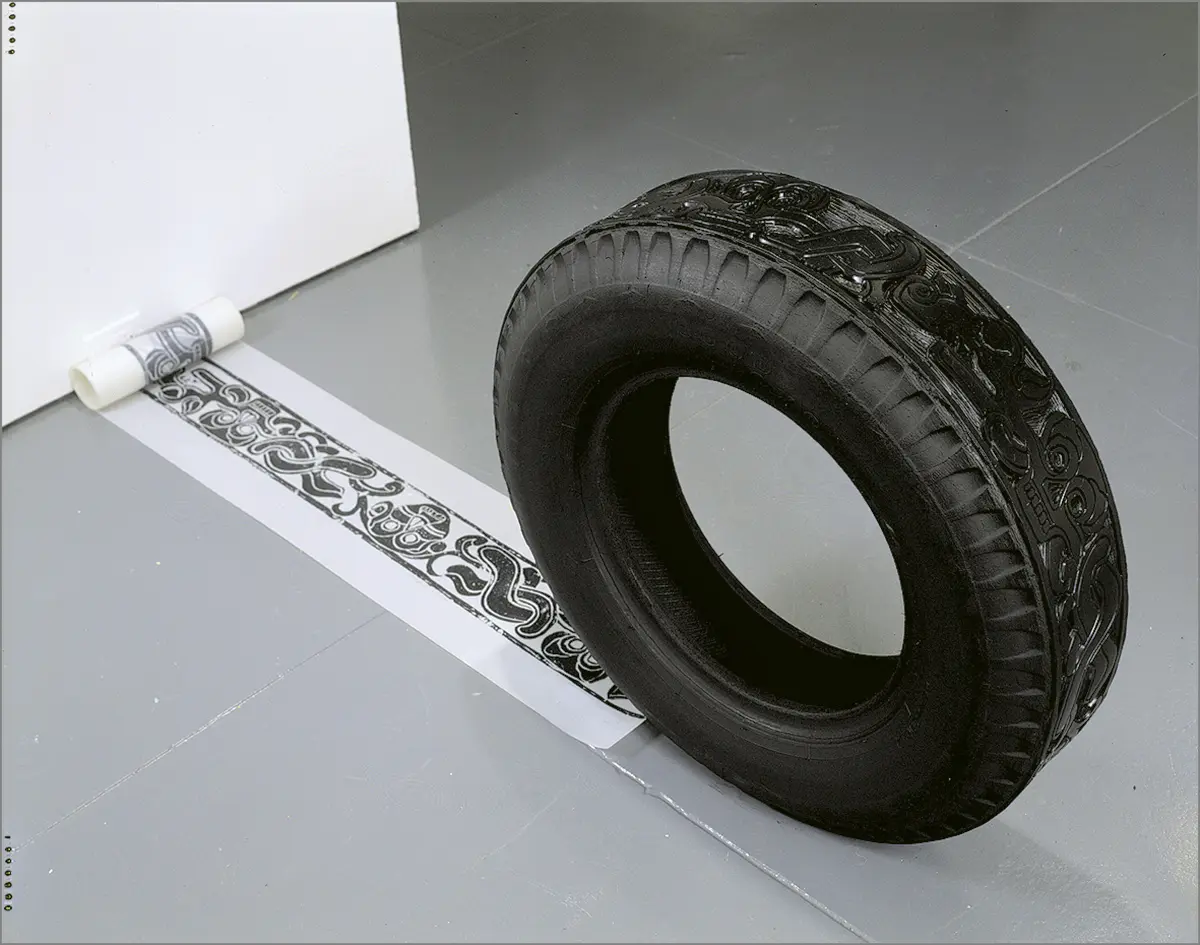
Mexico’s visual, cultural, and contemporary traditions figure prominently in Romero’s work. She employed these to particular advantage in this show with her extraordinary tire pieces. The Mexican-born artist carved the rubber tread of automobile tires into the type of simple but engaging figures and curvilinear designs found on pre-Colombian temple friezes or carved wooden furniture. In Pre-Colombian Archaeology (Aztec), 2002, a wondrous line of skulls with animals and curving lines between them recalls a temple frieze at Palenque or the pictographs found in the sacred texts of Mayan codices. The tire stands on the floor with a narrow scroll of paper unrolled from beneath it; the paper bears a print created by the impression of the carved rubber.
Another tire piece, Pre-Columbian Archaeology (Ball Game), 2002, hangs perpendicular to the wall, its tread carved like a rope with grooves reminiscent of a woodblock print. Installed jutting out from the wall, the tire deliberately recalls the hanging circle through which a ball must pass in the deadly Mayan ballgame performed in the ball courts found in ancient sites such as Chichén Itzá.
In Pedestrian with Cart, 2002, Romero carved a weighty, construction-crane tire with the engaging image of a man pushing a dolly laden with unwieldy, burlap sacks. She printed the impression of this figure on 192 small red, yellow, and white foam tiles and arranged them in a wall mosaic behind the enormous tire. The repeated pattern of the man struggling with his burden is viewed as if the crane tire had been rolled over and over the squares of foam.
Romero’s ingenious and well-conceived works culminate in the exhibition’s highlight, Volkswagen Tire, 2002. This tire lies flat upon a low platform and appears to be another rubber car part, but one without the lively carvings etched into the tread. On the wall before it, the viewer’s eye is drawn by comparison to Archaeology of a Freeway, 2001, in which a myriad of rectangular tire tread patches hang together creating a textural relief, each tread contrasting sharply with the pieces above, and below, and beside it. The tread of Volkswagen Tire resembles several of the hanging patches, but its surface bears a subtle sheen; one gradually realizes it has been created from rich, black Oaxacan clay. Romero has not only employed the motifs of traditional Mexican art but has appropriated an age-old medium as well. The tire, an inherently moveable component becomes, in clay, a rarefied object of fragile substance for exhibition. This unexpected quality epitomizes Romero’s project: she takes the car out of context while simultaneously reinforcing the many levels of its influence in our lives.
MARY SCHNEIDER ENRÍQUEZ