
Carmen Rita Pérez/Arte Actual Gallery confirms the high standard it has set for itself with this new exhibition of paintings on canvas, and a portfolio of those same works transferred to serigraphy, by Bismarck Victoria. Also, a strong sculpture, previously shown at the Art Center opening, joins the collection.
Attesting to the coherence in the evolution of an artist whose career one has followed over the years is particularly gratifying for any art critic, especially in the case of an artist who, within a certain fidelity to the original plastic ideas, has never ceased innovating, and who has always maintained an ethical approach to the professional life. This has been our experience with Bismarck Victoria.
We became acquainted with the artist in New York, at a time —the 1980s were only dawning then— when he was a dedicated disciple of the great Japanese sculptor Noguchi. Victoria worked with synthetic materials, practiced geometric abstraction, and researched assiduously. To see, for instance, those totem poles of his conquering such great heights with their implacable cuts was a surprise for observers used to more conventional wood carving techniques. Victoria’s art was a symbiosis between Western minimalism and the Eastern teachings of Noguchi, and certainly, an Afro-Caribbean memory manifested itself in his original and powerful works, which were also independent and always immersed in contemporaneity.
In 1982, a show at the Voluntariado de las Casas Reales —at the time the preferred space for contemporary artists— introduced Bismarck Victoria to the Dominican public at large. It was my first contact with international sculpture, as practiced by a national artist. The horizon of tridimensional art was thus widened. Bismarck Victoria became a catalyst, and those who were young in age or in creativity felt the pull of his desire for change.
From New York to Santo Domingo and Santiago, Victoria has maintained an interest in monumentality, in the integration of sculpture into architecture and the surrounding space. From his Toys, Juguetes, modular pieces located in a park but dimensionally adaptable to a tabletop, to the at once complex and distilled, geometric and expressive project of a construction encased in an architectural space (which was finally realized in the Choir of the Santiago Cathedral). It should be noted that Bismarck Victoria gives equal consideration to all his projects, even those that seem destined to remain as explorations, ideas, and designs. In fact, this phase of his work is of enormous importance, and it allows for experimentation that is of great benefit afterward. Victoria has taken over small areas in an urban space, the Boulevard 27 de Febrero in Santo Domingo, with two pieces corresponding to his artistic development over two decades (and now being corroded by the city’s pollution).
Bismarck Victoria is a multifaceted artist: a painter as well as a sculptor, skilled in the graphic arts, and an excellent craftsman, as can be verified in any of his pieces, in any genre, from his earliest beginnings. His painting, however, was for a long time a constructivist echo of his sculpture; it was done in acrylic or highly sophisticated derivatives, in an expressionistic figurative style, and its chromatic subtlety irradiated a spiritual aura.
The return of figurativism is now enriched with digital resources and processes, which confer a special magic to the work. The use of digital media was certainly suggested by the careful craftsmanship of his earlier works… well before Bismarck Victoria started using computers as a favored tool in his work, from conception and projection to execution and finish. We find here a rare achievement in Dominican visual arts, in both artistic creation and the contributions of technology.
A commitment to aesthetics has characterized Bismarck Victoria’s career. Yet, already in his expressionist beginnings Victoria showed interest in social issues, reaffirmed today with the series (perhaps something more; a period?) 71o 45'/The Broader Picture. The title refers to the island as a geographic unit encompassing both Santo Domingo and Haiti. There is no greater social theme than this, both today and in the past.
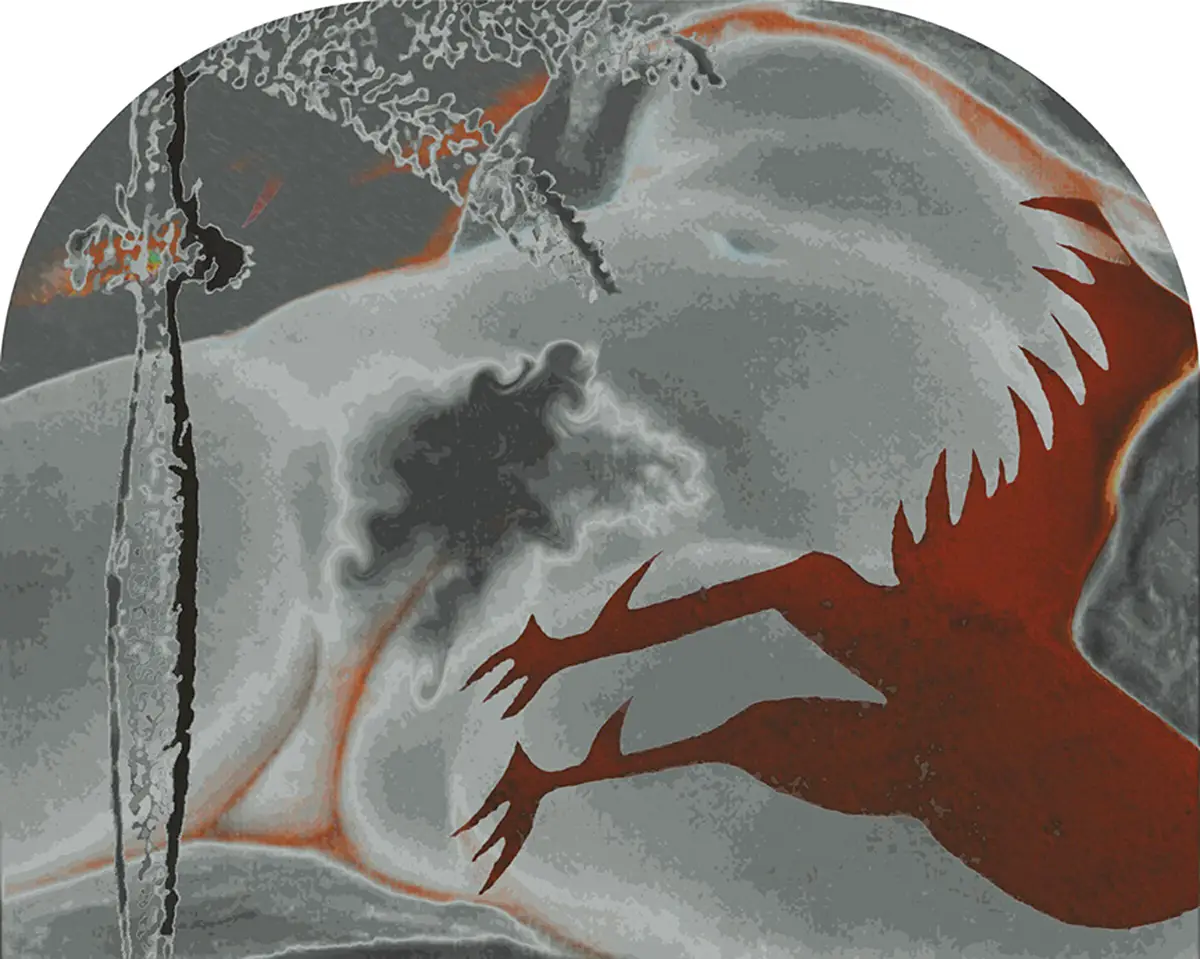
Victoria synthesizes a topic that tends to bring out the greatest ideological differences, an issue regarding which passion triumphs over reason, and where literature and the visual arts, both Dominican and Haitian, have found it difficult to find the middle ground. Bismarck Victoria nevertheless arrives at a perspective at once emotional and balanced. Along with politics, Victoria expresses an intense poetics —two inseparable values in large format works such as Quisqueya Paradiso and Morceaux choisis d’après Courbet/El Origen de la Indolencia en la Tierra del Remordimiento, con Vestigios de Prevaricadores, Incluso (Fragments Selected According to Courbet Courbet/The Origins of Indolence in the Land of Regrets, with Traces of Prevaricators, Even), the latter an unusually long title, to begin with, intriguing in itself. The same goes for a splendid black sculpture in which Victoria magisterially explores the relationship/contrast between the horizontal and the vertical, presenting a guillotine ready to cut across the island. The reference to the French Revolution of 1789 and its sinister instrument of punishment (then actually a humanitarian solution, superior to more cruel methods) must be seen as the symbol of a period of extreme importance for Haitian independence
Bismarck Victoria has studied, painting, history, and sociology. It is not a merely formal matter. And within his historical associations, politics is dominant, more terrible perhaps by being “exquisite” in its formulation of the image. Latin Lover, with its profusely decorated uniform and its skeletal cranium, alludes to the Trujillo dictatorship and, indirectly through being in the context of this show, to the massacre of Haitian immigrants ordered by the despot. It would have made a perfect cover for The Feast of the Goat, Mario Vargas Llosa’s novel on the same topic.
There is nothing more difficult, after the classic mastery of the theme, than to paint skies and to transfer maps onto paintings. Victoria dares to attempt both, and in a single work. The result, Quisqueya Paradiso, is not only of great beauty in its interplay of colors and hues but full of connotations as well. This island of sheep-like clouds invites several readings: dreams, ideals, fragility, and utopia. Then, the composition, highlighted by the support’s curved shape, infuses the work with a dramatic feeling of density and weight.
A similar aesthetic and ideological richness is to be found in those Fragments Selected According to Courbet. This is a work that would certainly merit collective analysis and debate… The work of the famous and rebellious Courbet was kept a secret during the prudish 19th century, because of its scandalous nature, but it has been recovered with passion in modern times, and many artists have accepted its influence. Bismarck Victoria uses the reference with special talent and intelligence, creating a metaphor for the birth of the island —an unstoppable fuzz, an open wound/burn, between the palm tree and the red rooster. Shapes fuse. Colors become emblematic. The first time we see this work, we are shaken. It is an anthological work in the artist’s career.
Bismarck Victoria, son of Santiago, also alludes to his hometown in his paintings. He is pained by the way in which the city’s most representative monument was destroyed in the name of development. This work is so strong, desolate, and tragic that it suggests the ravages of war, with the monument miraculously intact. Again, the title supports the piece's strength: La chronique scandaleuse, residuos del patrimonio cultural, sus monumentos y otros detritos en el primer Santiago de América/el Yaque, incluso (La chronique scandaleuse, Rests of a Cultural Patrimony, its Monuments, and Other Detritus in the Americas’ First Santiago/El Yaque, Even).
This show, equally fascinating in the very limited serigraphic edition of Victoria’s paintings, calls for multiple commentaries and interpretations, including the titles’ linguistic variation. It will remain in our visual memory as the culmination of Bismarck Victoria’s aesthetic and conceptual commitments.
MARIANNE DE TOLENTINO