
Born in 1913 in the town of Rivera, Uruguay, near the border with Brazil, and a resident of Paris since 1948, after the breakup of Madí, Carmelo Arden Quin is a paradigmatic figure in the school of geometric abstraction and in non-objectivist art in the Southern Cone. His biography and artistic resume are intense and multifarious.
He was a friend and a theoretical correspondent of Torres-García, Fontana, Berni, Picabia, Vantongerloo, and Seuphor. Arden Quin and Torres-García met in 1935, when, after 43 years abroad, the latter returned to Montevideo. In that same year, Arden Quin moved from a pedagogical form of cubism to geometric abstraction, and a year later he was invited to participate in a group show of "Río de la Plata" artists at the Montevideo Ateneo, along with, among others, Torres-García, Barradas, Del Prete, and Horacio and Augusto Torres. There, Arden Quin showed for the first time three cut silhouettes painted in primary colors, very close to Mondrian's chromatic trilogy.
Arturo, a journal of the abstract arts, appeared in January 1944. Its first and only issue included an article by Torres-García and two pre-Madí manifestoes: The Frame: A Problem for Contemporary Art, signed by Rhod Rothfuss, and The Dialectic, Arden Quin's first programmatic text. In "La dialectica" (The Dialectic), Arden Quin reaches the emphatic conclusion that the new art will be nothing if not pure invention, "...Neither expression (primitivism) nor representation (realism), nor symbolism (decadentism). INVENTION.Of anything, of any action, form, myth, purely as a game, purely out of a sense of creativity: eternity, FUNCTION."1
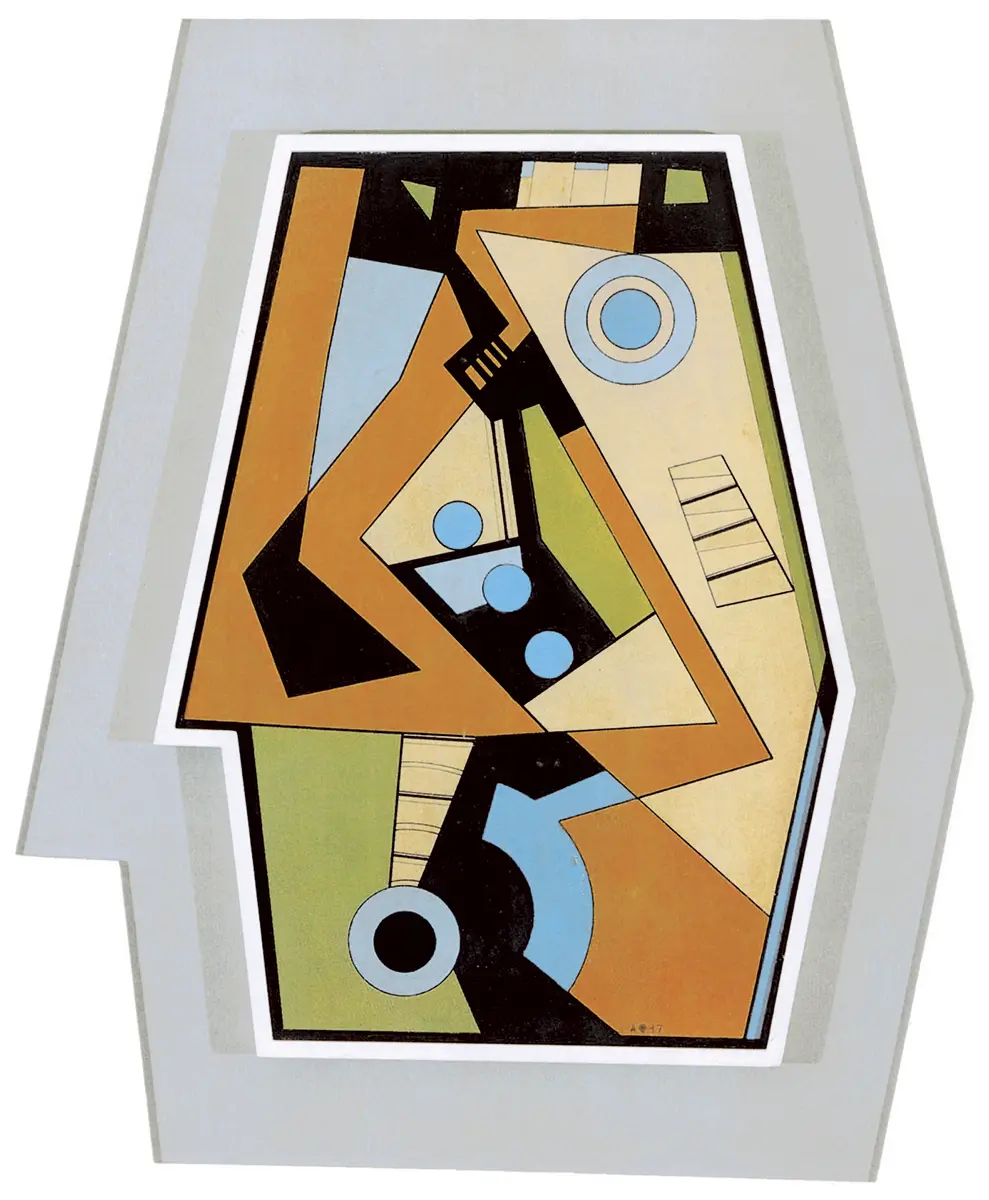
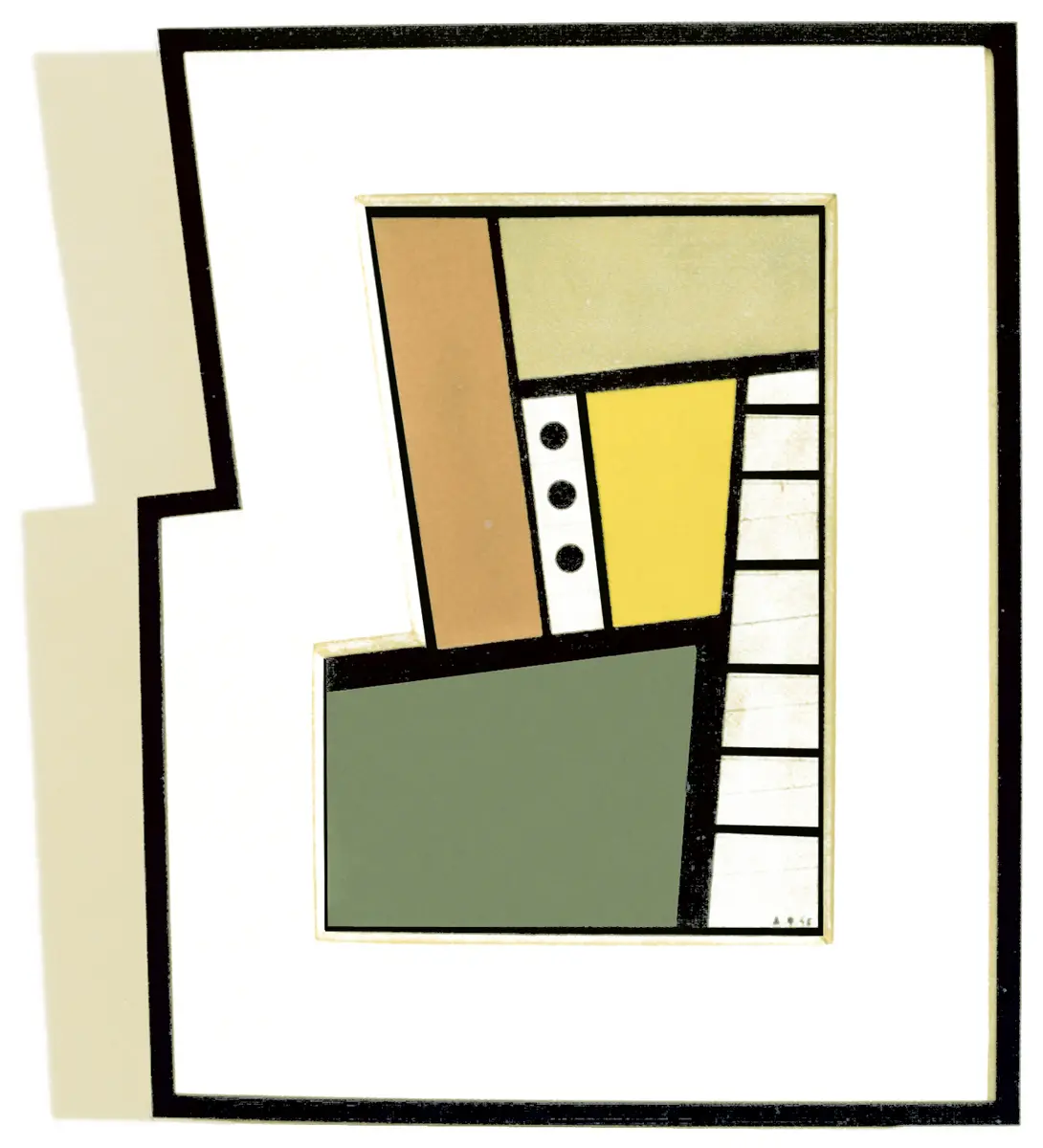
Between 1944 and 1945, Arden Quin created paintings with a punctured surface through which one can see the supporting wall, and also paintings with irregular frames, mobile sculptures, coplanars, and object paintings. From this period is Points Noirs (1945), a small-format oil on cardboard where, unlike in orthodox neo-plasticism, the artist avoids vertical and horizontal lines, generating diagonal fields of color that break with the orthogonal conventions of pictorial illusionism. This work is closely related to Torres-García's constructivism and his palette of gray and warm hues, especially his ochre and earthen tones.
In 1946, Arden Quin founded the Madí movement (Movement, Abstraction, Dimension, Invention) together with Gyula Kosice, Martin Blaszko, Rhod Rothfuss, Esteban Eitler, and others. In the Madí show at Buenos Aires' French Institute, Arden Quin presented some of his coplanars (articulated relieves) and his earliest formes galbées (paintings with a concave surface, among which the Cosmopolis series merits special mention). In 1947 Madí broke up into two factions: one led by Kosice and Rothfuss, which under the name of Madimensor remained in the "Río de la Plata" area; and one led by Arden Quin, based in Paris since October of 1948. From that date on, Arden Quin focused on organizational work and the launching of Madí in the French capital.
In 1949 Arden Quin participated in the Salon des Réalités Nouvelles. The next year, together with Bresciani, Vardanega, Desserprit, and others, he took part in the Madí Show at the Colette Allendy Gallery in Paris. There he presented découpages, paintings, relieves, and Madí poems, already showing a more radical and direct connection with pure European geometric art.
Towards a New Dimension of the Monochrome
In 1950, already installed in Paris, Arden Quin began his "White Art" period, under the influence of the aesthetic theories advanced by Georges Vantongerloo and Michel Seuphor, with whom he interacts frequently. It is in this period that the artist frees himself from tonal painting, which had characterized the original "Río de la Plata" Madí.
In connection with this systematization of a non-restrictive use of color, Arden Quin's own words are illustrative: "I still didn't understand Mondrian or Vantongerloo, plastically, although I did admire them intensely. In Paris, I recovered the white function for Madí. It was only at the Nouvelles Réalités exhibit that I saw white geometry, until then something entirely unknown to me."2
This "whitening" of the Madí support is sustained by a revaluation of achromatism in its optical and spatial possibilities. In the case of completely monochrome pieces, the geometric assemblage is presented as an authentic body in space, while color or value have no referent —this is to say, they do not direct us to anything else: they are self-signifying. In the case of fine lines, points, and color planes sprinkled in an achromatic background, polygonal forms are perceived at their highest degree of visual pregnancy, against the whitening of the surrounding space. The paradox here is that the chromatic asepsis of the background only highlights the luminic surface effects, taken to the limit as far as saturation and intensity go.
On this topic, Peirce's semiotics offers a useful tool for an understanding of artistic experience as an instance or interpretation. Peirce's general science of signs establishes that our experiences can be of a first, second, or third degree; these three instances are categories of Being as well as modes of knowledge3. As an aesthetic category, the "first degree" of experience relates to the immediacy of sensation, to pure quality. As examples of "firsts," Peirce offers color perception and vitalist feelings such as freedom, beauty, and the sublime. Color applied to uniform areas or expanded fields, then, will directly stimulate our sensibilities, generating feelings of calm, puzzlement, or rejection. In this sense, Arden Quin's monochrome works are a clear example of first-degree experience, pointing towards the creation of a "different" physical and aesthetic quality on the given support; moreover, they even erase the border between frame and pictorial surface.
This feature is also present in Lucio Fontana's dynamic of slits (tagli) and holes (buchi) inscribed on uniformly colored canvases, as well as in Klein's blue monochromes, Manzoni's achromes, and some works of Newman and Ryan.
In Fontana's case, the use of white worked at the structural level, allowing the artist to highlight the almost infinite depth of the slit or incision on the intervened support, following a gestural strategy that remained close to the poetics of Italian Informale. In Fontana, Klein, and Manzoni, we encounter "firsts" that attempt to progressively dematerialize the support, in favor of the pure quality of non-color.4
Unlike them, Arden Quin does not seek to eliminate the work's physical aspects but to strengthen them. The material substrate remained a fundamental anchor in Madí practice. Nevertheless, Arden Quin's monochromes tend to the creation of a more ascetic, barer form of spatiality, moving towards a zone of non-objective perfection where dialectical oppositions are resolved in pure plasticity.
Some of the more recent monochrome pieces show that Arden Quin continues to pursue first-degree experiences of non-color and light, formulated over half a century ago. In between relief and tableau-objet, by virtue of the juxtaposition of out- ward-pointing planes, these open forms are complemented by chromed rods that fold on one of the polygon's apex. In each of these instances, the metallic piece balances and supports the polygonal structure. A work such as Monochrome blanc (2001) establishes a dialogue, in intertextual key, with the mobile relieves of Le Chien (1949-1950) and Le Chat (1950), and with the articulated structure Rotation (1994). For Arden Quin, the aesthetic tension between geometric forms and the transgressive impulse must always be preceded by knowledge and the assimilation of new ideas, associated with already incorporated values. As the artist says: "Monochromatism is very rich, although it is true that in Europe monochromatism continues to be extremely relevant but within the rectangle or the square, as in Rodchenko or Klein. Madí discovered that white monochromes have a different meaning in geometric form. Madí did not create monochromatism but reinterpreted it on the basis of the open polygon principle. This is why when a prototype is created, the series follows."5
Mobiles and Coplanars
From his earliest manifestoes and programmatic texts, particularly in El Móvil (The Mobile) of 1945, read in the home of psychiatrist Enrique Pichón Riviere, Arden Quin denounced the oppressive nature of immobile right angles, which he deemed the prison of abstraction. This aesthetic hegemony was the privilege of two polygons, the square and the rectangle. Arden Quin thought it necessary to break with naturalistic rhetoric as a frame of reference while keeping the bi-planar character of the support. In order to break with this visual tyranny, the members of Madí inscribed their works in a variety of polygonal figures, such as circles, ovals, trapezoids, rhomboids, pentagons, hexagons, etc. From then on, an infinite range of options was open as far as a work's support is concerned, since any given Madí form could also be composed by the combination of polygonal figures in open configurations, with an irregular or shaved frame. In the words of Arden Quin: "Historically, there is no reason for geometric art to remain trapped in four-angle polygons, such as rectangles or squares. We in Madí need to create our own structure to be dressed up in composition. The concept of polygonality opens a wide avenue for geometric constructivism in art; that concept is a creation of Madí, one that emerged here in Buenos Aires more than half a century ago. When one speaks of Madí, one has to say that it is an heir to geometric non-figurative- ism, to Russian constructivism, to Mondrian, to Kandinsky, to Vantongerloo —but none of them really systematized the notion of polygonality."6
A textual precedent of fundamental import for the writing of El Móvil is found in one of the specific manifestoes of Futurism, signed by Giacomo Balla and Fortunato Depero and dated in March 1915. It is a technical piece of writing, titled Ricostruzione futurista dell'universo (A Futurist Reconstruction of the Universe), which appeared in the journal Noi. From this piece, Arden Quin takes, and revisits the key of Madí, the slogan about "systematic infinite mobile invention." Balla and Depero stated, among other things, that painting should be pure geometry, invention, color, and movement, although related to a four-angled support7. Balla and Depero wanted a luminous painting capable of generating objects that moved in space; they demanded the use of all kinds of materials, be they of an artistic or a non-artistic nature.
The reading of this futurist text was to become essential for Arden Quin's own manifesto: "I consider this text the most perfect pioneer Madí manifesto ever written. In the genealogy of Madí, Futurism must be granted pride of place, in particular its ideas of speed, movement, and simultaneism."8
Balla and Depero's manifesto was to become one of the essential supports for Fontana's Spatialism and for the famous Manifesto Blanco (White Manifesto), where the Rosario artist refers, in the voice of his disciples, to "that malleable and luminous substance" and decrees "the death of all paralytic forms". Fontana posits a "tetra-dimensional art" made of light, movement, sound, and space-time, as an overcoming of orthodox painting and sculpture 9. His postwar ambienti spaziali, both the rectilinear and the cursive geometry ones, propose the gradual dissolution of matter and its gravity into a fluid, ethereal new entity. In these pieces, the use of neon light signals a Futurist/Baroque synthesis. It is also worth noting that these fluorescent spaces are clearly indebted to the futurist concept of the work as an environment.
Another precursor of El Móvil can be found in some of Joaquín Torres-García's hand-made objects with interchangeable pieces and in his articulated toys. The formal and theoretical reach of both precursors is key in the development of Arden Quin's aesthetic theory and artistic practice.
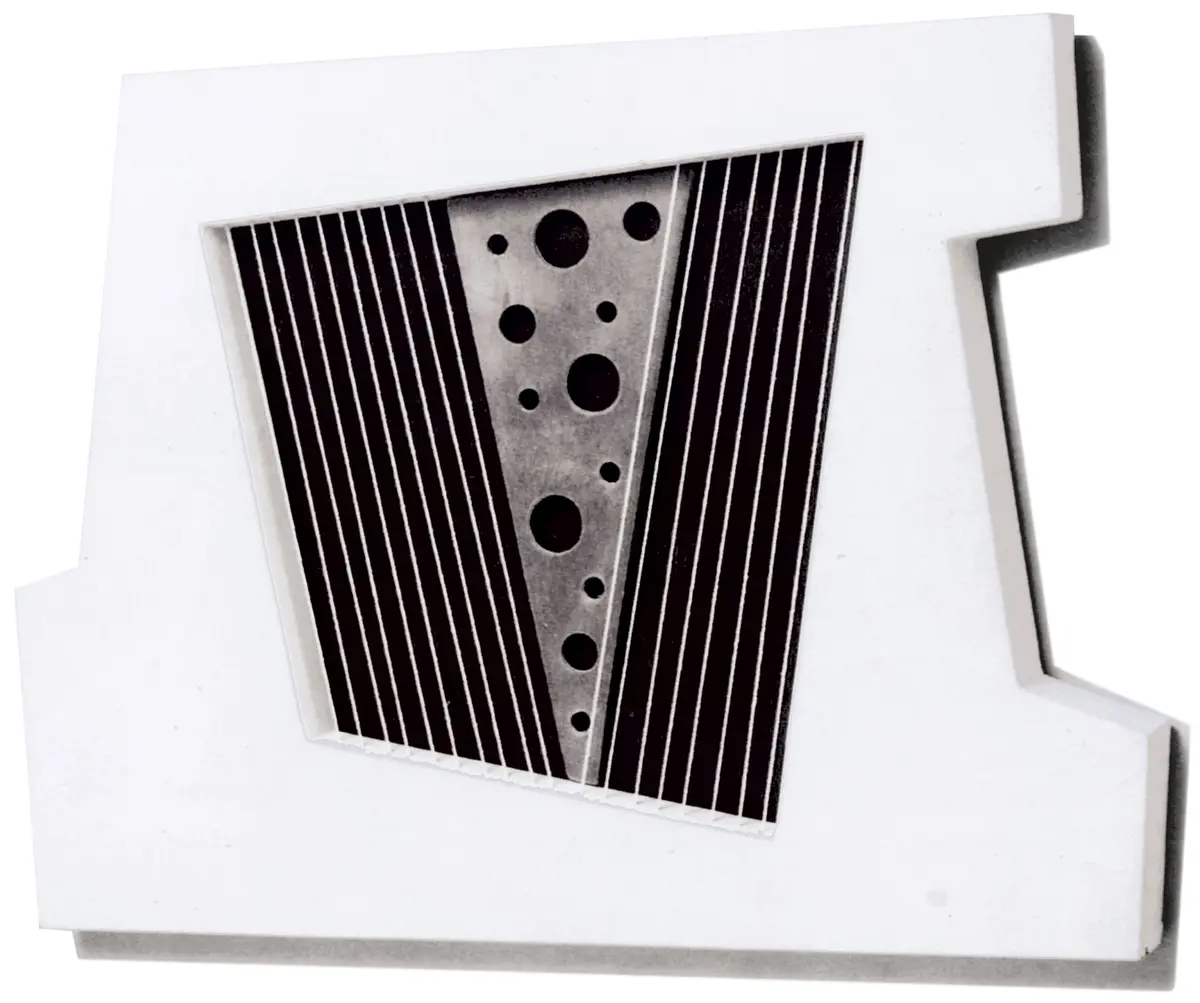
In one section of El Móvil the artist points out the singularity and specificity of Madí aesthetics, as evidenced in the principle of an open polygonality —that is, the principle of infinite angles and edges. Moving against the grain of orthogonal forms, which he saw as historically contaminated by the idea of a frame and the Renaissance's veduta, Arden Quin defends the use of triangular, trapezoidal, rhomboidal, or mixed geometric structures. With this, he anticipated for more than two decades the North American artists of the shaped canvas and the future minimalist and conceptual art trends, in particular Ellsworth Kelly's "concrete" minimalism. Arden Quin moved to the antipodes of the fixed pictorial surface, when he said, striking an avant-garde note, that "what distinguishes us, what makes us original, is the use of regular polygons as a dimension to inscribe a composition. In abandoning the four classical orthogonal angles (square and rectangle) as a basis for composition, we gained possibilities for invention, in every sense of the word. We can create an infinite number of flat forms, and each one of us has a flat form in the depth of our psyche...The elements of sculpture —volumes, and vacuums— interrelate in a variety of ways, forming a rich and playful range of plastic positions, all of this within geometry and non-figurative. They are present in their own nature, without realist remnants. They are ludic since one can choose positions in one's own way and give it any desired form. There is no need to express, represent, or symbolize. The artistic object must be pure. We arrive at this point through the dialectic of art, as I have said in the Arturo manifesto. Presence is, in itself, already an event."10
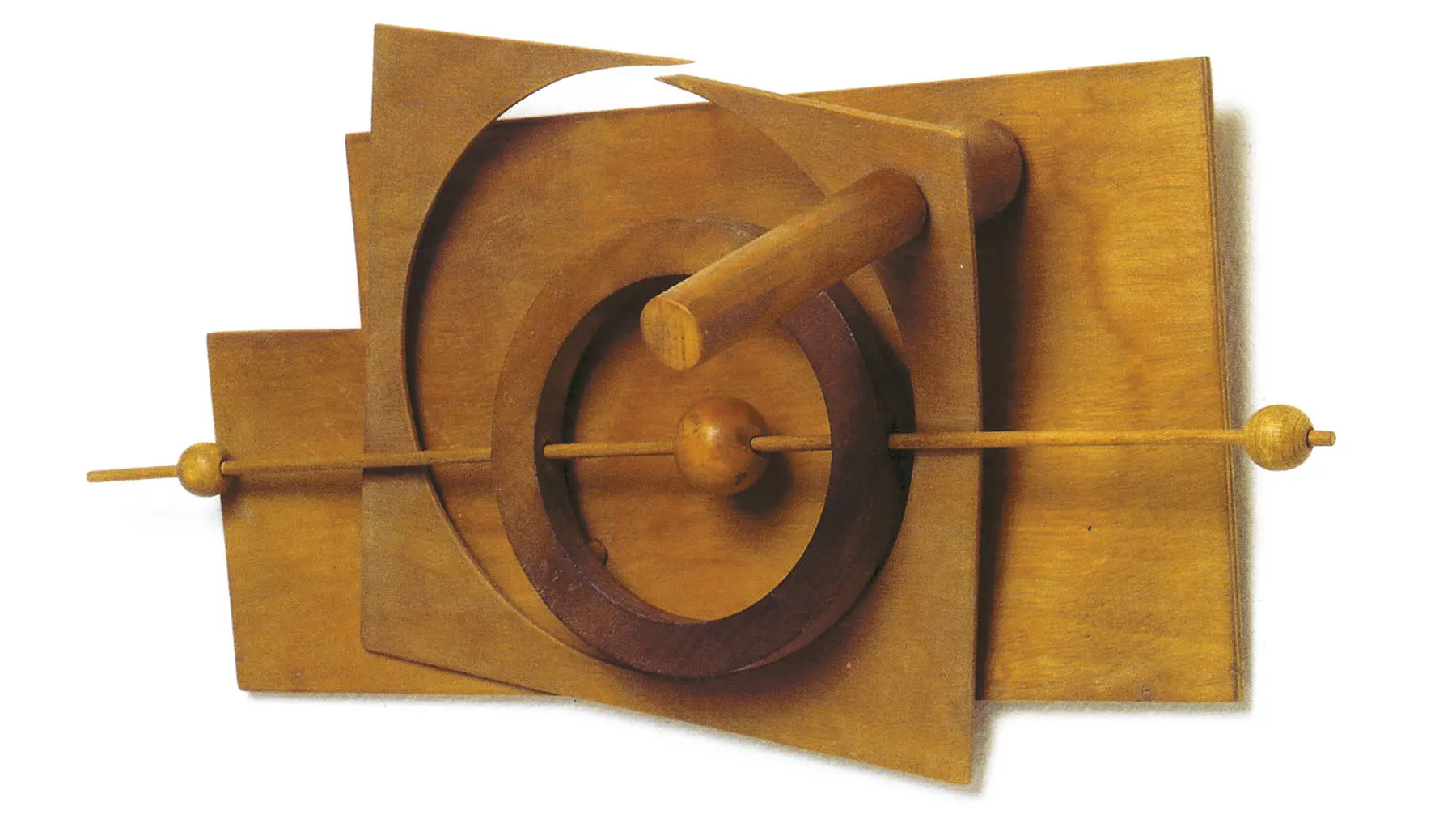
In this period Arden Quin created abstract relieves in wood, pieces that are notable for their emphasis on the volumetric interplay of geometry and the articulated encasing of their parts. These characteristics remind us of Joaquín Torres-García's transforming toys and Hans Arp's Dada objects. In Arp's work, particularly in his Clock, a 1924 relief on painted wood, formal solutions are governed by chance and indeterminacy. In a Madí work, in contrast, fortuitous factors such as these would be replaced with a ludic component.
Ivry (1946) is an assemblage in non-polychromous wood resembling some form of sculpture suspended on a wall. This work explores the possibilities of the hole, the vacuum, and the almost complete segregation of spaces, in search of a growing dynamism for the relief.
The horizontal metallic rod and the cylindrical form support and finish the work, linking the various planes. The piece's whole tectonic weight rests on these two elements.
Coplanal (Coplanar), 1945, is a mural construction that highlights the maximum contrast of values. Articulated on four rotary modules turning on their own axis, situated on the edges of rhomboid fame, this work displays the original Madi's enormous potential for mechanical playfulness, and at the same time, it makes evident the use of suprematist black and white.
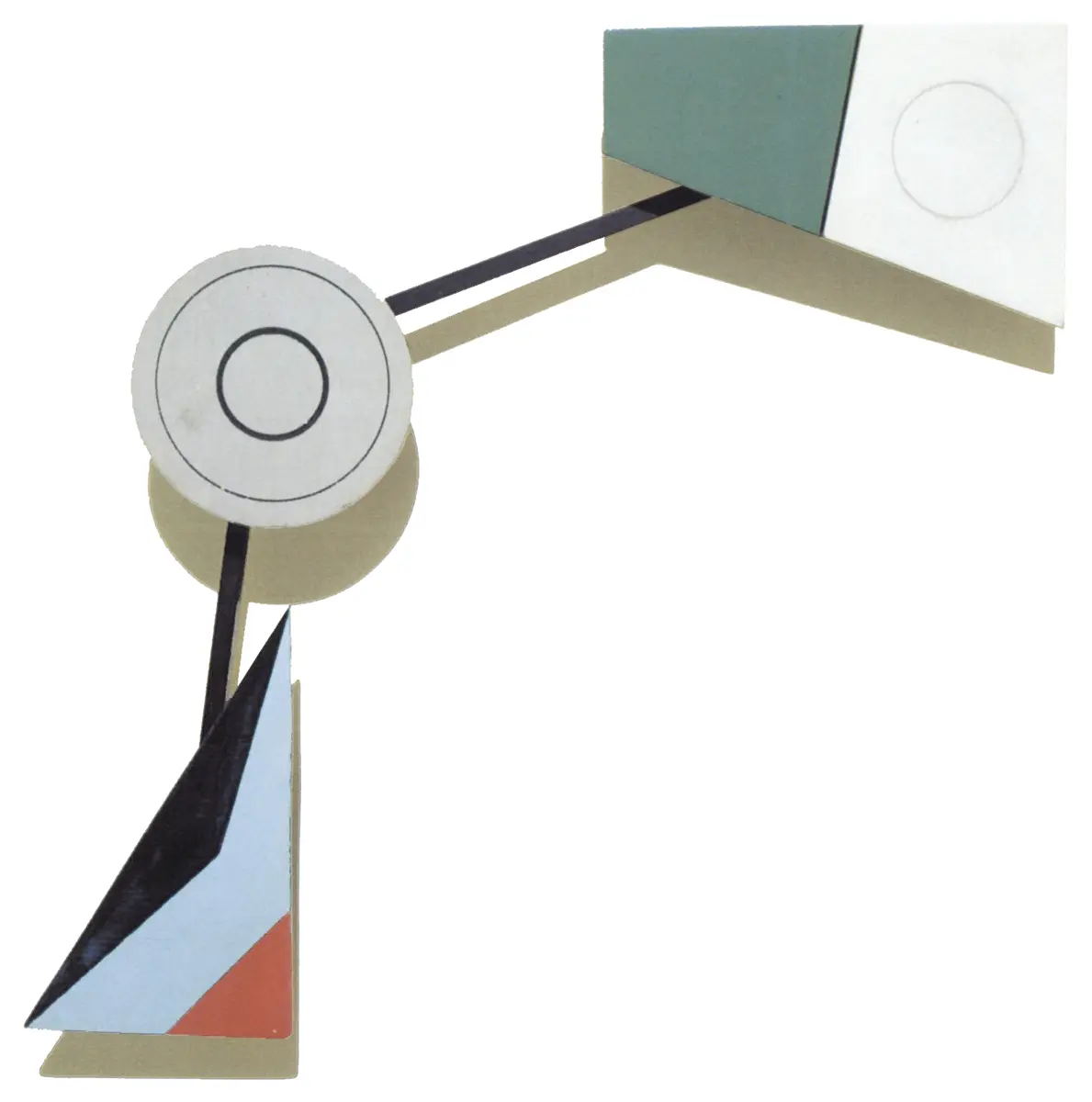
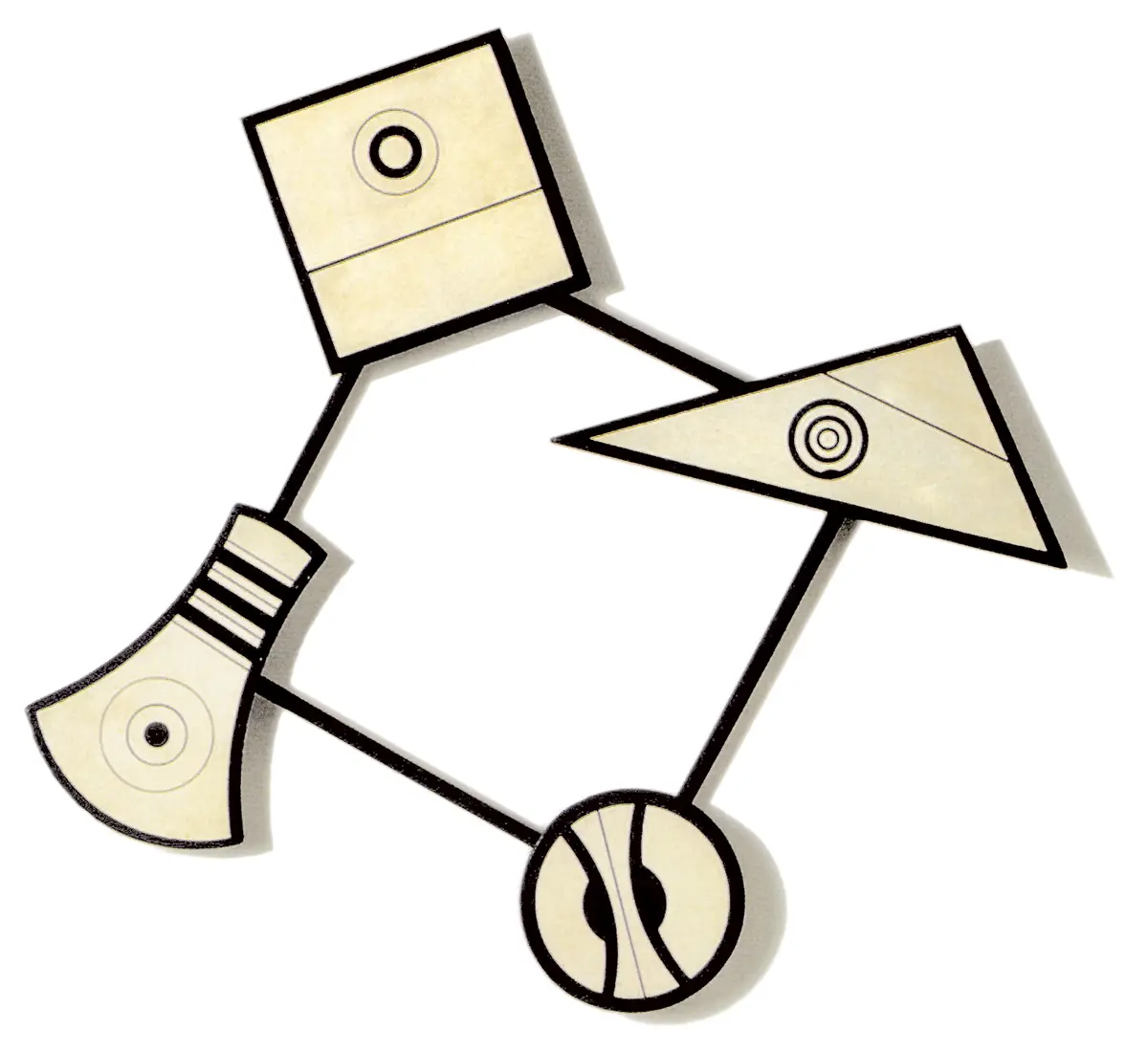
Another coplanar work, dated the following year, comprises three parts —circle, triangle, and irregular trapezoid— and presents a flat chromatism applied in stripes or zones of expansive color that segment the forms. The parts are connected through two fine black rods, and the linear accent focuses on the composition's circular radius.
From Purism to Geometrical Baroque
The principle of open polygonality continues to be one the basic pillars of Arden Quin's current work, now enriched with the assimilation of new materials derived from decorative arts and from interior design, such as metal, plexiglass, translucent plastics, chromed buttons and hoods, small colored-glass spheres, along with unusual visual textures of a lustrous, steel-like appearance.
To all this, Arden Quin adds a more intense, exalted polychromy, wisely distributed through the counterpoint of shines, translucence, iridescence, and monochrome opacities In this body of work, the artist takes the tableau-objet in an entirely new direction, by making the relationship between support and surface complex. This is even more evident in his latest free-geometry coplanar pieces, articulated relieves, and punctured surfaces, shown at Galena del Infinito last October as part of the Confrontaciones: Arden Quin/Iommi exhibition. These works present a family resemblance to the formes galbées cycle, and the h-shaped structures, of previous decades. Regarding them, Arden Quin says: "My new works are a kind of systematization of the painting- object. For instance, I have brought back the coplanars from the 1940s, again placing one plane next to the other."11 In this sense, two basic laws of Madí are still in place: plurality and playfulness. Coplanars are mobile, ludic, and plural objects, constantly changing their position on a wall. In these objects one plane integrates into the other while preserving its independence, since the two or more parts that comprise the work can approach each other but not superimpose on each other; a playful instance of enormous visual importance is thus created. In manipulating a coplanar, the viewer can assume the role of co-author.
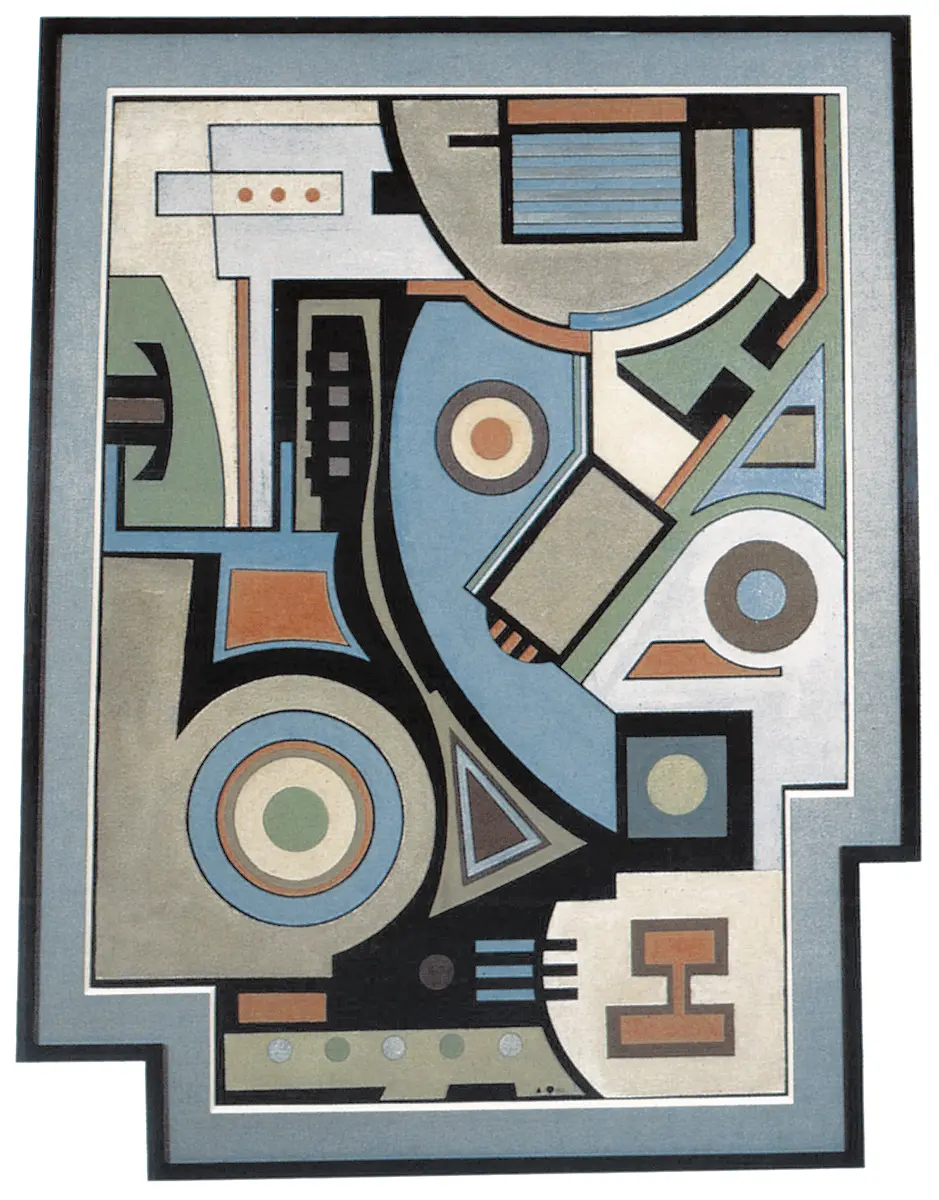
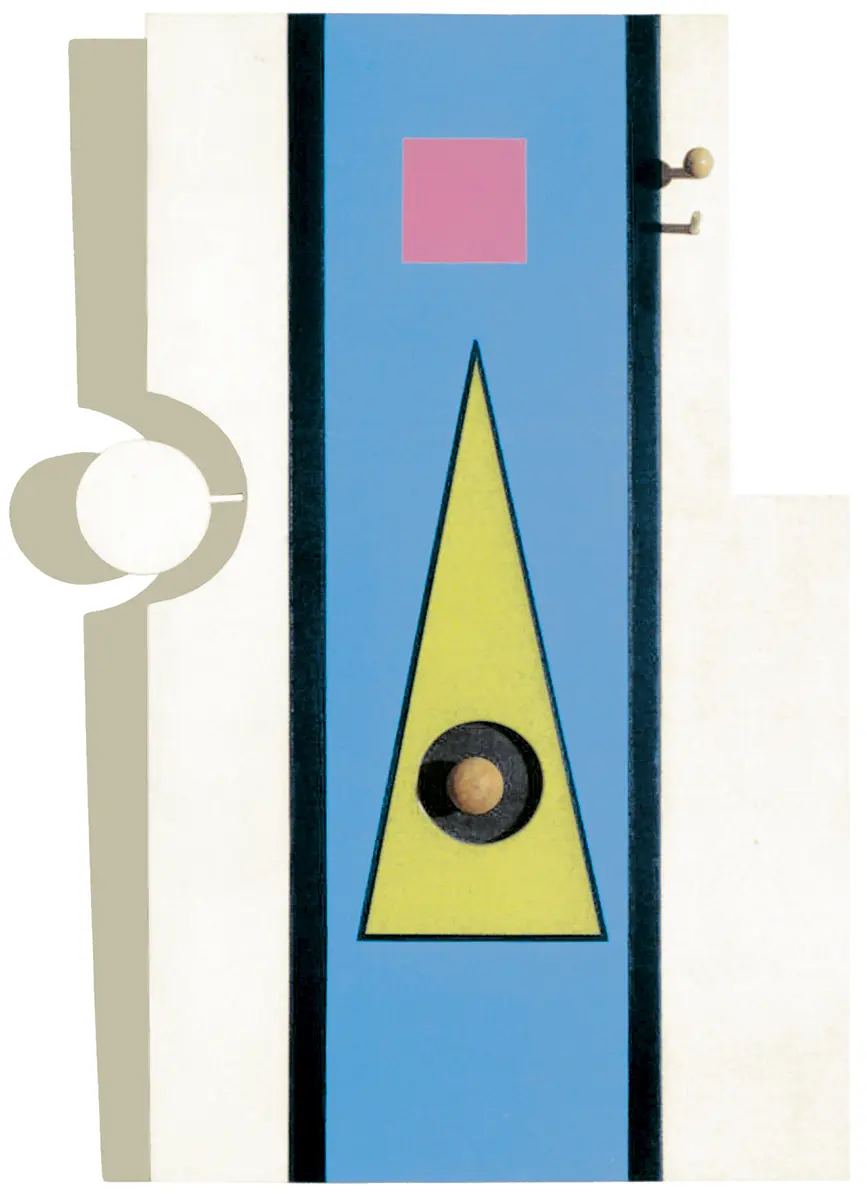
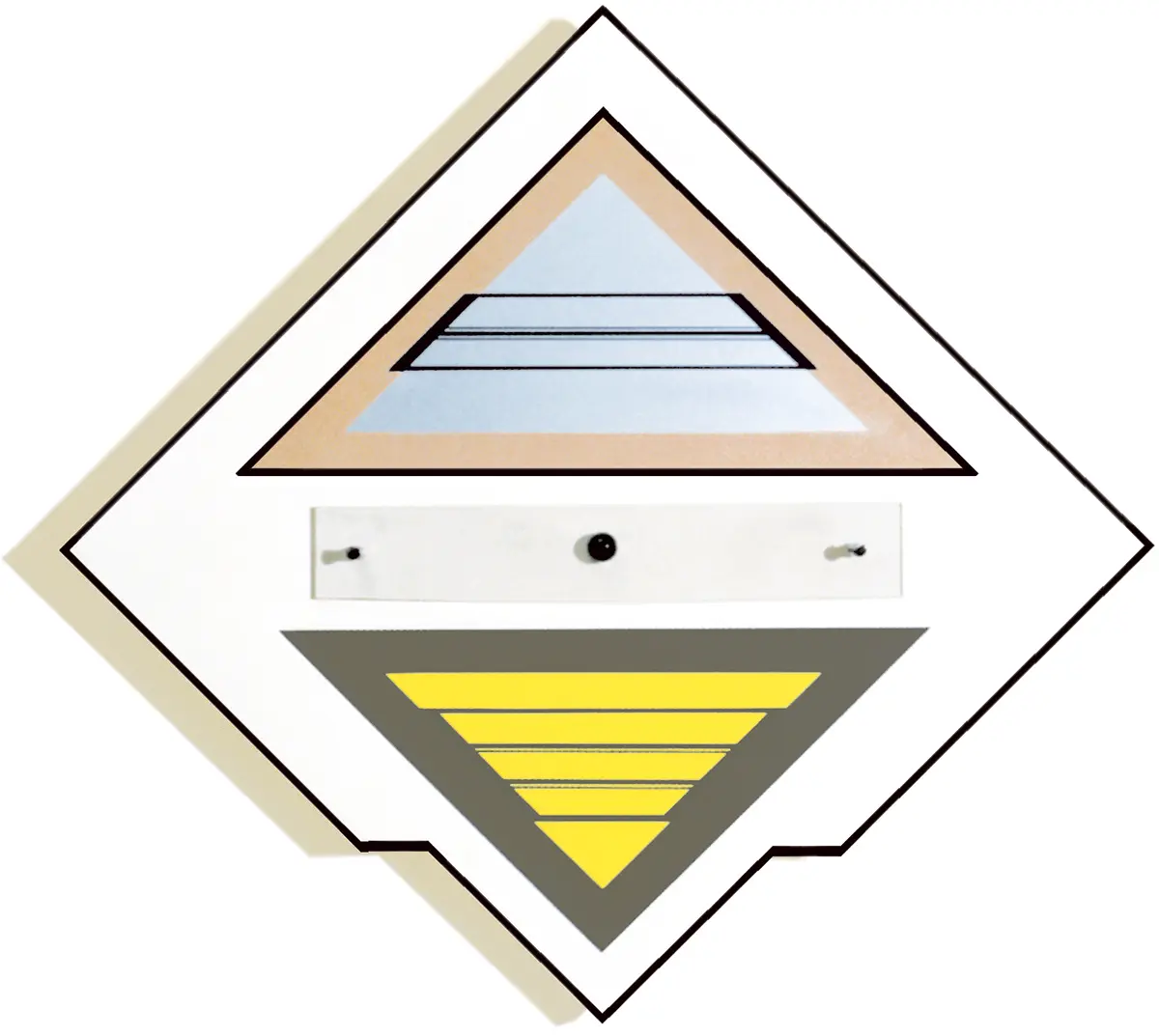
In Coplanar (1991), the new pentagonal form contains rotary circular modules, découpages, and wooden door handles that are activated and moved. Also worth noting are works of the 1990s such as Elan Neuf VII (1997) and Professionally Altered (1994), which present innovative perimeter silhouettes and generate an interaction of cubist collage with Dada relief.
The former piece is an irregular rhomboid with a translucent plexiglass "bridge" that unifies the whole Madí structure, composed of triangles in different colors converging on their bases. This "bridge" is a kind of mediation linking one zone with the next and renovating the peinture-objet. It is a formal element of an extra-pictorial nature, but it is not a sculpture, since it is still anchored on bidimensionality. Its function is to activate the composition in an interplay of shadows and reflection that goes beyond support and surface. Removing this element, the triangles would lose their internal cohesiveness. It should be noted that this connecting element gives the work not only an objectual value but a gestalt value as well. We can in fact "say that the "bridge" works as a medium, a trait d'union articulating the two geometric figures.
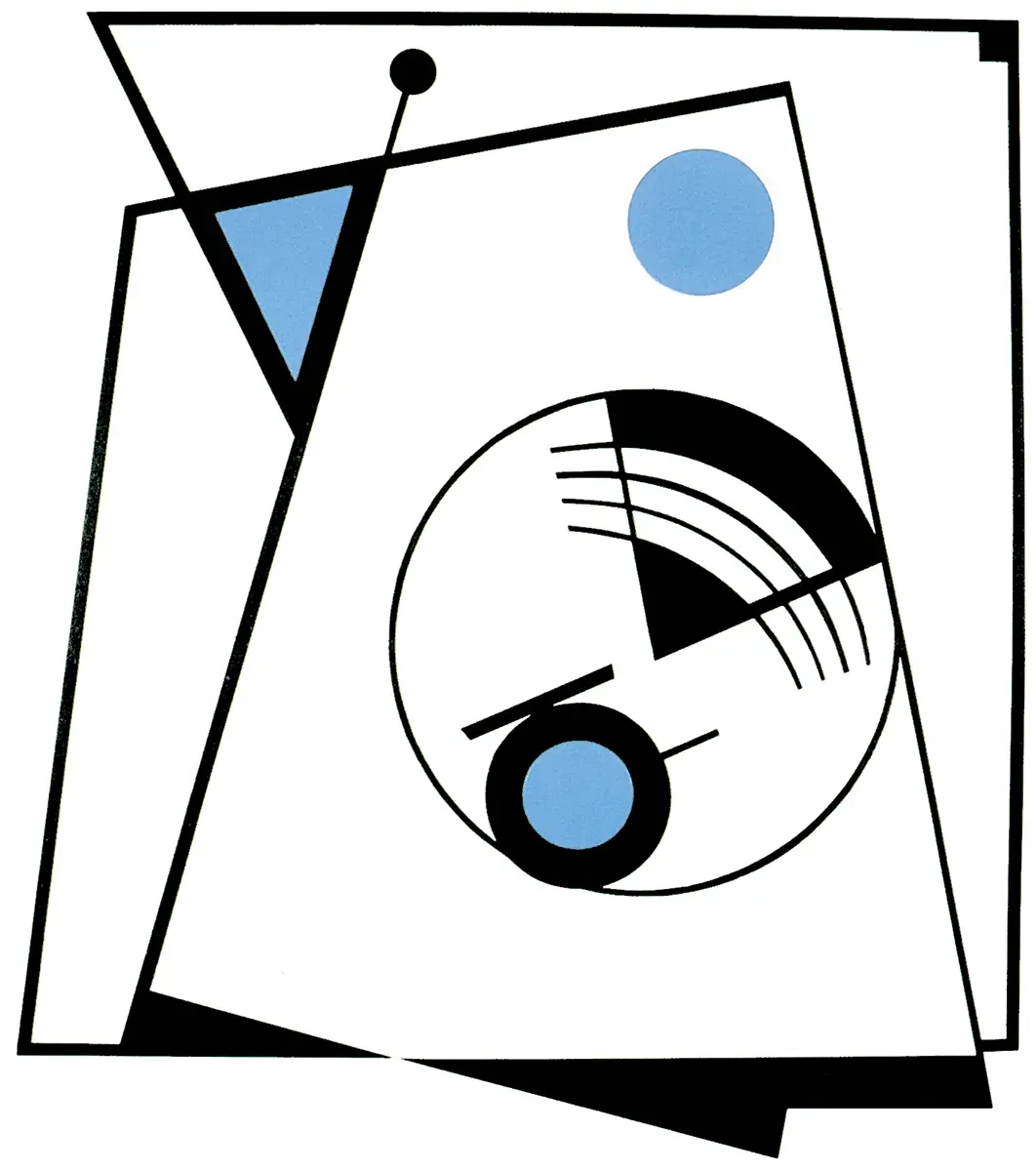
The latter piece displays the interplay of juxtaposed shortened planes, trapezoids, circles, triangle sections, and arc segments, dynamized by a close-up or black contour line around the entire work. Here the support determines the form and the extension of the painted surface.
Works of this kind are conceived as true territories of the mind where colors and shortened forms enjoy complete autonomy. Yet, it is the stricture of geometry that defines, in the last instance, the composition's tectonic limits.
Since 1990, the year of his show at Rachel Adler Gallery in New York, Carmelo Arden Quin has continued producing art at an intense pace. Among his most recent solo shows we can mention the one at Fundación Telefónica (Madrid, 1997), curated by Maria Luïsa Borràs (who also wrote the critical text), and his retrospective at the Museo de Arte Contemporáneo de La Plata (MACLA) in 2000. He has also been present in several anthology shows, such as La Escuela del Sur: el taller Torres-García y su legado, Madrid, Reina Sofía Museum, July-August 1991; 20th Century Latin American Artists, New York, MoMA, June-September 1993; Versiones del Sur, a section on Heterotopias: medio siglo sin lugar, 1918-1968, Madrid, Reina Sofía Museum, December 2000-February 2001; Abstract Art in the "Río de la Plata": Buenos Aires and Montevideo, New York, Americas Society, September-December 2001 (curated by Nelly Perazzo and Mario Gradowczyck); and the most recent, Geometric Abstraction: Latin American Art, at the Fogg Art Museum of Harvard University, with loans from the Patricia Phelps de Cisneros Collection.
In 1992, Arden Quin created the International Madí Association. Among the shows realized with this group are: International Madí movement, 50 Years Later, in Zaragoza (1996), and the important retrospectives at the Reina Sofía Museum, the Museo Iberoamericano de Caceres, and the Fondazione Mazzotta, in Milan, Italy.
NOTES
1. "La dialectica," signed by Arden Quin, has been reprinted in its entirety under the title Invention in the catalog for Heterotopias. Medio siglo sin lugar, 1918-1968. Madrid: Museo Nacional Centro de Arte Sofia, pp. 500-501, in the "Documentos" section.
2. Interview with the artist, Buenos Aires, July 2001.
3. Writings of CH. S. Peirce. A Chronological Edition. Bloomington: Indiana University Press, 1989.
4. Claudia Laudano, De la acción a la performance. Greco, Manzoni, Fontana y el espesor de la intertextualidad. Rosario: Ediciones La Manija, August 2000. p. 29
5. Interview with the artist, Buenos Aires, July 2001.
6. Claudia Laudano, "Arden Quin, figura relevante de la vanguardia constructiva rioplatense." In Rosario/12 newspaper, "Plástica" section, Tuesday, October 30, 2001, p. 6.
7. Maurizio Calvesi, Le due avanguardie. Dal Futurismo alia Pop Art, Roma-Bari, Editori Laterza, 1991, p. 50
8. Conference by Carmelo Arden Quin, Buenos Aires, Galena del Infinito, October 10,2001. Part of the show Confrontaciones: Arden Quin/lommi.
9. "Scritti di Lucio Fontana." In Enrico Crispolti, et. al., Lucio Fontana, Milano, Electa, 1998, p. 115. Catalog for the artist retrospective, Roma, Palazzo delle Esposizioni, April 3-June 22 1998.
10. "Manifestos de Arden Quin." In Arden Quin, Madrid, Fundación Telefónica, 1997.
11. Interview with the artist, Buenos Aires, July 2001.
CLAUDIA LAUDANNO
Ph.D. in the History and Theory of Art at the Universidad de Buenos Aires. Titulary of Aesthetics for the Licentiate degree of the Conduction and History of Art, of the Universidad del Salvador. Correspondant for ArtNexus and Rosario/12.