Ciro Beltrán is obsessed with space —with structural and architectural space, yes, but also with space created by color on two-dimensional surfaces, such as those of the canvases and carpets on which he has conducted his investigation on, precisely, color and form. Two different traditions converge on Beltrán’s abstract paintings: geometric abstraction and abstract expressionism. Yet, these traditions contaminate each other; the one interferes with the other, subjugates it, or supports it at the level of the relationship between planes, or at the level of the figure/background or form/stain dichotomies. As if following the constant reflux of art produced in Latin America and Europe during the first half of the 20th century, Beltrán’s treatment of color reveals the influence of two defining schools: Chilean abstract painting and post-WWII German Expressionism. With a degree in painting from Universidad de Chile, Beltrán later settled in Germany, continuing his studies at the Kunstakademie in Düsseldorf.
His recent show The Presence of Silence, held at the Gallery of the Universidad de Concepción de Chile during the months of August and September, revealed a decade of intense productivity in Beltrán's career. More than 50 works produced in the 1990s were shown in two rooms.
Simultaneously, La Sala Gallery in Santiago presented six of Beltrán’s more recent works, along with a collection of paintings on canvas in small and large formats dated from 1997 and 1998.
The pieces shown at the Universidad de Concepción gallery were separated into two exhibit spaces without attention to the chronology of their creation. Dr. Antonio Fernández, the show’s curator, built in the first room a narrative that organized Beltrán’s paintings and carpets in distinct series, while the second room contained mostly works on paper, such as books of drawings and poems, and catalogs of Beltrán’s work. The first room’s narrative served to illustrate different periods in the artist’s career, showing the oppositions that have played such a major role in the development of his art: “pure” abstraction and figurative images; ordered geometry, and the apparent chaos of the stain; the lines of drawing and the subtle softness of atmosphere created by diffuse color; the use of sand to create texture and free stains; the radiance of reds, yellows, and oranges, and the opacity of grays, sulfur-greens, olives, blacks, and whites.
In the early 1990s, and following a path initiated already in the mid-1980s, Beltrán’s painting was devoted to an investigation of color in its use of “pure” reds, oranges, blues, and greens, and to experimentation with textures like sand. At the same time, there was an interest in reconciling two opposites, of relating intensely-colored abstract backgrounds with superimposed figures of faces that sometimes were synthesized into masks. Other figures recreated architectural forms or drawings of animals such as those of pre-Columbian pottery. These images became icons in Beltrán’s work after his first return from Germany, in 1993.
Beltrán’s stay in Berlin was very significant in terms of his artistic development: a dramatic shift in his use of color derived from the German experience. In Man Watching His-Our Sea, 1993, 1.85 x 1.94 cm., done in Berlin, Beltrán abandons the radiant, almost Caribbean colors of his Chilean paintings in favor of a narrower palette centered around the opacity of gray and the shadings of brown and black hues. Against a highly detailed and textured background created with pigments, sand, and straw, Beltrán divided the surface into several planes on which he drew geometric figures and mask-like faces. This division of the surface into several plans was to be adopted in many of his later works, such as the series Landscape Catalog, 1993-2001, in which the artist seeks to synthesize different oppositions in each square of the grid.
Throughout the 1990s, older motifs kept reappearing in Beltrán’s work, from “pure” abstraction to the reminiscence of architectural forms, faces, and masks in his series of 1993-1995. The constant in his painting, however, is the drawing of structural forms suggesting architectural abstractions that seem evoked by memory, or organic forms floating above masses of color. Beltrán would eventually return to a more varied, richer palette in his paintings on canvas, but not in the paintings-objects of the first series of carpets created between 1996 and 1997. Beltrán’s experience with these carpets picked up from the streets of Düsseldorf gives his art a new layer of meaning while continuing to stress his formalist interests and his research of form-figures, which has driven him to objectify his painting. Beltrán has suggested that the carpets picked up from the street incorporate a sociological element to his work, but at the same time the traces of human use on the surface, the placing of the carpet on a frame, and Beltrán’s work on both sides, as though it were a sculptor object, connect the work immediately with the Chilean artist’s formal explorations (which, of course, do not leave entirely aside other psychological and semantic elements.)
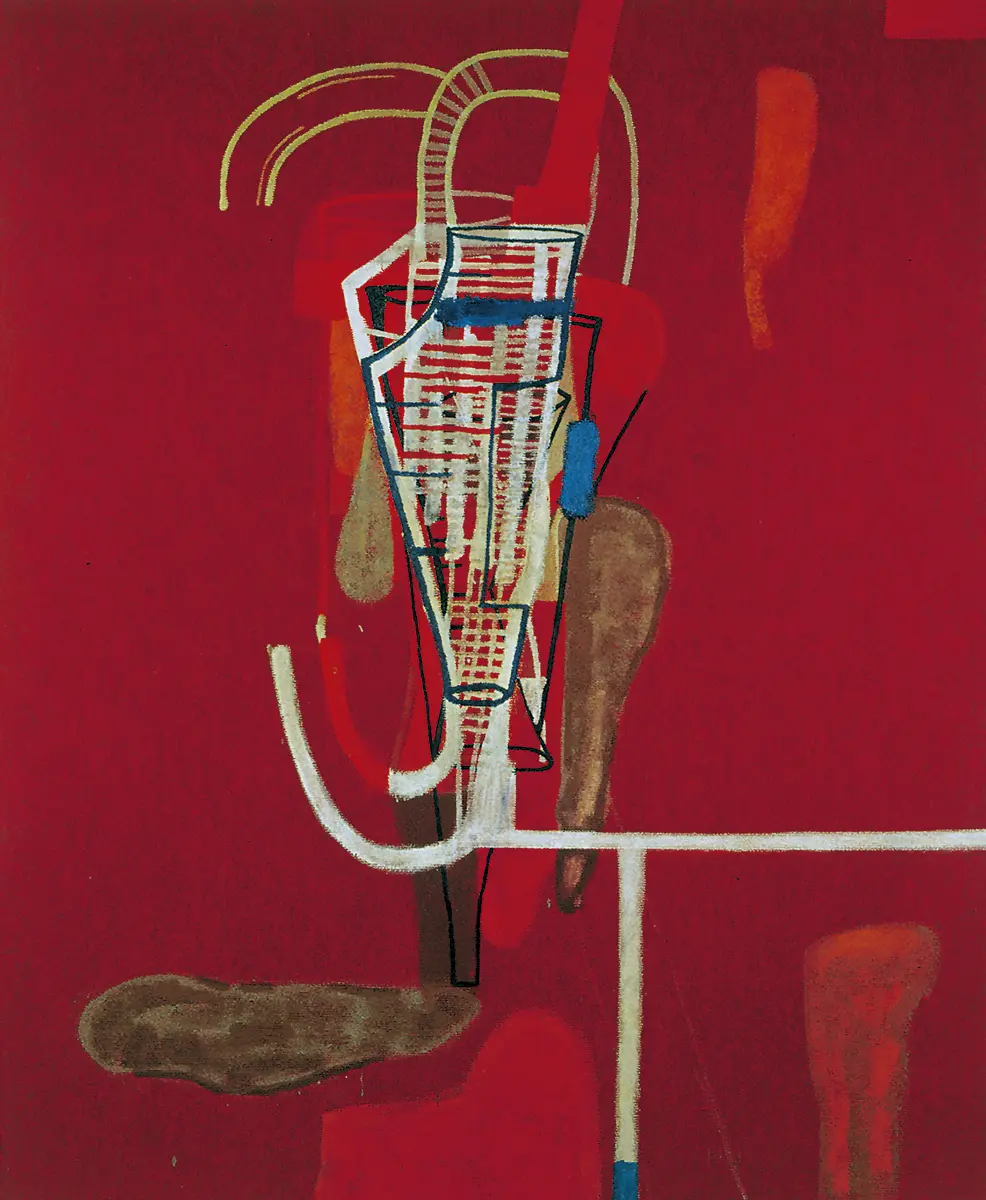
As far as this continued investigation of color and form, Beltrán has arrived at a synthesis of his different periods. The artist creates his particular atmospheres through the mixture of cold and warm colors, superimposed stains, crossing planes like those of a chess board, and textured, atmospheric backgrounds like a wall to support his drawings. Color is what dominates Beltrán’s work, and the artist could not do without those forms or drawings that sometimes curve to subjugate geometry, on the basis of which his painting’s backgrounds are often organized. Pintura sobre alfombra #40 (Painting on Carpet #40) (2002, 180 x 150 cm), recently awarded with Chile’s Quinto Salón Sur Nacional de Arte prize, is a good example of the synthesis achieved in Beltrán’s recent work. The carpet’s color red and its very texture give the background for an elegant abstract drawing —in between the geometrical and the organic— and the combination of cold and warm colors.
Beltrán’s works on paper possess a particular dimension. His drawings, like the carpets, are freer and more experimental than his works on canvas. significantly, the drawings reveal the same formal interests as Beltrán’s earlier works, while incorporating new elements such as letters and words that have only reappeared in Beltrán’s more recent paintings shown at Galería La Sala. What we see in the calligraphy of works such as Sapiens Wasser, 1999 (50 x 35 cm) or Lenguaje (Language) (2000, 50 x 35 cm), where the drawing would seem to suggest a tongue: Is it a linguistic recourse, or is it perhaps yet another experiment in visual poetry? Individual titles in Beltrán’s body of work are like phrases that become part of the work, rather than a guide to understanding it in the traditional sense. Words and letters, however, seem to evoke places and atmospheres, a sort of game in which a word’s letters are playfully switched in order to suggest sound rather than grammar. These changes and switchings seem to emerge from linguistic confusion due to the experience of migration, and the use of three languages in which sounds are similar but grammar is not.
DERMIS PÉREZ LEÓN