
Upon entering Clemencia Echeverri’s video installation, viewers are confronted with two sound spaces, both completely dark. In the first one, 16 medium-size video screens hang from the ceiling; in the second one, an equal number of screens rest on the floor. Each of these screens extends to the back so that while as a whole they have a light, ethereal presence, they become a significant corporeal entity in space after obtaining a certain density or volume. A sequence of images flows through the screens. They come from four projections and are mostly in a blurry black and white. They move from one screen to the next, and from the first room to the second. Similarly, in the midst of the constant sound coming from recordings done in the street, a woman’s voice can be heard clearly, calling for boteeellas papeeel (pa-a-a-per bo-o-o-tles!) —a shout that anybody who’s lived in Bogota will immediately recognize as one of the city’s most typical: the call of countless women, heard daily through countless neighborhoods, who walk the streets buying scraps of paper and used bottles. By recycling these materials, the women eke out a living for themselves and their families.
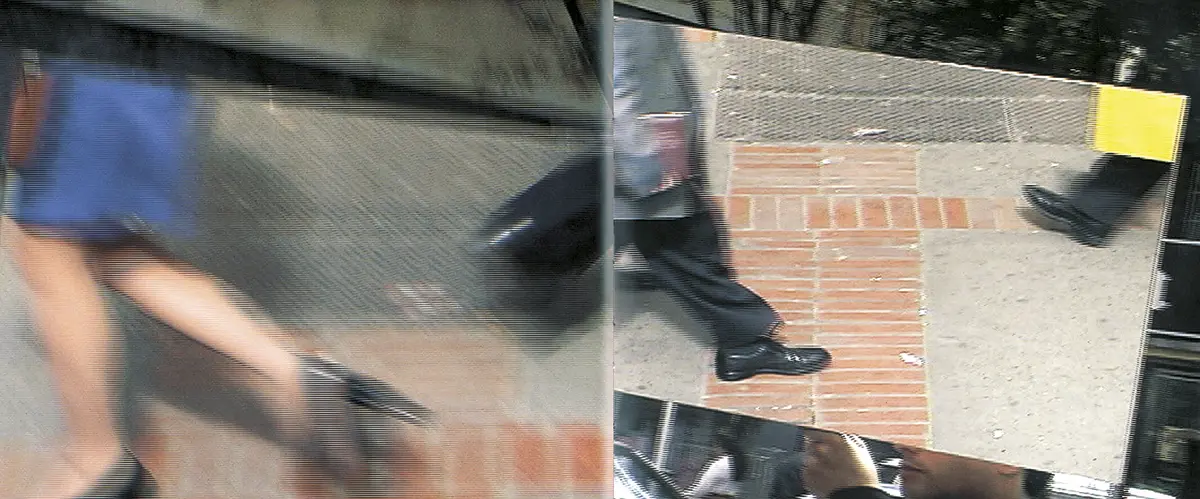
Clemencia Echeverri began this project, titled Lime and Song, two years ago. It developed from two experiences living in the city. First, a free breakfast program offered by the city’s municipal government to the people of El Cartucho, one of Bogota’s most dangerous and infamous districts. El Cartucho is home to all kinds of marginal characters, many of them drug addicts, and it is known as an “olla,” or center for commerce in illegal substances. Echeverri comments: “I went there accompanied by several people, among them Diego Arango, a Colombian filmmaker with whom I shared a camera in order to do an informal recording. It was a strong, dramatic experience, but above all, it made me indignant. They called it a carnival, but it was no party. What were we celebrating? People’s miserable living conditions? A tamal and a bowl of hot chocolate? What the whole affair made evident is that society’s attitude towards El Cartucho, and the attitude of the State as well, is one of impotence and contempt."1
The images from El Cartucho intersect those from the second experience that served as a basis for Echeverri’s video installation: a street rally, a “public, extroverted event, a place for protest,"2 one among the many such street rallies that occur today in Bogota, signaling a general dissatisfaction with the country’s situation. Her video installation intercuts one set of images with the other, making it impossible to discern exactly which is which: we see masses of people, patches of pavement, bodies in motion, garments dragged through the ground, knives, guns, glue bottles (many of the El Cartucho inhabitants are addicted to sniffing glue), gestures, and faces that fuse into an unending succession of moving images, at times so blurred that all we perceive is the movement, the slow movement of something in space. These images flow from one screen to the next, in a loop that invites viewers to follow and move in turn, first looking up and then looking down. Suddenly, in the middle of this slow procession, an image acquires color and becomes clearer, a woman’s face appears, and a camera stops on it and resumes a slower movement. Her facial features identify this character as a “common” woman; she smiles, shakes her head, and disappears, and the flow of images continues following the pace of the calls of boteeellas papeeel.
The neatness of the installation, the lightness of the screens which, mirror-like, multiply the image backward, the exact handling of video and sound resources, and the placement of these elements in space, all contrast with the theme of violence in the city, the rootlessness of these urban characters that move through Bogota, people whose entire lives take place in a place that most in the city consider inhabitable and impossibly hostile: the streets of El Cartucho.
Accompanying the show, a catalog was produced where Clemencia Echeverri, in conversation with Piedad Bonett, guides us through her creative process and explains her transition from sculpture to video. The images selected for the catalog illustrate with greater precision every one of the video’s elements, so that the knife, the cachucha cap, the ruana poncho, and all the other elements acquire a more detailed significance. The catalog includes a CD with segments of images and sounds from the artist’s most recent works. Printed on the disc we find the close-up of a toothless mouth, belonging to one of the women who go through the streets calling for boteeellas papeeel. It is a good summary of what Echeverri attempts with this video installation, shown last October.
NOTES
1. Clemencia Echeverri, conversation with Piedad Bonett, in the catalog Clemencia Echeverri, MamBo, Museo de Arte Moderno de Bogotá, October 2002.
2. Ana María Lozano, ibid.
MARTA RODRÍGUEZ