
My first impression from the Connie Lloveras retrospective at the Museum of Contemporary Art was one of great tonal intensity, and of sensual warmth. The show represented 12 years of work by this Miami-based Cuban artist, and it offered ample proof of the harmony in her creative vision, in particular with respect to her handling of color and light. Important highlights are the exploration of the aesthetic aspects of works in an abstract line, as well as her use of a wide range of reds, oranges, and yellows.
Within the wide variety of images and formats on display here, some works called our attention with their organic qualities and their colors, which suggested the warmth and humidity that can be found in soil or blood. At the same time, the pictorial elements told an inviting human story, one that the viewer immediately perceived as a psychological response to the images. This is an almost immediate consequence of our visual reaction to the works, resulting from the variety of materials Lloveras uses.
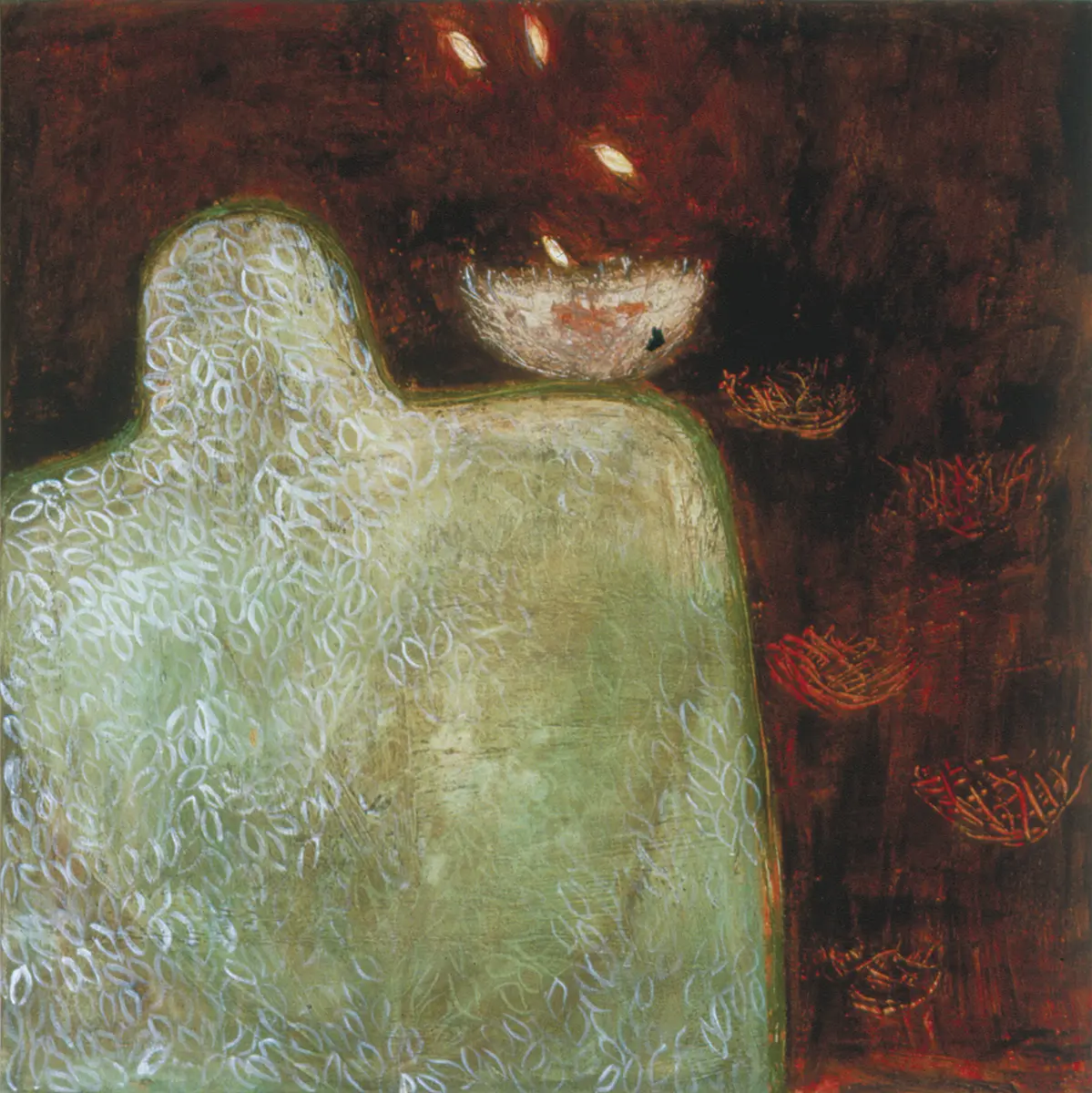
Lloveras’ evolution as an artist shows her technical skill growing throughout a decade, in a body of work characterized mainly by the use of mixed techniques on canvas, along with the incorporation of ceramic materials in some cases, and clay sculptures. The artist uses clay as an enrichment of the pictorial surface, and her works invite not only a visual analysis but also a tactile experience.
Lloveras’ art is not, however, purely abstract, despite the importance of color and texture in it. Lloveras is a creator of symbols. Her shapes announce or describe ritual-like objects and situations. In fact, her most interesting works are those that generate in the viewer the greatest number of interpretive questions.
The sequence of Lloveras’ works over the years shows a progressive reduction in the number of repeated shapes, arriving at stronger figures in ever-freer compositions. In the early 1990s, Lloveras’ images included recognizable figures, such as small houses represented in a child-like manner as a rectangle topped by a triangle. In works such as Off in All Directions, the artist used repetitive patterns of four of these houses, centered around a large “X”. Each of the houses’ grid patterns included, without breaking the compositional rigidity, a variety of allegorical elements. The same happens in Bears the Golden Fruit, a 1993 sculpture where a black column supports a blue triangular container full of apples, realistically executed but golden in color. This piece is rendered almost banal by the expressive capacity shown by Lloveras in later works.
The retrospective made clear that Lloveras progressively left behind the literalism and the small motifs of her early works, in favor of compositions based on larger, bolder, almost emblematic shapes. In what amounts to a personal symbolic language, combined with the use of clay, Lloveras offers elemental, ancestral shapes such as spirals, vessels, crosses, stairs, and wings, which bring to mind traditional iconographies in the history of art and, at the same time, the symbolic codes of Afro-Cuban religions and of psychoanalysis. This language of the artist’s own invites multiple, fascinating interpretations of her work and its message, intimately linked to human experiences and sensations.
The semi-circular vessels featured in many of Lloveras’ pieces merit a detailed analysis, because they relate directly to the incorporation of pottery in this artist’s work, as well as with the old idea that the art of pottery, which involves the four basic elements (earth, water, fire, and air), possesses magical and spiritual meanings. Also, vessels such as this have been taken throughout history to represent women, as well as the ideas of protection and nourishment, and internal values. A similar reading can be made of the many everyday objects that Lloveras uses in her works of the late 1990s, such as the cooking pot of Trials of Endurance and the watering can of Watering the Abyss, elements that represent iconographically “the cosmic waters, the generating matrix, the receptive feminine principle, fertility, and the heart.” (J.C. Cooper)
Towards 1997, a new emblem appeared in Lloveras’ painting: the tongue, which since antiquity has been associated with creation and the word. We find large, downward-pointing vertical tongues that occupy not only the focal point but the larger portion of the painted surface. Mute Words, a mixed technique-on-canvas work, presents a menacing tongue-column in earthen tones against a dark background; there is a subterranean feeling to this image, with its blood-red sections above and below the central element. The tongue is traversed by a series of horizontal lines and by shapes of branches that have been scratched in the paint. Despite the phallic verticality, this organic image suggests pain and also procreation and nature.
Similarly, we find in Lloveras a variety of elements taken from nature, with a strong allegorical charge. In her more recent canvases, we find seeds, trees, and leaves —painted, scratched, scraped— on a pictorial surface that is never neutrally smooth but always expressive, full of texture. The are seeds falling on receptive ground in Fertile Soil, and seeds dispersed in the deep, dark spaces of Interior Gardens. There are also paintings of geographical abysses like gorges and canyons where, despite the darkness, flowers bloom — a reflection of Lloveras’ optimistic outlook.
In Oneness, the seeds —which could also be read as vessels or containers— appear as sources of light, like living entities, within a circle in the bottom part of the canvas, above which floats a Protean, warm sun; a line of hot energy, resembling melted glass, comes own from this sun. Red and yellow live equally in harmony in Fragrance of Light, where the shape of an amphora crowned by a golden, radiant semi-circle appears against an intensely red background with dark shadows and textures. Visually and symbolically, these compositions speak to us of feelings, sensations, and experiences outside the boundaries of time. Perhaps these two works are the most memorable in the show. They gather together what’s best in Lloveras’ art: a lyrical combination of the modern and the ancestral, of technical sophistication and pictorial rusticity, achieving the feat of artistic communication the artist herself describes as “mute words.”
MÓNICA KUPFER