
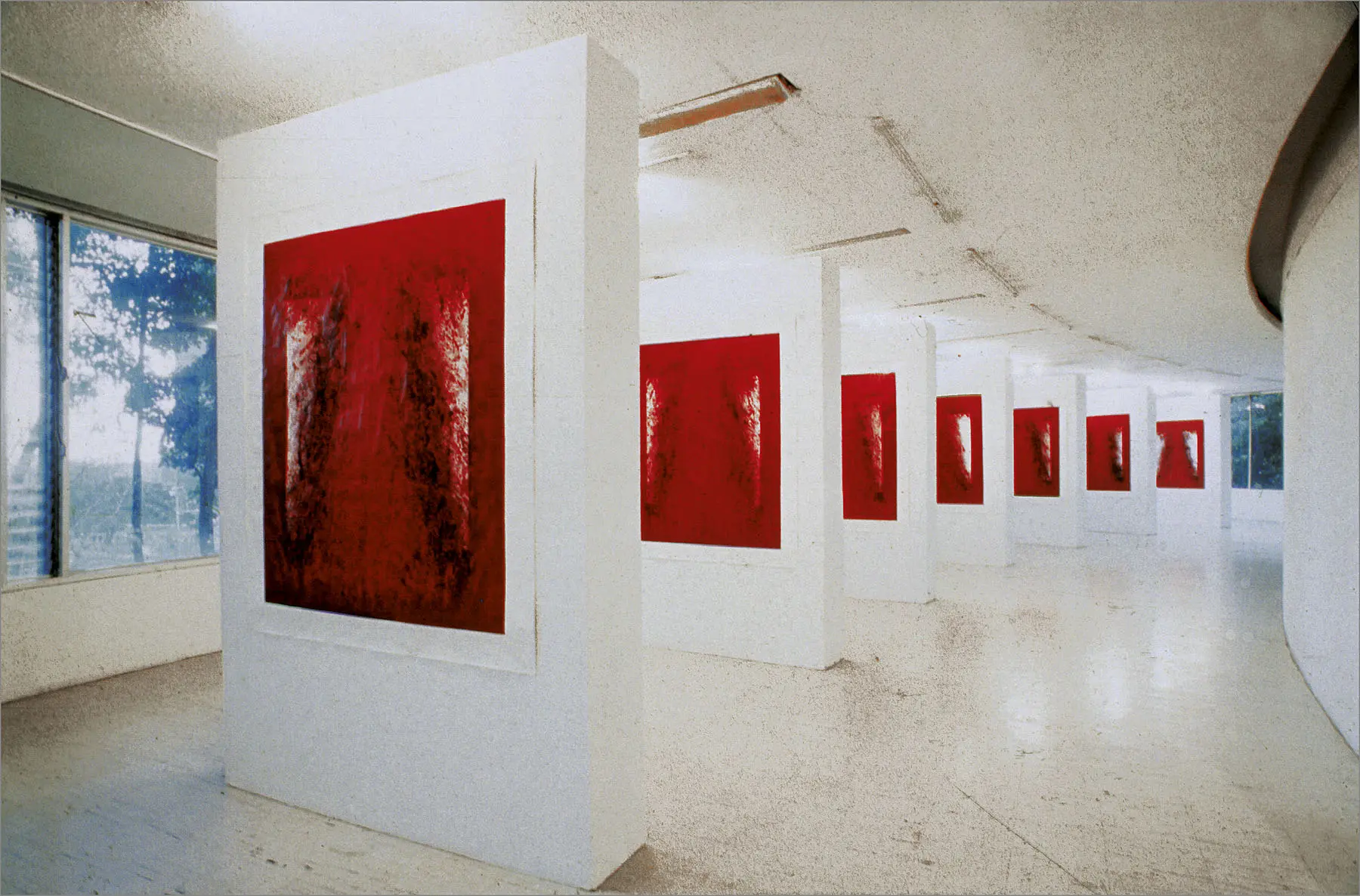
A simplistic view of the use of the color red in the work of Delcy Morelos (1967, Tierralta, Córdoba, Colombia) could drive us to rather obvious conclusions: a Colombian artist living in a violent society, she creates visual metaphors for the permanent presence of blood in her world. This reading, however, is too dependent on the immediacy of the observed, and it forecloses a deeper intentionality.
Morelos was born in Tierralta, a land of conflict between guerrillas and paramilitaries, and she lived there through her adolescence. After trying several other cities along Colombia’s coast, she settled in Bogotá, the nation’s capital. Immensely complex, Bogotá confronted Morelos, once again, with the daily reality of violence. Perhaps her adolescent experiences had been stored away only to reemerge when the artist found herself faced with an urban reality so different from that of Cartagena, her previous place of residence. It is in this period that Morelos’ reflections enter into contact with the other, identifying what she conceives as humankind’s natural disposition towards violence. Respect for difference has no place in a scheme of "to eat before being eaten."1
Already in her earliest works, Morelos showed a special interest in expanding the possibilities of her painting. She belongs, thus, to that significant cohort of artists who find in this genre an opportunity to analyze and drive forward their own processes, denying in that way the supposed obsolescence of painting —something about which there have been long debates during the second half of the 20th century2. Painting is no longer forced to play the role of window; it opens itself to installation, to the taking of space as a totality, and it breaks with traditional understandings that restricted the concept of two-dimensionality.3
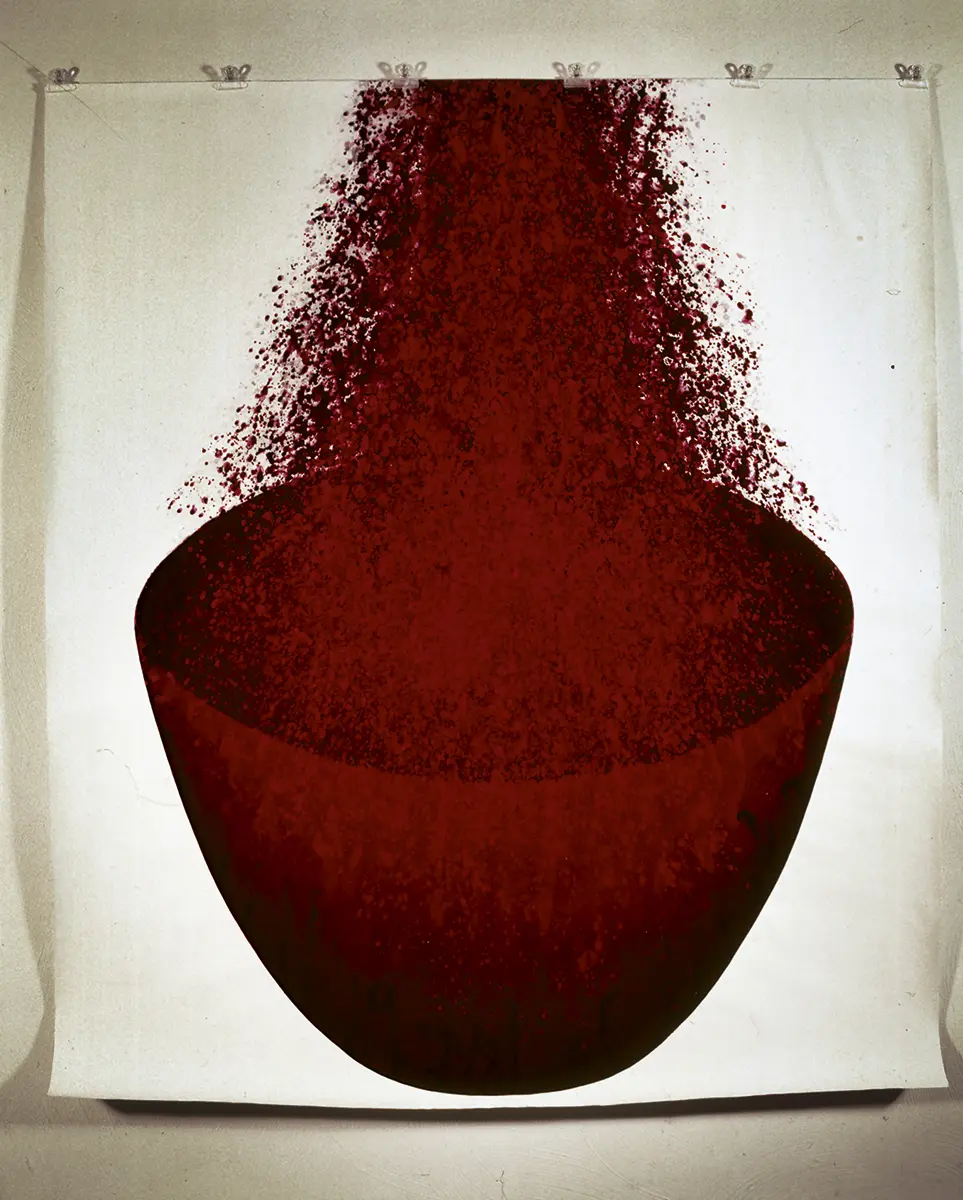
In 1995, beginning with her series Rojos por naturaleza (Reds by Nature) and De lo que soy (What I am of), the lines of force in Morelos’ work became more defined. Those geometric bodies she erects explode due to the impossibility of containing forces that confront us with the question of whether they want to destroy or liberate us, using torrents of red. Going back to that attitude of primary violence, so significant for this artist, this red that comes through impetuously makes us think of that state of mind, often nonconscious, which can drive people to hurt each other without concern or to assume that the other is evil. The double moral standard that is part of our daily lives, the tension between destruction and liberation, is the support for that disquieting duality of order, suggested by geometry, and a violent rupture of a container that blows up to smithereens, breaking all boundaries
Para seres que han perdido toda identidad humana real (For Beings Who Have Lost All Real Human Identity, 1997) closes Morelos’ first period of reflection on these topics and presents us with the human need for self-knowledge and self-exploration, as well as self-acceptance. In that self-knowledge, one needs to be particularly strong in order to break with the dominant patterns, remain uncontaminated by what the mainstream establishes, try to approach a conscious minority and hold one’s ground against that violence that reflects the situation of society as a whole.
Morelos’ paintings allude to that primordial violence that underlies society, as well as to some of its specific manifestations: racial discrimination, for instance —identities imposed on the basis of skin pigmentation. Color, besides being a basic element in painting, has given arbitrary names to various human populations, so that it is common to speak of "people of color" to refer to the non-white. We shouldn’t forget either those "caste paintings" that were common in Colonial Latin America since the 18th century, which created a convoluted inventory of races and their possible combinations; in this system, the greater the percentage of "whiteness," the greater the "purity," and the higher the social status.
In those old colonial paintings, the family group played a central role, and the emphasis was placed on the different racial variations mixed breeding created. There were specific names for each group, and these were the titles of the paintings: An Indian man and mestizo woman produce a Coyote; A torna atrás with straight hair and an Indian woman produce a jenízaro, A jenízaro and a mulatto woman produce a barcino. Several of these designations ended up acquiring a pejorative meaning in colloquial language. A peculiar classification of colonial populations was thus created following pseudo-scientific criteria, under the general drive towards classification that pervaded the natural sciences during this period. Of course, some of those paintings include judgments about the characters represented, emphasizing the white race’s superiority. In one painting of José Joaquín Magón, a Mexican from Puebla de los Ángeles, a sign could be seen reading: "Of a Spaniard man and a pure-blooded woman, the beautiful fruit resembles his father hair by hair." As racial mixtures grew more complex, the results were judged more negatively; the darker the skin, the more degrading the adjectives used to describe it.4
In Morelos’ view, this situation is not relegated to a colonial art that today can be considered intriguing; for this artist, the problem is one of our times. In the catalog for his series Color que soy (The Color that I am, 1999) Morelos included texts by well-known personalities of Colombian politics of the early 20th century, all of them emphasizing the need to legislate towards the "purification of the race." It should suffice to quote, as an example, the ideas of Luis López de Mesa, who wrote that "the mixture of the indigenous races with the African element and even with the mulattos derived from it, would be a fatal mistake for the country’s spirit and wealth. Instead of canceling each other out, the defects and shortcomings of each of these races would accumulate... This mixing of impoverished bloodlines, of inferior cultures, will generate inadaptable products, perturbed, nervous, feeble-minded, demented, epileptic, criminal elements that will fill asylums and jails upon contact with the civilized world."
Through a law passed in 1922 with the dubious goal of "purifying the race," Colombia denied entry to the country to people of Chinese, Hindu, and Ottoman origin while encouraging European immigration in order to promote the emergence of "select racial groups" by the mixture of Germans and Scandinavians.5
Color que soy (1999) and La base oscura (The Dark Base, 2000) are two series that explore the issue of racial segregation, which is also social and cultural segregation. Autobiographical elements are not absent from this exploration, since this situation arises in those places where there are non-white populations —places such as the artist’s hometown of Tierralta, and Cartagena, where she lived— even if these ethnic groups, considered "minorities" constitute the actual majority of the people. In Tierralta, the majority of the population is indigenous or black, but both groups are socially considered minorities. In Cartagena, the black segment of the population becomes a minority due to the territorialization of barrios, as well as because of the way in which power is administered and official culture imparted.
In Color que soy Morelos works with the colors of skin, the actual ones, to speak of the discrimination to which the darker hues are subjected. According to Morelos, "To be less dark is to be more."6
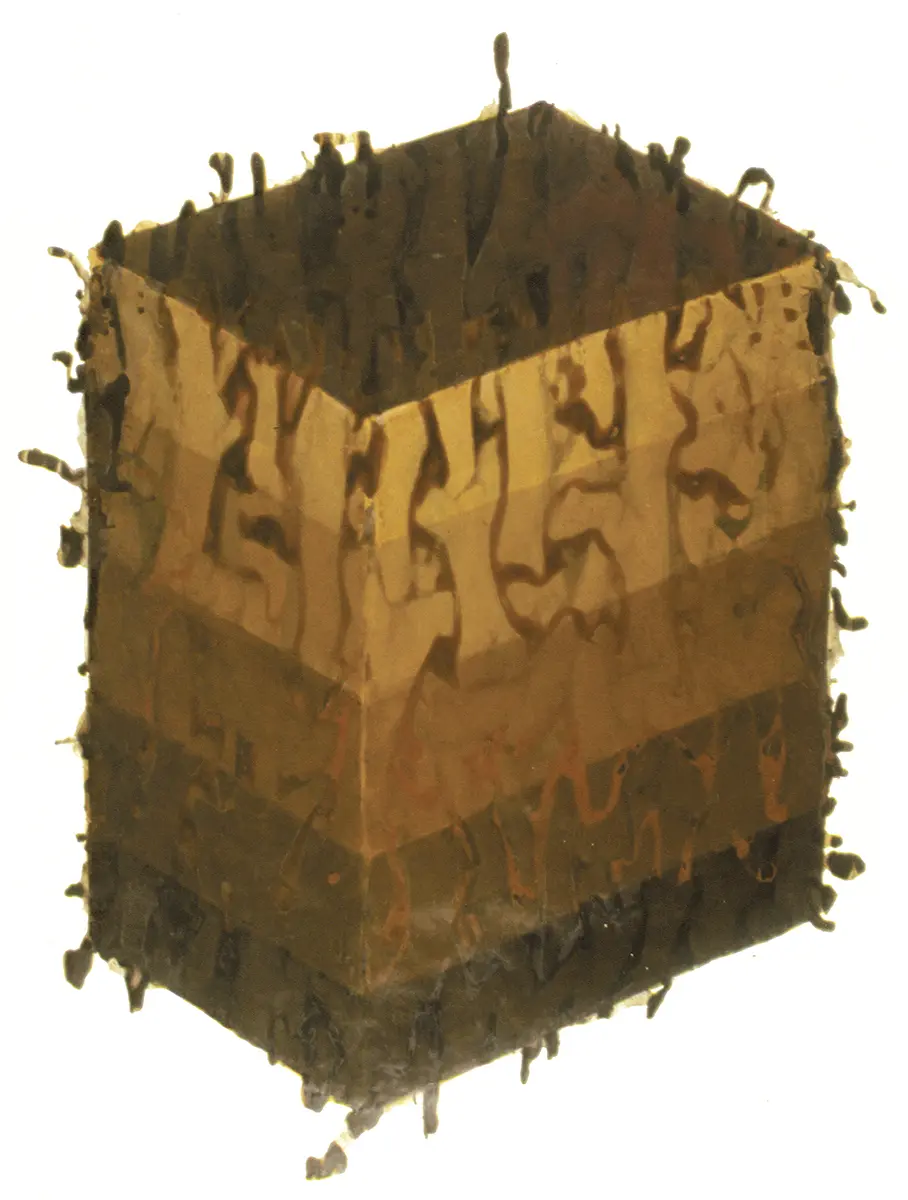
Distinctions and identifications are supported by what is visible: our place of residence, our clothing, and the color of our skin. These elements locate individuals in specific places within society. Morelos’ fields of color in her skin studies show a deep exploration of chromatism, one that leaves room for pictorial subtleties such as those that result from the superposition of erasures, textures that allude to the body and its fluids —blood, for instance—, achieving a series of disquieting chromatic fields in an abstract language, which denotes a particular sensitivity to the potential of color.
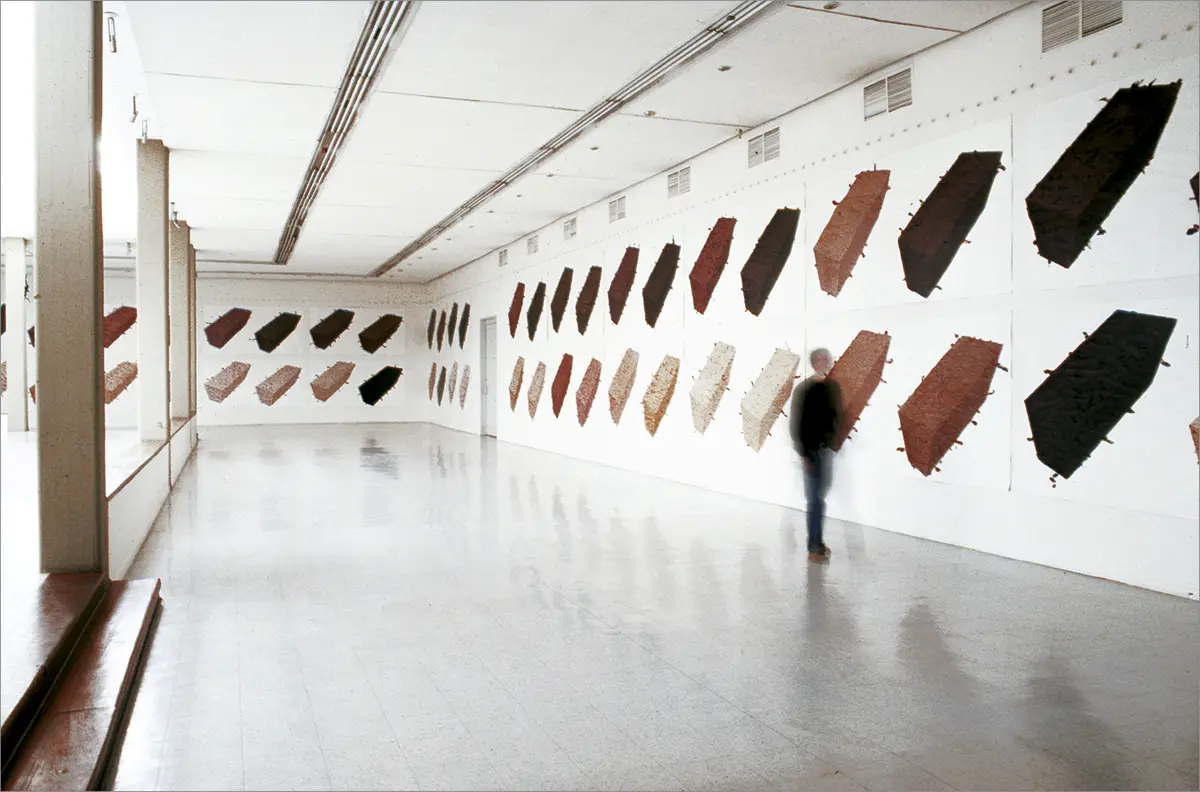
In La base oscura Morelos’ exploration of skin tones refers to the fact that the darker hues appear at the base end in many theories of color, and the move towards lightness is presented progressively, as if it were a development in the direction of something better. The relationship between human skin and color gradations, both essentially pictorial, links them to a reflection on social structures.7 Again we encounter the issue of segregation on the basis of color.
From the same series of explorations around the analysis of skins, colorations, and their meaning both socially and politically, a new proposal emerged and was shown at the Museo de Arte de la Universidad Nacional, in Bogotá, in August of 2002. Each of the 60 paintings exhibited represented a color scale from the darker to the lighter, the range of color studied by the artist as she prepared the show. Each one of them is intended as an independent geometric model, which in turn connects with the next, turning the addition of individual parts into a coherent whole —a whole in which an essential pictorial interest can be discerned. It is through color that meanings are deployed, in works that intertwine the cultural, the racial, and the autobiographical.
From her Rojos por naturaleza (1995) to the seven pieces of Dos mil cuatrocientas ocho veces (Two Thousand, Four Hundred Eight Times, 2002), Morelos has worked with rotund geometrical or organic forms in which color seems to overflow beyond the limits imposed by the format. Morelos paintings become installations thanks to her unique relationship to space. Space is definitive because painting allows her a handling of space-time that goes beyond the anticipated two-dimensionality. In Morelos’ projects, the relationship with the site generates an exploration that transcends the merely pictorial, and each piece becomes an integral part of a spatial intervention conceived as a totality, as a unit.
To paint is also to establish a special relationship with the gaze. Watery paint, superimposition of erasures and veilings, drippings—all of these techniques allow Morelos to build a sensual surface from only a few simple elements.
But Morelos’ paintings go beyond her interest in questioning space and matter; they make evident the problem of the individual submerged in violence. The artist’s intention is to make us think about the human condition, in a world where conflict is a part of human essence itself —a world where conflict is universal and reaches far beyond its immediate context.
NOTES
1. Conversation with the artist in Bogotá, September 24, 2002
2. The number of artists who have explored the possibilities of painting, from different perspectives and thematics, is ample and significant in Colombia. As an example it should suffice to name Beatriz González, Carlos Rojas, Miguel Ángel Rojas, and Óscar Muñoz, among the precursors; among the more contemporary artists who show a similar interest in formal pictorial treatments we can count Danilo Dueñas, Rodrigo Facundo, Luis Roldán, Joanna Calle, and Beltrán Obregón, among others.
3. Ilya Kovakov, "La vida de las moscas." Appeared in the catalog published by The Cologne Kunstverein, Germany.
4. María Concepción García Sáiz, Las castas mexicanas. Un fenómeno pictórico americano. Olivetti, Mexico, 1989.
5. Carlos Uribe Celis, Los años veinte en Colombia. Editorial Alborada, Bogotá, 1991.
6. Conversation with the artist in Bogotá, September 24, 2002
7. José Ignacio Roca: "La nueva exposición de la artista Delcy Morelos: una obra autobiográfica." El Espectador, August 6, 2000
IVONNE PINI
Art Historian, professor at the Universidad Nacional de Colombia, and Executive Editor for ArtNexus.