
Two South American artists whose careers developed to a significant degree in Panama, sculptor Ernesto Ortiz and painter Fernando Toledo, had individual shows recently at Arteconsult Gallery. Ortiz was born in Chile and lived for 15 years in Panama, a country he loves and whose citizenship he adopted. Toledo hauls from Ecuador, but settled in Panama City in 1991, and has achieved since then success as a painter.
Ernesto Ortiz
Ortiz has been working in three dimensions for over 20 years and is known primarily for sculptures (first in ceramic and later in bronze) of small and gracile female figures with round shapes, playfully posed. Those figures, explored for so long, gave him great popularity in Panama, and his gorditas (“little fat girls”) have appeared in all sizes, from miniatures to large-format public sculptures.
For many years Ortiz taught at the School of Architecture of the Universidad de Panamá, guiding scores of young artists and students through the languages of design. It was in fact at the School Architecture’s Las Guabas workshop that Ortiz, originally a designer, first acquired an interest in ceramics, and it was there that his earliest sculptures were born.
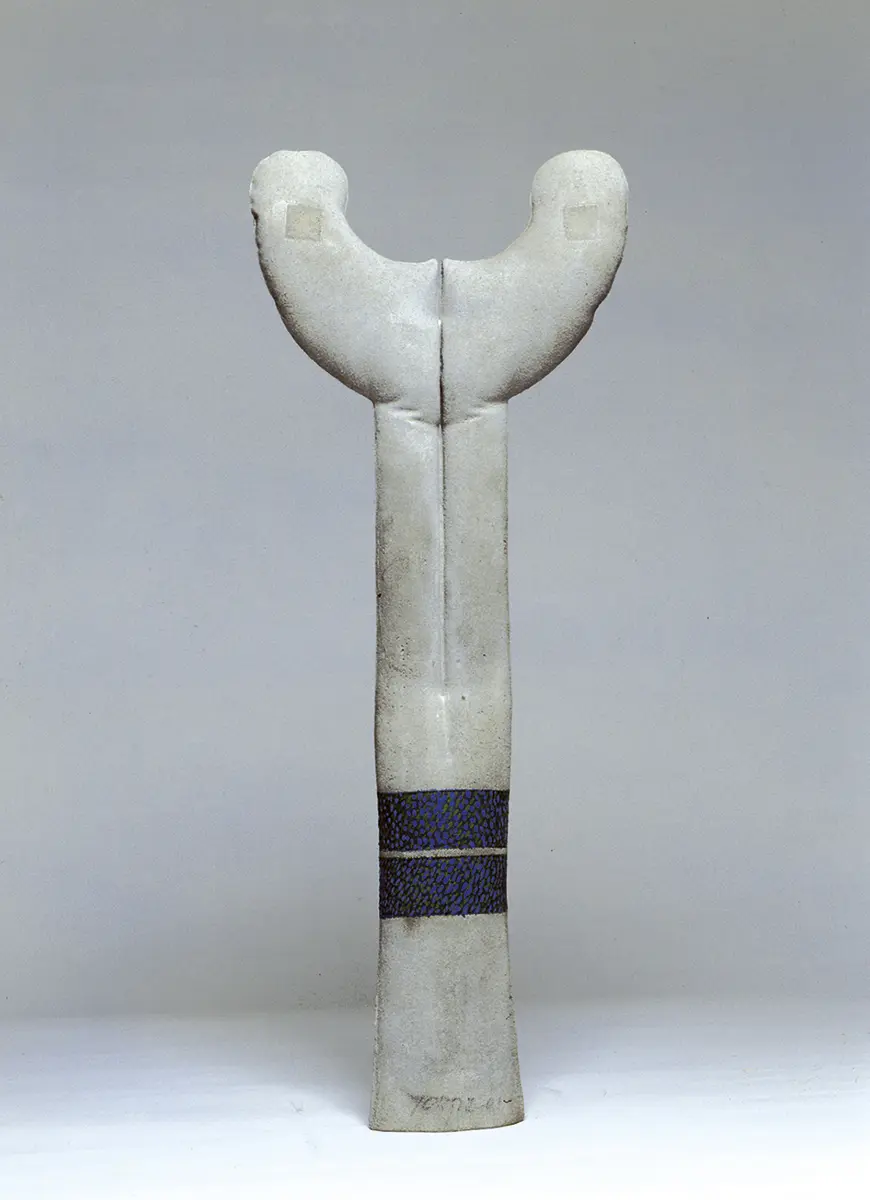
After Panama’s economic crisis, Ortiz relocated to Colombia for a number of years, and today he is back in his native Chile. Some time ago, he was invited to participate in a competition for sculptures in concrete, and the invitation induced him to experiment with new shapes. He thought up a system for the use of cloth molds, sewing together patches and turning them inside out to generate the space to be filled with concrete. With this system, Ortiz created a number of primarily vertical pieces, like solid, gray totem poles on which the tracings of the cloth were still prominently visible. Contradicting the solidity of the material, these sculptures looked like stuffed skin, and they were not without a certain morbidity. Somehow, this project in concrete managed to cause the same impression of fatness that has always characterized Ortiz’s works.
The cast iron sculptures Ortiz presented recently in Panama are derived from those concrete pieces. Noticing that concrete tends to crack, and wanting to achieve greater durability for his works, Ortiz opted for exploring similar shapes in metal. The challenge was to create iron pieces that would resemble cement and retain the organic, stuffed look of the earlier works, with their cloth markings. The result illustrated Ortiz’s ingenuity and creativity, adding a new turn to the oeuvre of a sculptor who for years has been primarily known for his figurative, comic, and repetitive works.
Regarding their technique, these sculptures originate in drawings that the artist sketches on paper and then transfer onto the cloth for the mold. The patches are sewn twice so that they can later be filled with concrete “like a glove is filled in by the hand”, according to the artist. The mold is created in the workshop to generate the original piece. These originals are unique works in cast iron created through a simple process known as “a la tierra,” which preserves the material’s natural state. Ortiz does not paint his sculptures; their coating is the product of oxidation, which the artist speeds up using chemicals. By polishing his works selectively, Ortiz achieves a variety of finishes within a single piece; the range of variation is wide, and some of the sculptures even resemble bronze.
Ortiz worked his pieces as abstract art, but the result is shapes that the artist himself relates to the textile art or the Mapuche people of Southern Chile. The show’s title, Tótems Australis, fits these ritualistic creations. They possess a strong symbolic charge, one that is not expressed directly, but only suggested. Their vertical orientation and symmetry remind us of tree trunks, crosses, roots, people, and even winged beings. They suggest a vague, distant memory of a past civilization, or perhaps a physical reaction indicated in the way the artist “pinches” the skin, forcing it into difficult positions. These totems are not only beautiful in their own right; they are beautiful in their miniature monumentality and in their announcement of a new artistic avenue for Ernesto Ortiz.
Fernando Toledo
Ecuadorian artist Fernando Toledo was part of the cohort of painters who gained prominence in Panama during the 1990s. His most recent show, titled Individual Signs, gathered a series of acrylic-on-canvas works infused with this artist’s known spirit of innovation. A three-time winner of the Panama Art Biennial in the 1990s, Toledo has continued to eagerly and skillfully experiment with drawing, collage, polypthics, and installation art, without altogether abandoning his essential commitment to the art of painting.
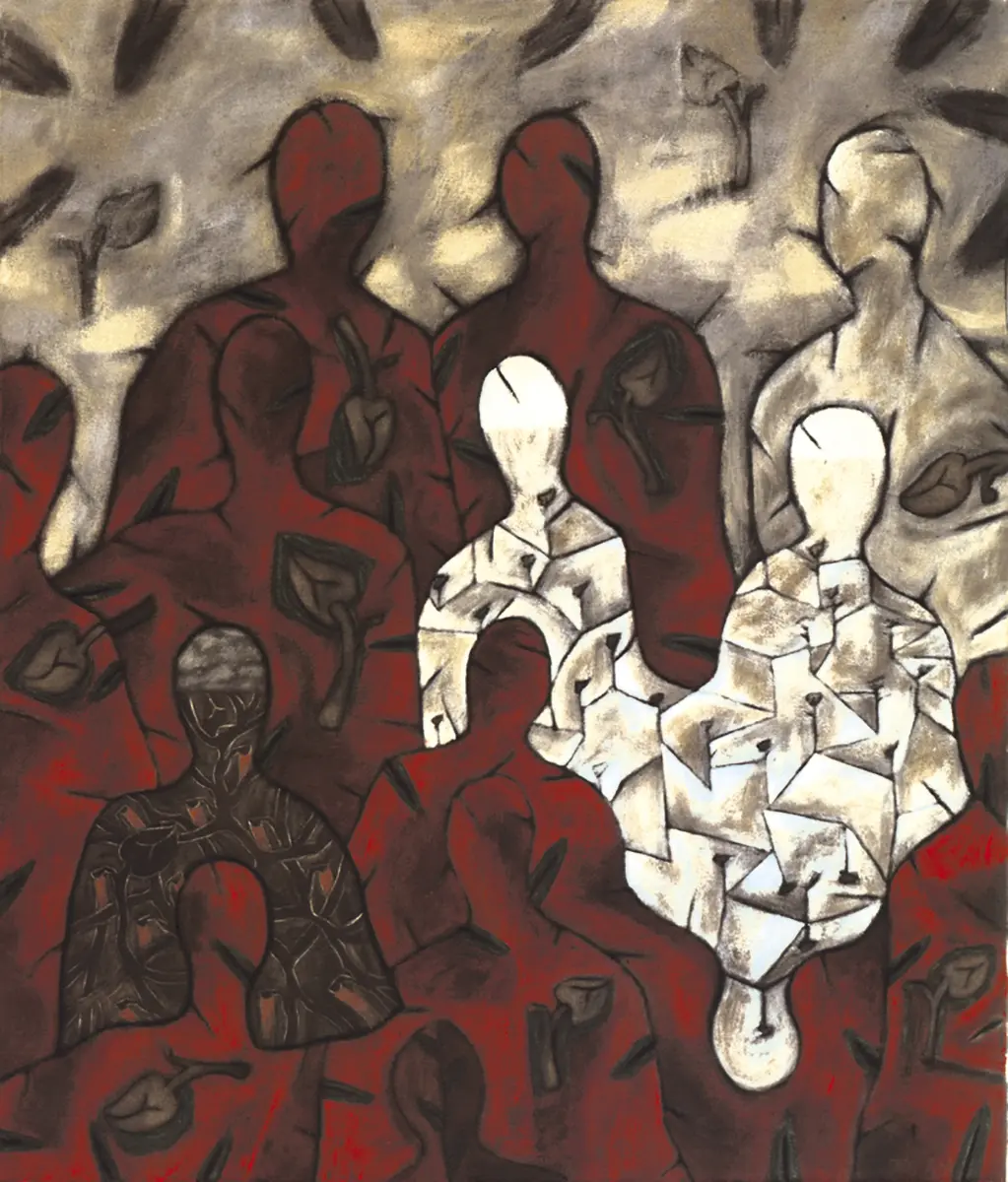
In these recent works, we find Toledo reinterpreting in new ways one of his favorite themes: the human condition. In contrast with his figures of 10 years ago —those small men in large, lucid, basically geometric spaces—, Toledo’s newer figures appear large and dominant, suggestive, enveloped in an entangled, confused darkness. These stylized, mostly faceless figures suggest a vision of human beings as concepts, as participants —sometimes dominant— entities in environments that are both natural and sociopolitical. The presence of many of these figures in Toledo’s new works brings to bear the question of human relations, of the sexual or biological as well as the social kind, with reference to conversations or groups.
In almost all of these works, Toledo paints his figures surrounded by curved shapes that resemble roots and thorned vines. His compositions evoke humid environments, full of warm colors, such as the rainforest or the tropics. It is tempting to assume that the artist is copying his surroundings; yet, in his works, we find not only the natural environment but political commentary and metaphors aimed at social protest as well. There are clear examples of this, such as Arboreal Nepotism, where a tree is presented as the symbol of political cronyism, with numerous men-parasites overtaking its branches, or those portraits of figures covered in thorns that Toledo describes as Honorables —the honorific given in Panama to people in high government office.
In these paintings, Toledo has tended towards dark colors, which perhaps derives from his vision of contemporary humanity. His handling of color is sensorial and careful, but the luminosity that characterized his previous work is missing here. The artist prefers now blood-red, ochre, and earthen tones, as well as blue hues in works that suggest flight or thought. In some of the most recent works, such as We Are All Honorable, Toledo has used for the first time mirrors as canvases where viewers find their own reflection and are thus incorporated into the piece, along with the light the mirror generates. On the other hand, perhaps the most creative pieces in the show were, despite their simplicity, some “raw” canvases that Toledo hung from the ceiling, banner-like. In these vertically hanging surfaces, we saw figures in human scale, within compositions created through expressive black-and-white strokes and in an entirely new format, all of which undoubtedly expanded the visual and interpretive potential of Toledo’s work.
MÓNICA KUPFER