Florencio Gelabert’s recent show at Ambrosino Gallery opens up a new perspective for the understanding of this artist’s work. At first glance, the photographs of small figures against a white background presented here appear to be an entirely new exploration for Gelabert. The figures’ irregular contours make it difficult for the viewer to determine their exact shape, and this discovery brings home the show’s conceptual point, at the same time helping us establish important connections with Gelabert’s previous work. This Miami-based Cuban artist has worked primarily as a sculptor, and his oeuvre is an exploration of conflicts of identity, migration, and sociological themes. Tools such as hammers, sickles, and axes have figured prominently in his work, with all their symbolic import: these are mutilating maiming, truncating instruments, and the artist has used them as such, but also as tools for the construction of new things and as aids in agricultural work.
In each of these pieces, the central character is the tool itself, masked by flowers; in an ironic turn, that which could have been cut down by the instrument becomes its support. Those who know Gelabert, know of his current circumstances. For those who don’t know him, let it be known that they are love, betrayal, dignity, and manhood. And these elements are, precisely, the foundation of his work. Each one of these concepts belongs to the artist’s personal history, and his iconography lies with them in the development of every one of his ideas.
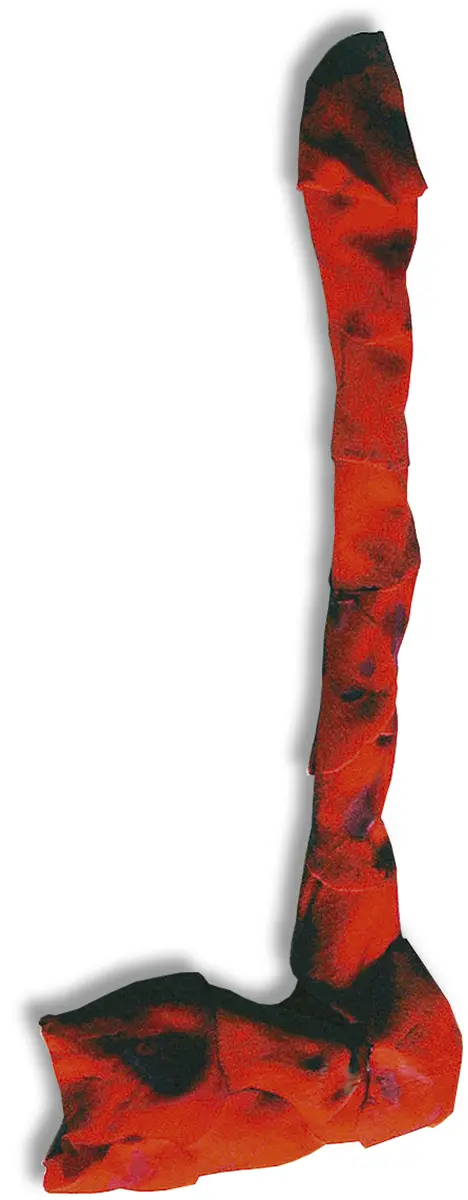
In He/Él, Gelabert uses a vividly red ax, personified by red roses that allude to virility and blood-letting. Implicit in the image’s forcefulness is the idea of violence, complemented by the placement of the ax: it is inverted so that the handle protrudes upwardly, erect, and phallic. This is how the artist represents a conflict in which passion is the protagonist. In She/Ella, however, the image becomes softer; again, the ax is the sole figure, but the roses are now pink. As in He/Él, the main focus is on the wide space created by the rose’s petals, completely open, and charged with sensuality. These two works use the same figure to represent masculinity and femininity; only the color and the placement of the petals induce different readings, giving each piece its own meaning and its own strength. In works like Three, Two, Gelabert has used knives that seem to threaten each other in a sharp confrontation, but again the presence of flowers softens the impact.
The white background reinforces the figures as the focus. The photographs were shot on the artist’s bed, and even though this fact is clearly discernible, it is made explicit. The bed, just like the white background, is the symbol on which passion is forged and brought to fruition.
Florencio Gelabert has demonstrated his ability to manipulate life’s events and to transform difficult situations into rituals of love, by bringing their energy to bear in the work of art. There are no complexes here; all the elements of the drama are represented, and intelligently reworked through symbols within a poetics of ambivalent connotations. Love can be destructive, but even then it is gratifying; in its essence, as in life itself, violence and seduction are implicit.
MARISOL MARTELL