The city of Havana, so often the source of inspiration for troubadours, composers, poets, and painters, is today the inspiration for Ismael Gómez Peralta’s work. This young artist, born in Cuba’s countryside, has appropriated Havana and made it the center of his art.
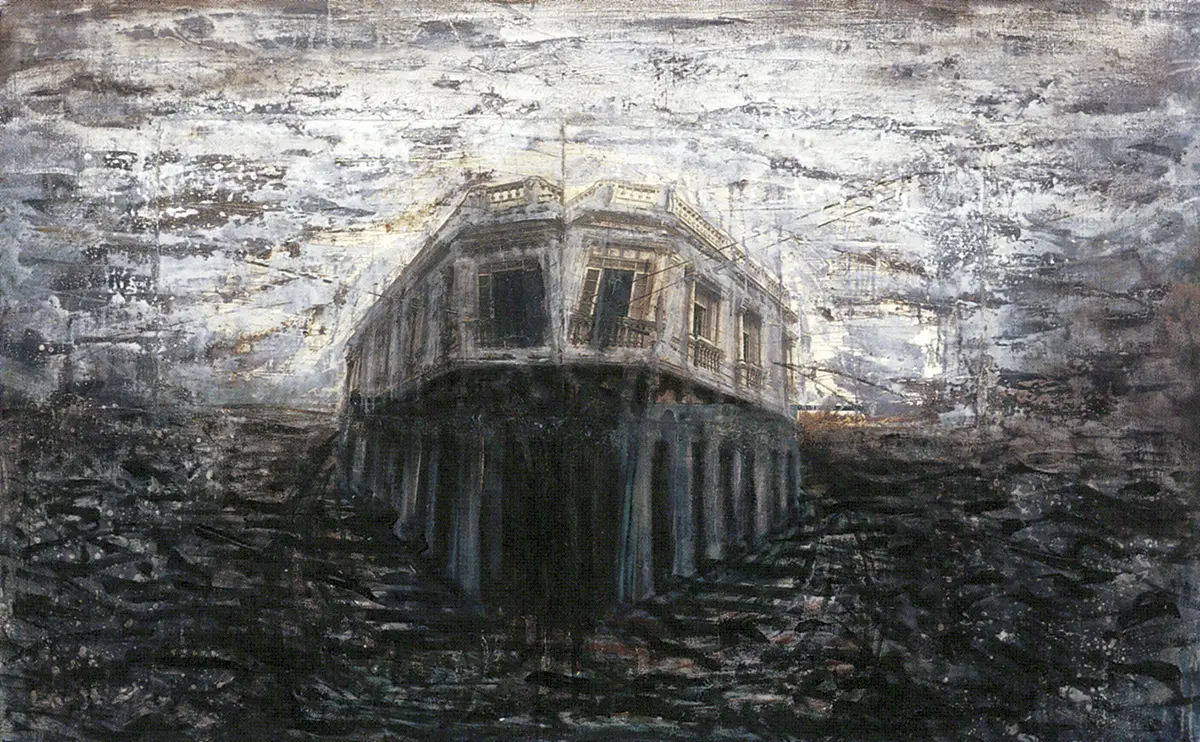
Gómez Peralta’s concept is to present Havana as it is, without adornments; he aims to show the actually existing, its everyday realities. One could assume that his goal is a purely mimetic mode of representation, and this assumption would be reinforced if one takes into account that the artist has used some of the city’s most famous street intersections and building façades. Plus, it is precisely at this point that his show acquires relevancy, as the documentation of the current state of the places it recreates.
Yet, although there is something to this assumption of Gómez Peralta’s direct representational aim, it is also an unduly simplistic judgment. The work’s documentary character is strengthened if we take is as a testimony of the times, of the passage of time, and of Cuba’s sociopolitical circumstances, In this sense, it is part of the vision and the sensibility of a contemporary.
Gómez Peralta’s work shows architecture devoid of human presence, enveloped in lonely and lugubrious atmospheres; these images transmit and generate sensations and feelings related to desolation, abandonment, and helplessness.
The artist directs our attention towards those things that habitually go unnoticed, dismissed as just plain and every day. Gómez Peralta’s city is presented in live flesh, so that we truly see it, so that we see it as it is in its current situation. We find ourselves before Havana’s streets and buildings, now emptied of splendor, marked by the inevitable passage of time and men. To paint a testimony of a Havana in ruins is a heartrending creative act.
Gómez Peralta’s poetics is supported by the art of black and white photography, allied to a sober palette of (for the most part) ochres, blacks, whites, and blues. Photography serves well the documentary's aim, as he works from non-manipulated shots that are added to the work until photography and painting are fused.
This can, at first glance, appear as a very local expression. Yet there is a more general lesson in Gómez Peralta’s art about the way we ought to look at our immediate reality, recognizing the merely superficial and searching for deeper truths. It teaches us to look up and discover those things that we normally miss, walking as we do immersed in our own thoughts. Those of us who know Havana are thus confronted with our own nostalgia and driven to discover the city as it really is, not as the subconscious remembers it.
Requiem for Havana is a kind of homage to the fallen city; its magic is powerfully poetic, but the city’s condition is a tragedy.
MARISOL MARTELL