
The title of the anthology exhibition of works made between 1957 and 2002 by José Ramón Sánchez (Maracaibo, Venezuela, 1938) could not have been more fitting for an artist of such peculiar originality: The Ghosts of the Living Pond. It refers to a piece started in 1997, when Sánchez was living on the island of Toas, and finished in Los Puertos de Altagracia in 2002 —a piece that for him “gathers all of Saturn’s calamities, the most mortifying, the sharpest canvas I have ever had to face, one that carefully walks through my temples, unending, subversive, infinite, causing the same sensation one has on a train: when I thought I moved forward, I was in truth going backward.” More and more Sánchez uses the accumulation of images located in a restless space and a restless atemporality. In his works of the last ten years, it is an accumulation of objects that we encounter, revealing a growing interest in the three-dimensional, without altogether rejecting the wall.
The artist’s wandering spirit has had him move from his native Maracaibo to Caracas, Paris, London, Nice, New York, and San Francisco, all the while coming back to the warmth of Zulia in order to find protection against the malefic oppression exercised on one’s soul by the other. The obsessions and flights of imagination that accompanied him in his travels have been favorable scenarios for the construction of hallucinated themes that, naturally, have and do not have to do with reality. For Sánchez, this almost metaphysical duality has always propitiated new encounters with art.
This is the work of a free spirit, a spirit that has not set any boundaries for imagination or for life. It’s the work of someone who felt himself capable of developing an oeuvre that defies conventional understandings and that, in my judgment, cannot be easily labeled with any of the –isms of the historical avant-garde. Already in the late 1950s, he presented himself as a natural colorist, as well as a teller of visual stories resolved in vertiginous accumulations of characters and situations. The surface of his works is traversed by baroquism and horror vacuii. The plastic situation is resolved by the addition rather than the subtraction of elements, something that the artist himself would define as “…the passionate diagram of an irrational symbolic geometry…”. It is as if Sánchez were committing an arbitrary plastic assassination only to transform it immediately, and contradictorily, in an act of love. It is not by chance that he moved closer to the aesthetics of surrealism and developed an interest in the poetry of Lautreamont as well as in Kafka’s literature, nor is it surprising that he felt the need to explore the issue of evil (does he condemn it? Does he justify it?). Both The Electrocuted Man and The Executioner, from 1965, speak to this topic.
In the 1960’s, and ever since, Sánchez’s work has incorporated aesthetic elements from the art of the comic. Equally perverse, his themes come from different places, but the main source continues to be the artist himself. From the very beginning, he saw his work as a kind of collage; even if he didn’t necessarily follow the technical conventions of the collage arts, he used the concept in the composition of the pictorial surface, as is clearly visible in Finally, San Francisco, of 1981-1985, where the superposition and juxtaposition of characters, forms, and figures, as well as situations and circumstances, turn the work into a veritable conceptual collage. In the 1980s Sánchez intensifies his use of color, to the point of an impossible ferocity. The shining effects he sought as a child by placing metal and glass shards in water are achieved here with an almost morbid feeling. The accumulation of objects is also intensified in this period. Found objects are resemantized by Sánchez into different levels of the aesthetic category, It is not the simple finding of stuff but something more complex, since the artist works on them and places them as if they were found lines in the gestural expression of intensity. A number of these works resemble Pollock’s Cathedrals. The artist’s madness is conscious of its temporality and of his own need for transcendence.
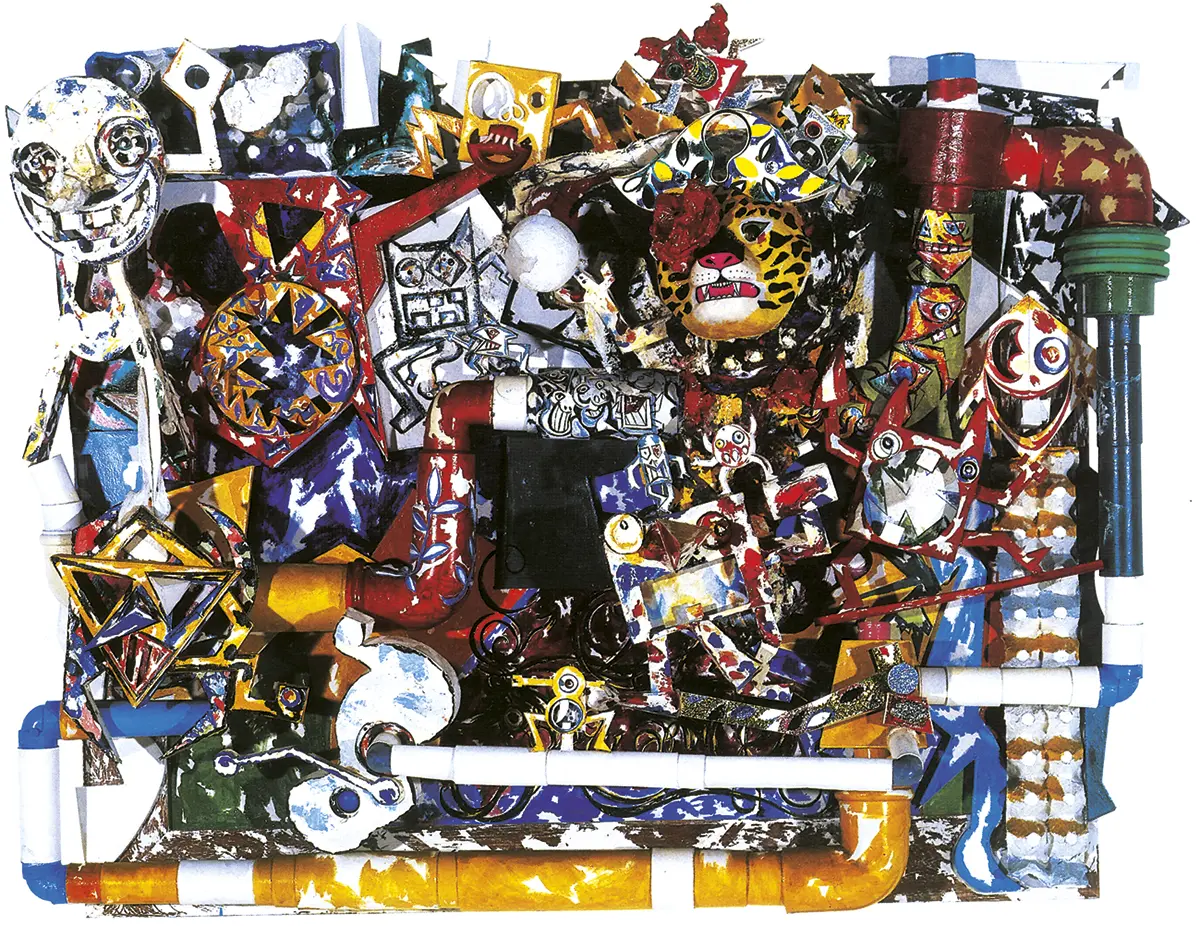
Extremely unique works are Three Astronauts, 1985 and Portrait of Marta, 1986-1988, where the playful aspect is already present with all the characteristics we will later find in The Sieving of the Wheat, 1997. The fiery colors, the intense accumulation, the absolute lack of respect for convention, collage is the end, collage “confirmed a taste and a smell that had already made a loyal amateur out of me, thanks to their diverse materials: glass, wire, silk, wax, fossils, jewelry, church ornaments… even the ferrous veins of Lautreamont’s sewing machine."
José Ramón Sánchez’s ghosts in a living pond, trapped in his works, have antecedents in Venezuelan art. They are not alone.
BÉLGICA RODRÍGUEZ