
In Satori, her show at Nina Menocal Gallery, Magali Lara presented one of the most introspected propositions of her career. We had known her large canvases traversed by revealing brushstrokes and evident gestures; Lara offers now small-format works of a more intimate character, yet possessing an undeniable intensity.
“In Zen Buddhism, satori is a form of enlightenment produced by the rupture of causal logic. It can appear as an instant revelation, as well as an intuitive experience,” we read in the show’s catalog (beautifully designed, it should be noted, by Ricardo Salas).
The show is organized into eight series: Construction of a Body, The Other (She-Monster), The Question, The Tip of the Tongue, The Sun, and Viscerality. Lara has worked on letter-sized pieces of paper, which generate a sense of immediacy and accessibility and allow the viewer to discover in each piece, along with traces and color patches evoking bodily forms, fine, precisely ironic line drawings of elements that complement the fields of color occupying the larger portion of the plane.
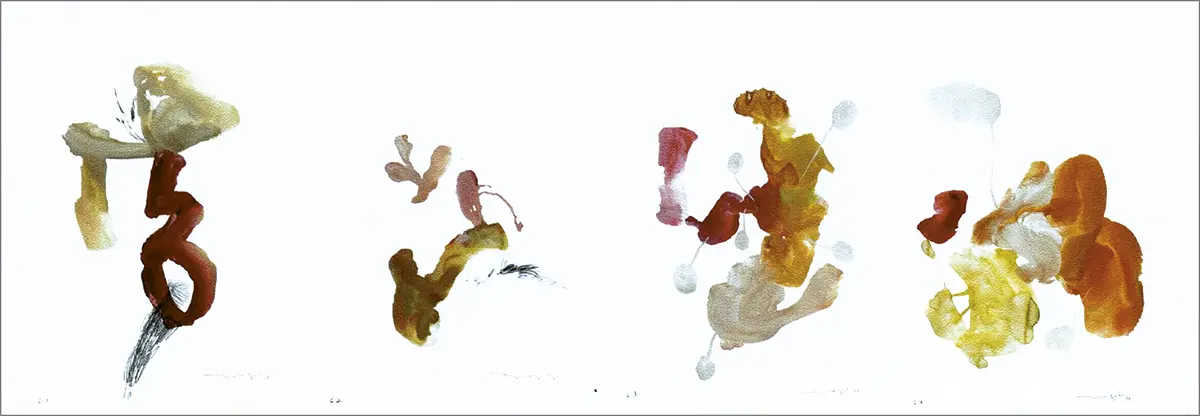
Satori would emerge from a reductionist abstraction and a chromatically eloquent, veiled form of figurativism. Without concerning herself with whether those fine lines give way for the fields of color to be the piece’s protagonists, whether these fields of color are less central than the text, or even whether lines, color, and text fight an unending battle that will end in a far-reaching plastic event, Magali Lara focuses her attention on the strange interplay of these elements as they travel together in the same work of art, sharing support, memory, and time but disputing each other the space of expressive dominance.
Eroticism is also present in Lara’s work. To varying degrees, each piece in Satori would seem to indicate a preferential interest in the unusual relationship that is established between unequals, over the resolution of their encounter. Lara’s works are at the same time sober and paradoxical; because they are emotional, they are silent; since they are reflexive, they are ambiguous. Eroticism is not approached here through its most common aspects, such as sexuality, seduction, and orgasm. It reaches beyond them, situating itself in the position of that which de-fragments the stereotypical roles of the masculine and the feminine, asking the most relevant question about the validity of the psychological and social differentiation by gender into which the richest forms of existence are confined —and about the constant attempt to transcend that differentiations.
“Real life scares us; to imagine what could be is always easier than to think about what is. I am a mother and I know what I represent, and even as I acknowledge the most intense passion for my child I realize that I assume other voices, some of them very distant and hurtful. To see and not understand. To tiresomely repeat somebody else’s old gestures, which I transmit with the same violence and the same ambiguity. I don’t know what I promise...” This is what the artist wrote for the show’s catalog, which includes a well-informed text by Karen Cordero Reiman, titled “Lessons in Logic through Magali Lara’s Satori.”
Other references Lara continuously makes in her reflections are the films Alien, directed by Ridley Scott in 1979, Aliens Return, by James Cameron in 1986, Alien 3, by David Fincher in 1992, and Alien Resurrection by Jean Pierre Jeunet in 1998. These four films are used by the artist in her exploration of the idea of the monster that inhabits all of us, (our personal beast, as she calls it), and in her attempt to see the world through its eyes, which are behind ours.
The presence of that Other hidden inside each of us, by the hand of whom we could even be killed (as the Alien stories tell us), is a recurring motif in this show. Not as much on the surface of the works, where the obvious idea would be that of cannibalism from within, but at a deeper level, where the artist explores —through traces, forms, and the placing of the whole on the plane— a perversely erotic attraction, suggesting a kind of orgiastic feast in which lines and color intertwine in a fluid act of love. Sexual demands are left aside, giving way to a critical exploration of the roles assigned according to gender. Satori moves directly into the search for that space for analysis. Pleasure is sought after, and it is found often in the visual and in evocations that appeal to our most atavistic and intimate references.
SANTIAGO ESPINOSA DE LOS MONTEROS