
The 1976-1983 military dictatorship in Argentina is known as the period of the “Dirty War,” one of the most shameful episodes in Latin America’s political history of the 20th century. Thousands of people were killed, and the remains of many were never found. Marcelo Brodsky (Buenos Aires, 1954) combines political activism and photography in his investigation of the topic, the results of which are exhibited in galleries and museums throughout the world. His shows include photographs, videos, texts, and recent news items. The artist’s brother, Fernando was killed by the government in 1979, at the age of 22. He returned to Argentina from exile in Spain in the mid-1980s, and he began to research the fate of his old schoolmates. He found that many of them were dead, disappeared, and exiled. Brodsky’s work originated in the tension between the grief caused by his brother’s death and his commitment to the defense of human rights. His photographic work appropriates family and archival images (he gives us the original archive dates, suggesting that those are the dates on which the works were created) as a register of objects, documents, and memorials to the disappearance of people and the loss of freedom. Nexo (Nexus) and Buena memoria (Good Memory), two of Brodsky’s shows, were recently combined at the Federal University’s Cultural Center, in Belo Horizonte, offering a rare chance to appreciate the Argentinean artist’s work in all its complex articulation of personal and collective imaginaries.
Brodsky’s work establishes an intimate relationship between text and image, moving between these two fields in order to express its ideas. Some of the images appropriated by Brodsky immediately grab our attention. The works seem to converse with each other in the galleries (which were, sadly, somewhat improvised). The sources are diverse, alternating between the public and the private. Fernando in La Boca,1968 is a beautiful photograph of the artist’s young brother, taken by their mother, as the accompanying text explains, for a photography competition. Almost exactly in front of this piece, we find the series titled Playing Dead, 1966, which depicts Brodsky and his brother in domestic childhood scenes, engaged in a playful bow-and-arrow mock battle. The perhaps prophetic significance of these photographs taken from the family album is thus revealed. In another photograph, the brothers travel on a boat through the La Plata River, and next to it Brodsky has placed an amplified detail of the river’s muddy brown surface, titled Río de La Plata (1997): “Nonexistent grave into which so many were thrown.” In The Wretched of the Earth, 2001, a series of photographs created on the basis of a video of the same title, the artist metaphorically retires from the earth a number of books with transgressive contents, which had been hidden away by their owners in order to save them from the government’s repression. The books are later exhibited, covered in dust and noticeably eroded by the almost 20 years spent underground. Reflections Book Fair IV, 2000 registers the reactions of visitors to one of Brodsky’s shows while looking, precisely, at those unearthed books. The photographer is interested in capturing the worried expressions of people and also objects that are possessed of some kind of aura, which are transformed. He is after a kind of impossible portrait, the portrait of the disappeared, and it is in this sense that his works posit a dialog between journalism and protest, while nevertheless operating in a field of communication that’s closer to the sensorial.
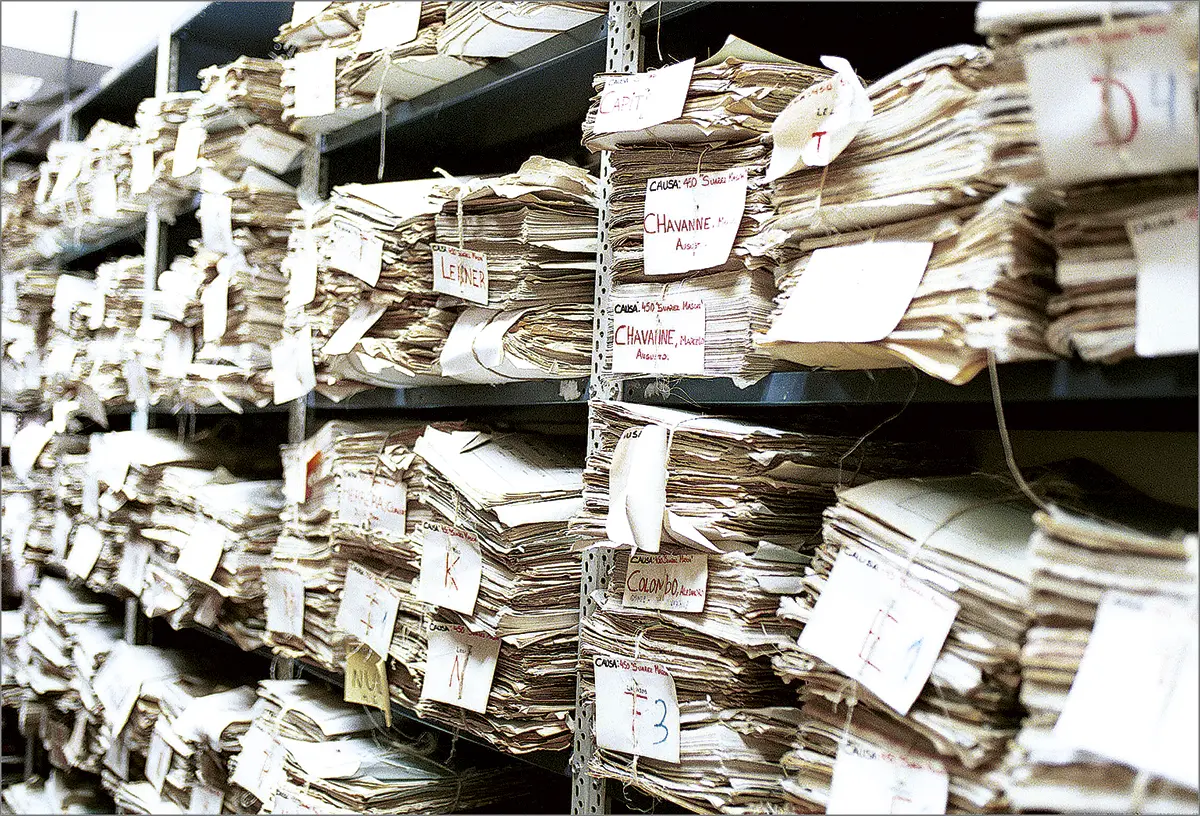
In some of the show’s most beautiful images, Brodsky has captured piles of documents found in the police archives. These are small sculptures created by the bureaucracy of repression, inflated volumes of information that remain mute as the artist presses them for disclosure: What happened to the criminals? His series Tree shows a memorial built in the Argentinean province of Tucumán, in which the surviving relatives of the victims of the Dirty War were invited to plant trees in a public garden. The names of the dead were placed next to the young trees, and Brodsky’s photographs capture a later moment, intervened by time, with the letters already distorted by the action of water. Memorial and life attempt to coexist in this place, but the photographs seem to belie the possibility. Brodsky’s images and texts are built through the search for memory —affective, personal, institutional, political, and cultural memory— and in this process, the artist has created a rich, infinitely sad vision of loss. His photographs bring to mind the impulse to capture the instant, as well as the genre’s historical power for denunciation; they also make us realize the contradictory character of both ambitions. The practice of photography is materialized here as an inventory of the small effects of loss —images of grief for absent bodies.
RODRIGO MOURA