
Pogolotti’s Century was the title for the exhibition of paintings and drawings by the most emblematic Cuban practitioner of Futurism, Marcelo Pogolotti, held on the occasion of the one-hundredth anniversary of his birth in the Museo Nacional de Bellas Artes of his native Havana, from July 12 to September 15.
The show included Magnetic Fields and The Man of Steel, two 1931 paintings that drove Marinetti to acknowledge the Cuban as a peer and to include him in traveling shows of Italian futurism. Around that time, writing for Torino’s La Cittá Nuova, Marinetti said that “Pogolotti shows… works resolved with the introduction of a variety of materials, entirely conscious of the Futurist sensibility, revealing a highly refined artistic temperament.”
Driven by an impulse towards experimentation, Pogolotti worked on those paintings with metallic applications of a purist and cubist lineage. Already present in them was the topic of the machine, which Pogolotti had begun to explore after his arrival in Paris in 1928, and which was to become a leitmotif in his brief but intense artistic career (as is clearly shown in this exhibition). Even his “aero-paintings,” also represented here, the plastic expression of the supra-terrestrial vision allowed by the airplane, implied the incorporation of that most novel of machines to the creative process; by nose-diving in an airplane the artist visualized ambivalent forms, patches of green and ochre, sinuous lines, and a general nebulosity.
Like it was for the Futurists, the machine represented for Pogolotti an eponymous symbol. But where his European counterparts were interested in the machine as an expression of the era’s dynamism, Pogolotti was concerned with its social implications. This, along with the Futurist’s fascist affiliations, contributed to his distancing from the movement's second period. This is when he embarked on the series of drawings titled Our Times, some of which are shown here. In this series, Pogolotti attempted to represent the situation of the worker, in a perspective that apprehending the universal included the national. For this, he used a dynamic technique indebted to Futurism but also to social and philosophical dialectical theories. Using only pencil and crayon on paper, Pogolotti achieved such a richness of tone, shadings, and visual effects that Guy Pérez Cisneros, Cuba’s foremost art critic between 1930 and 1950, thought his drawings were really prints.
The son of the builder of the popular “Pogolotti” neighborhood, heir to a family that owned sugar industries, and engineering student before changing course and devoting himself to art, Marcelo Pogolotti not only identified with the machine’s rationality but sought to find its “human heartbeat,” widening his register to include references to architecture and urbanism.
The latter development can be appreciated most clearly in Industrial Neighborhood, Dawn, and The Meeting of Two Eras, also present in this show. In these paintings, Pogolotti recovered, now with a symbolic character, the architectural and urbanistic sign of his Havana work of 1925-1927, the period when he rediscovered the physical realities of a city he had been absent from for several years after moving to the United States as an engineering student and later abandoning his studies to enroll in New York’s Art Student’s League.
In the later works, however, the original architectural precious is entirely absent, as are his uncontrolled use of color and his complimentary, somewhat fauvist combinations. Now Pogolotti resolved the representation of buildings in more or less flat, rectangular forms, using a geometry derived from his own abstract experiments —carried out two decades before Cuban art assumed abstraction as a trend.
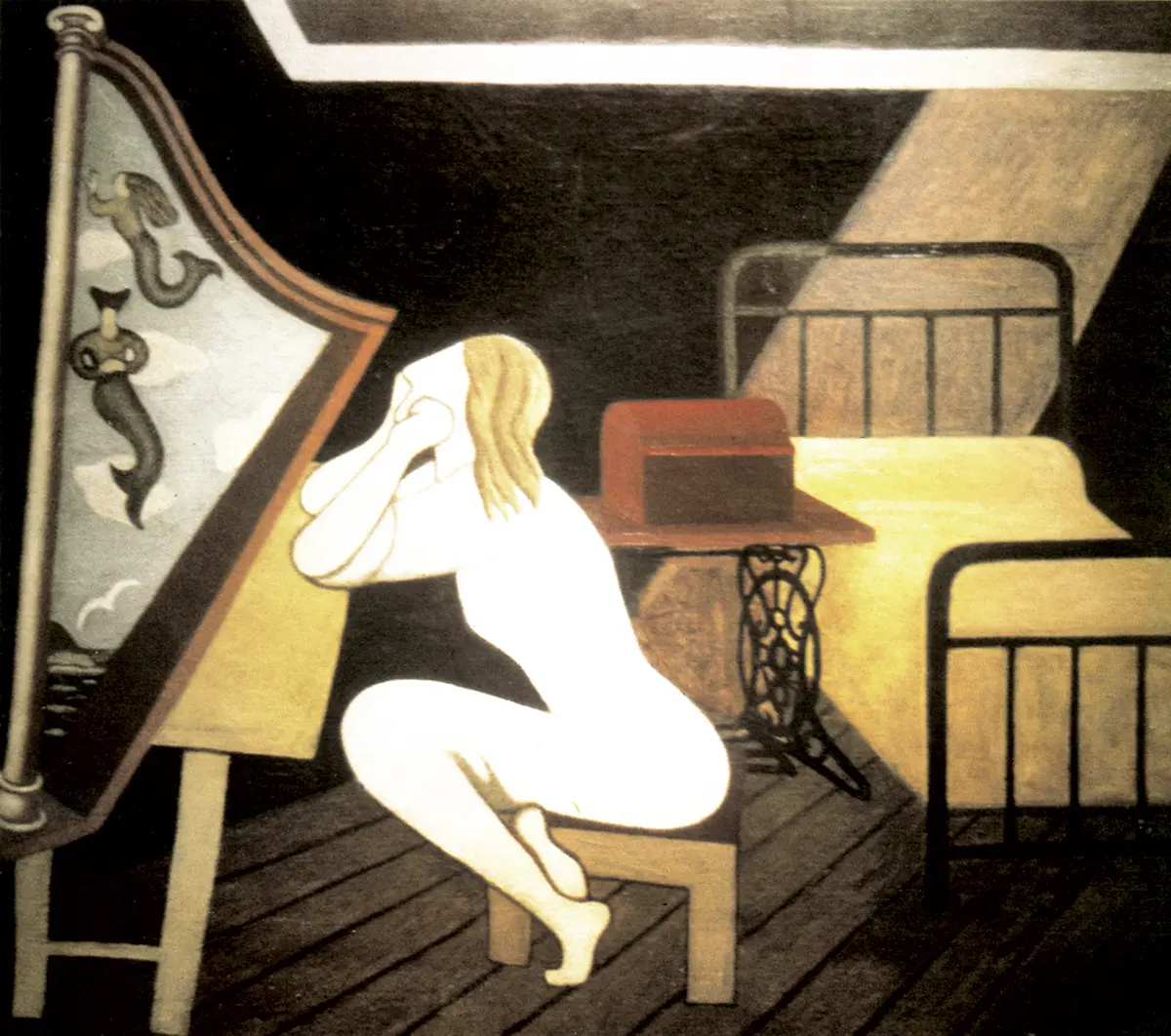
Encuentro de dos épocas as well as Silence, Evasion, and The Intellectual, three from 1937, show the way in which Pogolotti —affiliated since 1933 to the group of artists led by Louis Aragon, who considered the working class the only capable of endowing art with a truly human and truly transcendent content— inverted the classical Surrealist norm of “the meeting of a sewing machine and an umbrella on an operating table”, turning it into a socio-historical paradox: a modern factory and a medieval village, emptiness and intellectualism, reality and utopia… These works, and others present in this show such as Time-Taking,1934, meant a step forward in the formal depuration the artist had established as his goal after Social Landscape, 20th Century, and A Present for the Mistress, all of them from 1933, or his 1934 Heaven and Earth, among many other canvases of an enormous compositional complexity due to their chrono-topical visuals and the simultaneity of the scenes.
Encuentro de dos épocas is an emblematic work also for a different reason: it was Pogolotti’s last work before becoming completely blind in 1938, the year of his first individual show in Paris. There, in the Carrefour Gallery, he showed both abstract and figurative works. Several periodicals reviewed the show, comparing Pogolotti to Rivera and praising his skill and his humanism. Guy Perez Cisneros would later comment that Pogolotti was the Cuban artist most commented on by European critics up to 1938, and in 1931 Alejo Carpentier wrote, in a French dispatch for the Cuban magazine Social, that he was “in ideas and technique, the most advanced painter produced by Cuba.” Pogolotti’s works continue to shine today, 100 years after his birth, in a world even more technologized, mechanized, and traversed by social conflict.
ISRAEL CASTELLANOS LEÓN