
As often happens in art, the work of María Fernanda Cardoso lends itself to multiple readings. It can be the nostalgic evocation of the immense gap that separates modern men and women, with their urban technocracy, from Nature; it can be an interpretation of the tradition of violence and the immediacy of life and death in her native country, Colombia. Cardoso’s work can also be seen from the point of view of the sustained contradiction of natural materials versus artificial ones, be the latter either similar to or abysmally different from the former. In the age of modern genetics, it can also represent an interpretation of the scientific idea of cloning. There are recurring themes in Cardoso’s oeuvre, such as her interest in the mythic, or the different ways in which domination is expressed. In aesthetic terms, it makes us think of a contemporary alternative to the tradition of still life painting, or the superposition of connotations of what is implied in a landscape.
Works of art aimed at representing the natural world began to appear in Europe in the 16th century, linked to the advances of science, changes in religious intention, and political and economic interests. Dutch artists, for instance, painted flowers for their rare beauty. The existential dimension of vanitas, centered on the feeling of life as fleeting, appeared in the 17th century.
The sociology of art teaches us that the direction art takes relates closely to a nation’s socio-political project; this is why when around that same time Spain undertook the pictorial revision of some elements of the real world and of nature, it did so in a much more austere manner, since its artists, influenced by King Felipe II’s fanatical Catholicism, were mainly interested in representing the mystical meaning of reality.
The history of art has reflexively sifted through the uses of nature in landscape. Some artists, such as Delacroix, left aside the copying of things like peaceful marinas in order to include in their work the world of the imagination. Delacroix himself said it best: “I sought the most awe-inspiring, the most poetic side of nature.” We can also attend to the lessons taught by Ingres, followed by Poussin. Ingres said that “the painter acquires skills by observation. The painter needs to lodge a model in his mind, lodge it as if it were part of him; he needs to incorporate Nature to his memory so that it will come by itself to inhabit the work."
María Fernanda Cardoso’s work takes off from Nature’s predetermined forms. Sometimes she uses animals —which, of course, already include in their own bodies a set of definitions and functions. It is on that basis that the artist defies the notion of “animal forms,” which she has come to dominate with great analytical discipline, achieving with them (the forms) a different geometric order. A special alchemy. Taxidermy. Animal cacophony. A new order. All of this at once.
Cardoso remembers the presence in her life of a grandfather who was a medical doctor and performed all kinds of experiments on animals. Thus her work always implies a deep investigation of presuppositions and possibilities. Sometimes the artist is seeking to defy gravity, and her works surprise us by being suspended in space following a rigorous geometric order that evokes the circle or the cylinder. In these cases, her main interest is to explore the organic meaning of surfaces in order to find, through this de facto reorganization, a mode of space centered around the signaling of the vacuum. Vacuum as text and context. A vacuum is that which indicates the parts and articulates the whole. That which tells us of the precarious nature of our gestures, the harmony of forms, the regularity of a universe of flowers that echo violence as in Comentarios verticales (Vertical Commentaries), or the dance of toads where the static participants and the skins, devoid of any live pulsations, achieve harmony.
The concept of the taxidermist’s dead and mounted animal is one of her work’s axes. This induces us to consider the ancient Egyptian necrophiliac idea, where death becomes eternity and the body’s journey stops, while the soul follows its destiny. Cardoso seeks to interpret life after death before oblivion enters the process of disappearance. She wants to conjugate a verb without time. Or, perhaps, to bring us closer to the universal synchronicity of the living with that definitive final encounter. And, since we find the justification for this definition in divine design, death —which transforms everything— implies our commitment to religious values. For Christians, it is reward or punishment; for Hindus, the karma of reincarnation.
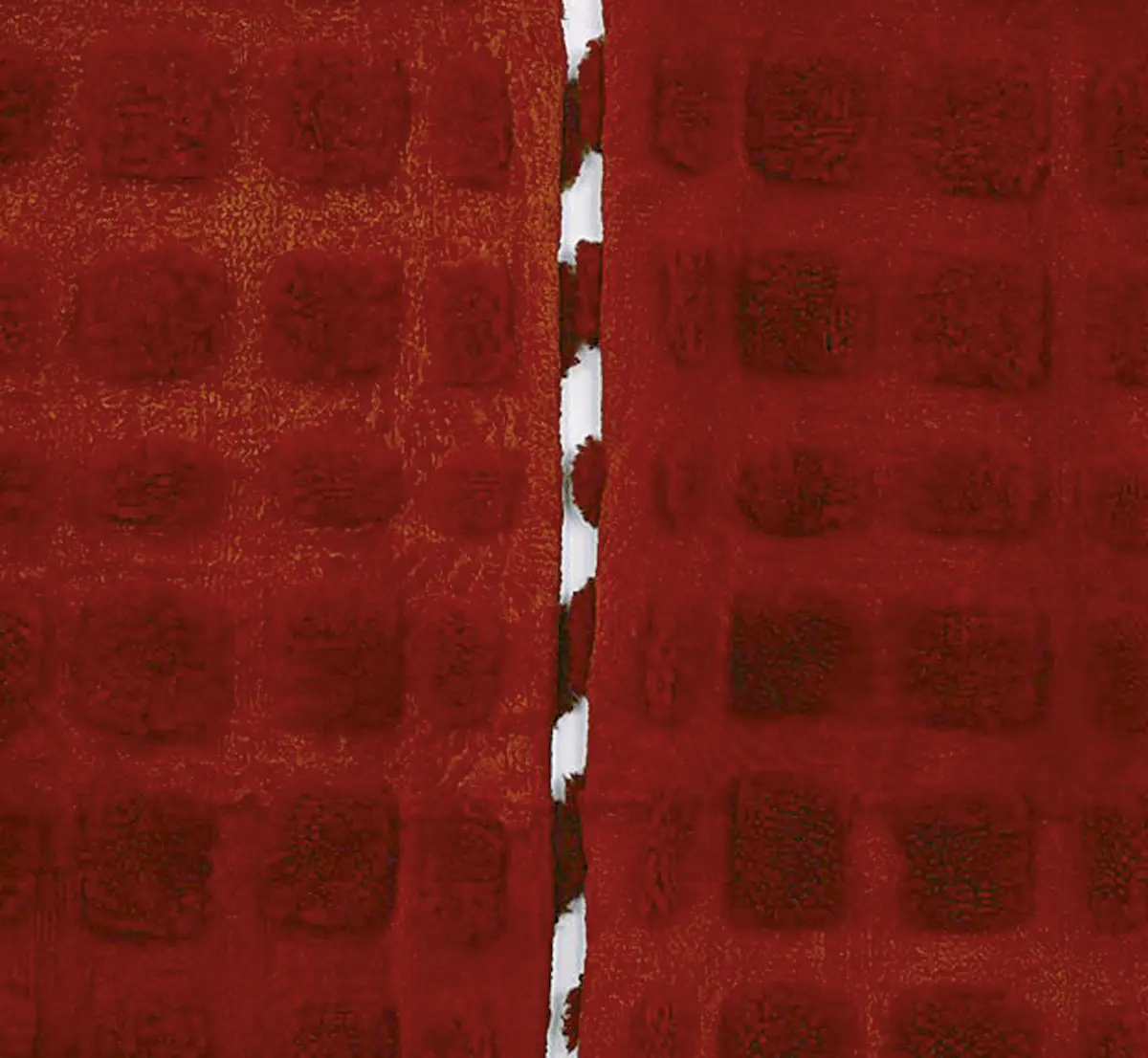
In her most recent work, shown at the Museum of the Americas in Washington D.C., Cardoso recreates the visual adventure of an Australian landscape using small pieces of sheep fleece, sewn together in pairs. There are 82 pairs, died in fall colors and shaven in geometric patterns (squares and straight lines). The geometry thus added to the fleece recreates the verticality of human presence and the horizontality of the landscape, as well as the mythical evocation of the totem pole. María Fernanda Cardoso incorporates the emptiness of absence, objectively distinguishing between the artificial and the natural, the presence of death in life, and the dominion implicit in domestication. But now with an animal form that also speaks of the solitude found in the landscape of Australia.
In reference to the way in which Cardoso uses empty space, it is important to remember that in Australia’s expansive plains there often seems to be more sheep than people. She also incorporates to her work a socio-economic level of meaning, in that Australian wool was for a number of years one of the most profitable products in international markets. In this new work, created under the auspices of the Australian Council, the artist transforms herself into the arid landscape of places that are ideal for the raising of sheep, providing this landscape with a new natural history.
Sheep were among the first domesticated animals, some 11,000 years ago. This is why these animals appear in countless legends, along with their shepherds. Often, sheep are represented in these legends are “good and harmless;” they are also what we count in order to fall back asleep in a night of insomnia. I believe we can include the “black sheep” in the same category, because, like the ugly duckling of the story, they become swans towards the end of the tale.
In modern history, the idea of cloning entered our consciousness through the figure of a sheep: Molly. She revealed to us the new reach of genetic engineering, and with it, we acquired our first intuition of the concomitant problems in scientific ethics. In the 21st century, Frankenstein invented by Mary Shelley in her literature of horror is becoming a reality. Dolly and Frankenstein are classic British creatures. We cannot forget that Australia is an heir to the British Prometheus.
It is in this context, where many circumstances and many temporalities come together, that we can appreciate the way in which María Fernanda Cardoso reinterprets science from art. The duality of cloning is real; Cardoso duplicates forms and, by sewing those fleeces, creates a new form. A reflection? An echo? The construction of an image without an image?
A related element is the modern dichotomy between a bucolic, pastoral view of agriculture and a more electronic and synthetic vision, where only the autonomy of modern men and women triumphs. The herd and the shepherd correspond to the bucolic idea, a symptom of rural solitude, where human goodness and patience are seen as coexisting. These concepts are in opposition to the dictates of the electronic age, where the Verb is a second of fast, efficient, impatient connections. These are urban customs that each day leave us with less and less time to exist in a herd and to make the epic of computerized individuality.
ANA MARÍA ESCALLÓN