During the spring of 2002, the Jewish Museum in New York presented an exhibition under the title Mirroring Evil: Nazi Imagery/ Recent Art.1 The manifest intention of the organizers was to survey the ways in which a younger generation of artists born long after World War II has dealt with the phenomenon of Nazism and the Holocaust. To do this they raised five questions: “How has popular culture represented Nazi evil? How can the mundane be made dangerous and the dangerous mundane? Who can speak about the Holocaust? How has art helped to break the silence about the Holocaust? And what are the limits of irreverence?"2 Given the questions posed, this became an exceedingly risky curatorial project. There was a strong possibility that a show focusing on the manipulation of Nazi imagery for aesthetic purposes would offend many people. There was the challenge of finding a way to be both critically distant from the works selected and at the same time respectful and not condescending to the artists involved. And finally, there was the challenge of finding something useful and important to say beyond the simple observation that there is, as stated in one of the catalog essays, a “continuing fascination with the Nazi era.” In the end, the project was less successful as a contribution to art and criticism than it was in managing and surviving the scandal it caused.
It is clear from the catalog that the organizers of Mirroring Evil believed they had a strong defense of their project, which they offered in advance. One line of defense was to cite the social value of freedom of expression, a standard defense, no less appropriate for that, and one which was likely to resonate with the public even more forcefully than usual because of New York Mayor Rudolph Giuliani’s recent infamous assault on the principle of free expression in the case of the Sensation show at the Brooklyn Museum of Art (2000).3 The second line of defense, articulated by Renee Greenberg, was to assert that while “Visitors may feel deeply threatened, outraged, or betrayed... it is safer by far to explore the implications of the continuing fascination with the Nazi era in the confines of a Jewish Museum than outside it."4 In other words, they argued, that the context of the show should help to allay personal sensitivities and focus attention instead on the exhibition’s true objective—theoretical research. Judging by popular and critical response, the scandal that erupted over Mirroring Evil was less formidable than in the case of Sensation. There was pressure from some Jewish groups to cancel the show, and there were some who refused to go on principle, but by all appearances, the scandal remained modest and manageable;5 there was no loss of focus as there was in the case of Sensation, where further revelations proved embarrassing to the organizers. The owner of the works exhibited in Sensation had secretly paid a sizeable sum to the Brooklyn Museum, and once this became public, the Brooklyn Museum was forced to make a particularly strong defense of the artistic value of the show, whereas, in the case of Mirroring Evil, it was possible for the Jewish Museum to maintain a certain institutional distance. The Museum’s director, Joan Rosenbaum, when asked about her institution’s endorsement of the art exhibited, responded by saying: “This is art with a message, political art, so we’re not talking about aesthetic issues, by and large."6 The heat of public reaction died down without igniting a major crisis. The exhibition itself, however, is disappointing. The reasons for this are far less clear than the points made in defense of the exhibition against scandal.
The selection of artists to participate in Mirroring Evil would seem ideally suited to the goals of the exhibition. All the artists are post-conceptualists, working in an aesthetic that allows the content of the message to be addressed without distractions related to technical virtuosity or craft. It is an aesthetic that zeroes in, communicating with a minimum of static interference. The artist can “calculate” the work and control the effect. The degree of depth or complexity in the artist’s imagination becomes immediately visible. The connection between the artist’s ideology and emotions is transparent, and manipulation of the possible ways of reading the work is evident. All of this would seem grounds for a successful outcome. What went wrong?
One problem may have to do with the conventions of post-conceptualism. In its claim to clarity—the cutting of artistic red tape so to speak—the vulnerability of the artist is intrinsic to the work, much more so than in earlier, pre-conceptualist aesthetics. Since there is no hiding place, the post-conceptual artist struggles to achieve distance, to demonstrate invulnerability. Historically, two strategies of resistance to vulnerability have predominated in post-conceptualist art—industrial finish, and ingeniousness or wit. This limited array of options helps to explain why, in spite of the great freedom the conceptualist break offered art in the mid-twentieth century, it has not exceeded previous aesthetics in the production of moving, mysterious, or enlightening works.
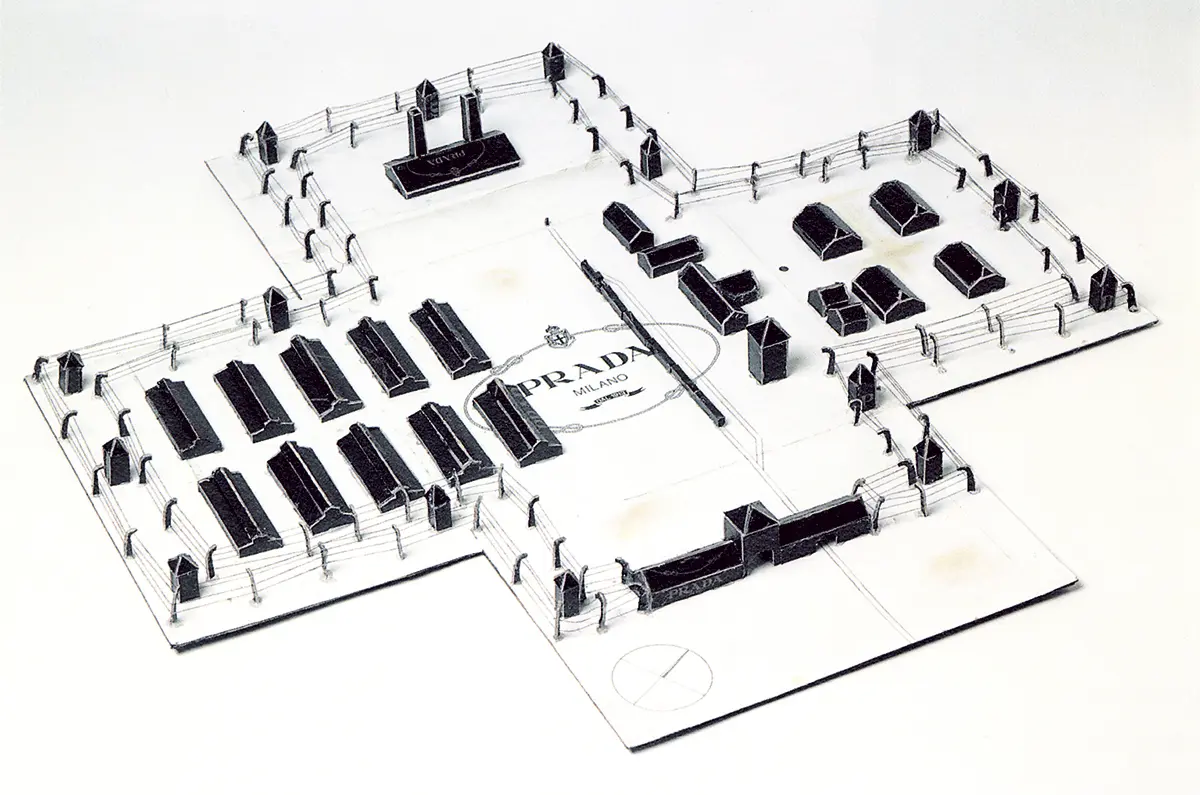
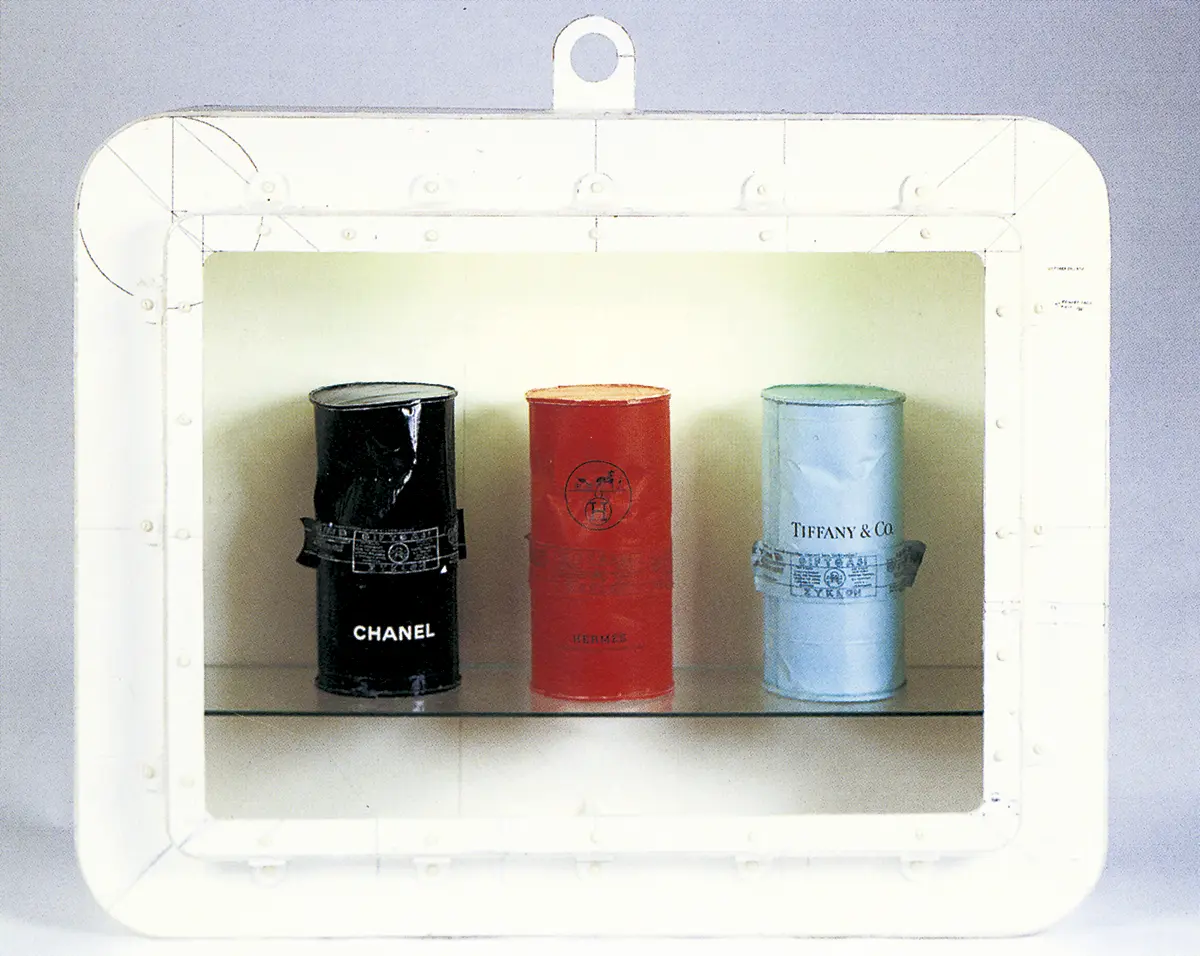
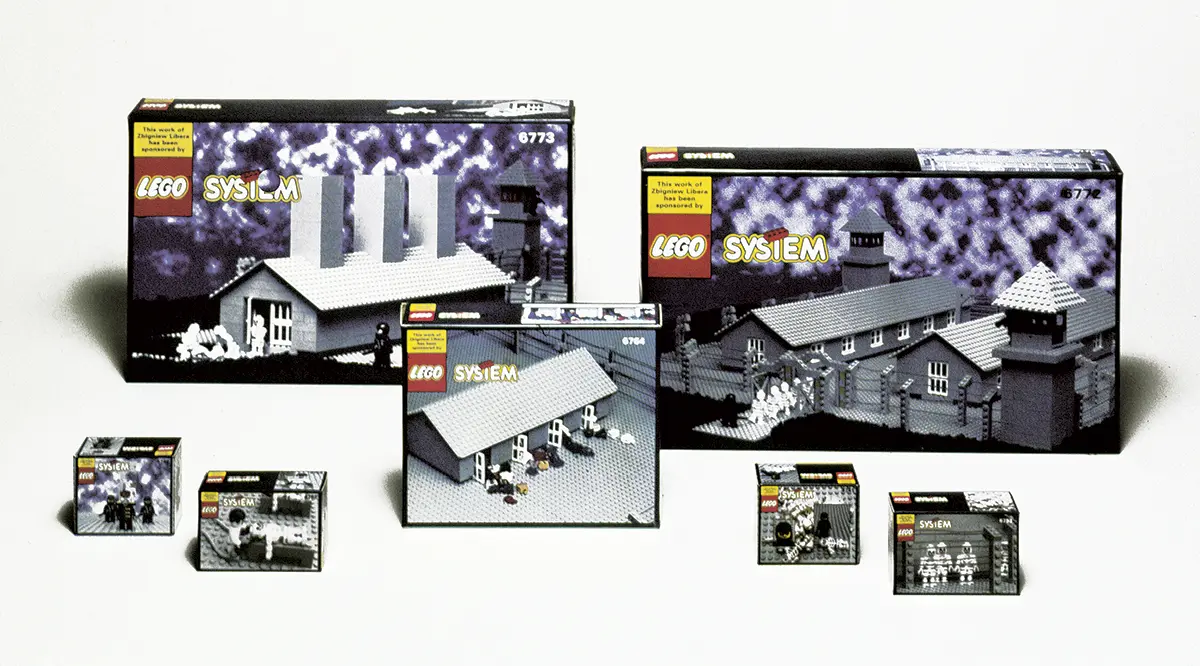
In Mirroring Evil the strategies of ingeniousness and finish take over the museum. The wit, however, is often flat and simplistic, like a well-turned phrase that dies as soon as it is read. Given the enormity of the topic addressed here, the ephemeral quality of the wit makes it hard not to be offended. It’s not the manipulation of “untouchable” subject matter that’s offensive, but rather the pomposity and presumption of believing that this weighty topic can be resolved with a one-liner. The most notorious piece in the show (it already had left a string of scandals in its wake, including censorship in the Polish Pavilion at the Venice Biennial of 1997 and legal proceedings initiated by the LEGO Company) was Lego Concentration Camp Set, 1996, by Zbigniew Libera. It consists of a series of boxes of toys, with photographs of details of Auschwitz buildings made out of Lego blocks. Parallel to those pieces by Libera are two by Tom Sachs, both from 1998. Giftgas Giftset is a set of three cans that supposedly contain the pellets that generate the lethal gas used in concentration camps. They are painted in pleasant colors and labeled with brand names like Chanel, Tiffany, and Hérmes. The wit here is shown in the play on the word “gift,” which means “poison” in German. The second piece, Prada Death Camp is a model of a concentration camp placed in an open Prada hatbox. Any trace of wit is utterly absent.
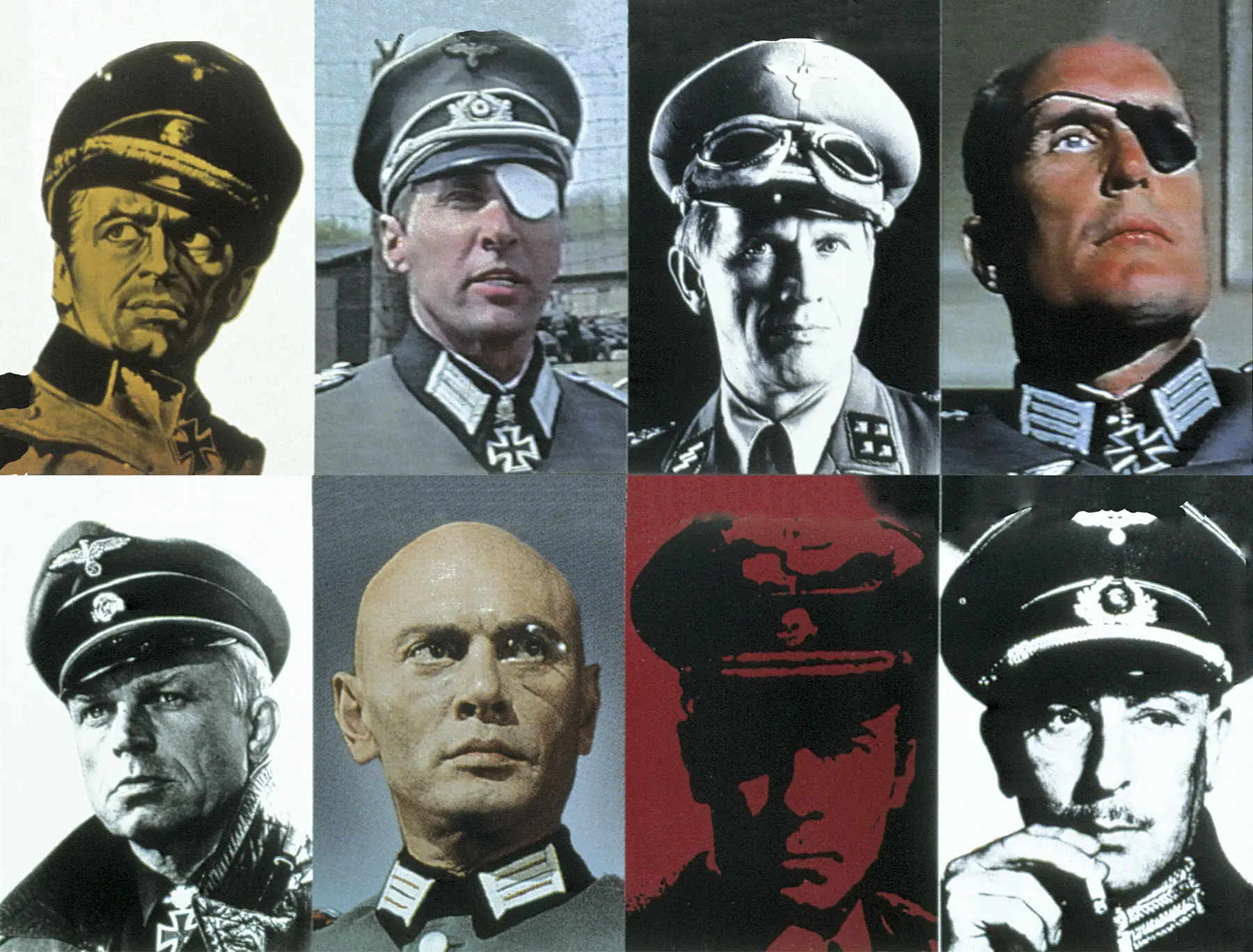
In another piece, Piotr Uklanski fills three walls with photographs of post-war movie actors playing Nazi officers. The Nazis depends entirely on the effect of the great quantity of film images brought together in one place. One is left feeling all this must surely signify something beyond mere documentation of a cultural fascination with the Nazi era, but there is nothing in the piece to encourage speculation. In the catalog, The Nazis, 1998, is compared with Andy Warhol’s Thirteen Most Wanted Men, 1964, a piece that was designed for the U.S. Pavilion at the World’s Fair and was censored. But Warhol’s piece does not validate or enrich Uklanski’s installation; it only precedes it by nearly forty years. Uklanski’s idea was ingenious, much more promising than the ideas for the pieces of Libera and Sachs, yet the effect is one of a fleeting truism.
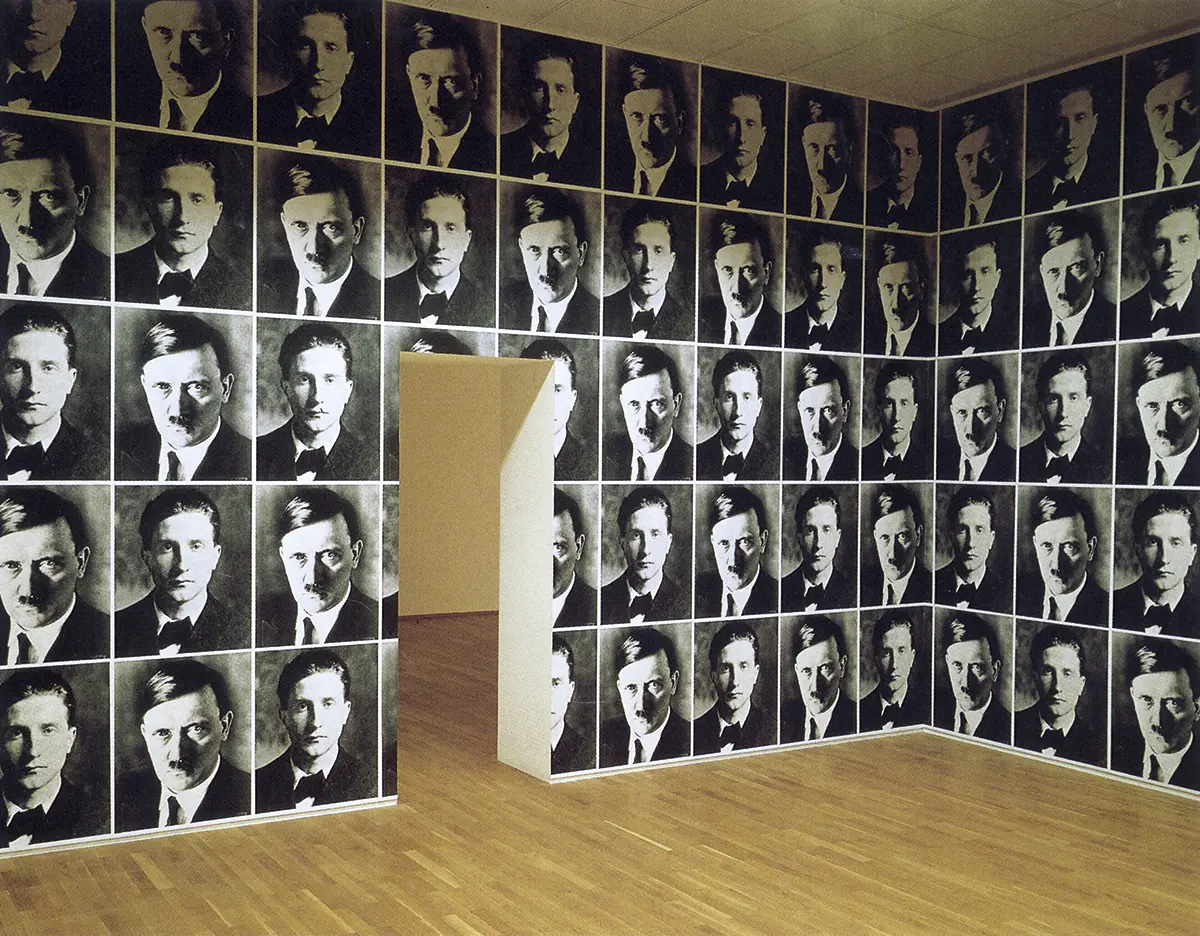
In Rudolf Herz’s piece, Zugzwang, 1995, the wall is covered with a photograph of Marcel Duchamp alternated with a photo of Hitler. The entire weight of the piece, and its only possible significance, rests on the freak coincidence that both photographs happen to have been taken by Heinrich Hoffman, Hitler’s personal photographer. Making the coincidence even more incidental is the fact that Duchamp was photographed in 1912, and Hitler in 1932.
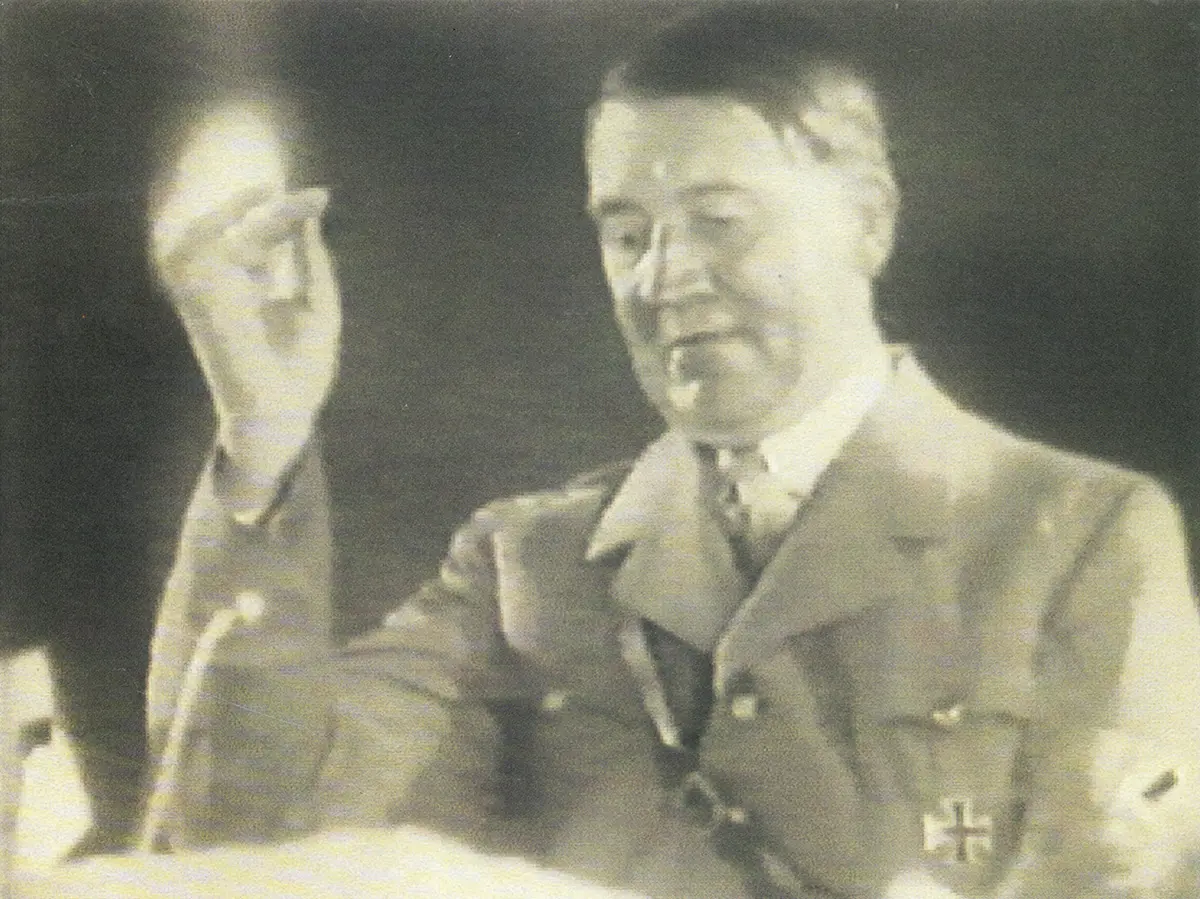
Somewhat more elaborate and decidedly more satisfying is the video Hebrew Lesson, 2000, by Boaz Arad. The artist isolated sound bites from many of Hitler’s recorded speeches and reassembled them until he was able to produce the effect of Hitler appearing to say, over and over, “Greetings, Jerusalem, I am deeply sorry.” The effect is eerie and provocative, raising questions about the role of apology in social healing.
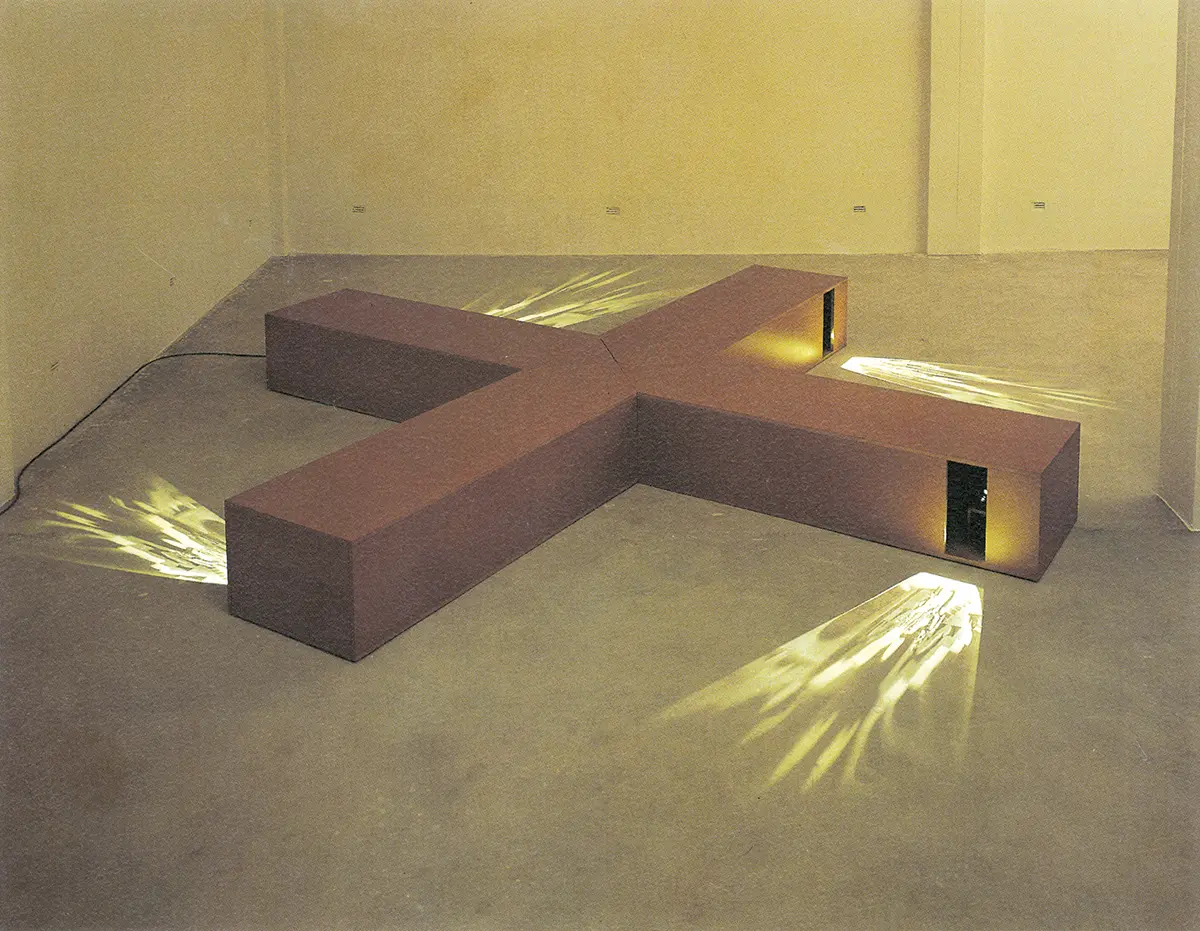
The strongest piece in the show, and one that underscores what is missing from the exhibition as a whole, is Hitler’s Cabinet, 1990, by Mischa Kuball. It consists of a plywood cross on the floor with a slide projector flicking images at right angles from each of its ends. When the slides are projected, the completed piece forms a swastika. It’s a work rich in implications. The slide images are taken from German films of the period between the wars, including The Cabinet of Dr. Caligari. In 1947, Siegfried Krakauer, in a book entitled From Caligari to Hitler, advanced the thesis that the movies of the period shaped the German character in ways that led to the Nazi regime. The fact that the material core of the piece is a cross hint at possible connections between Christian culture and the phenomenon of Nazism—certainly Christian anti-Semitism comes to mind, and the deplorable passivity of Pius XII in the face of Nazi racism; also the possibility that Christianity played out in German culture in ways that provided favorable soil for the later development of Nazism. From another angle, Kubal also seems to be commenting on the German context of today, where the swastika is a forbidden symbol, the use of which is punishable by law. Made and first shown in Germany, Hitler’s Cabinet, with its intermittent slide projections, thus alternates between legality and law-breaking, thereby hinting at the futility or at least the porosity of public prohibitions on hate, and suggesting the flickering presence of hypocrisy.
With the exception of the pieces by Kubal and Arad, Mirroring Evil fails to stimulate the imagination. The overall effect of the show is tepid and flat, which is puzzling, given the emotional resonance of the topic. Is it possible that overwhelming human catastrophes simply elude aesthetic investigation? Theodore Adorno once asserted that writing poetry after Auschwitz was barbaric.7 He was suggesting that the Holocaust (or the liquidation of Armenians; the ravages of gulags, Pol Pot’s massacres; the demolition of the Twin Towers; the massacres in Rwanda; or any of the multiple genocides of the twentieth century and those continuing today) was not only too horrific to be reduced to an aesthetic solution, but was also sufficiently powerful in itself not to require an iconography or a revelation in order to create or sustain consciousness. The weakness of Mirroring Evil would seem to make it all too easy to agree with him. It neither documents the horror and evil of the Holocaust nor elicits speculation about the spoors of predisposition to Nazism that may be lying about in the soil of present-day culture. It doesn’t move us in any direction and provides us with no new clues as to where our emotional resistance to evil might be directed.
Adorno’s point, for all its apparent relevance to a show like this one, is yet unpersuasive. It is hard not to believe that what is “barbaric” after Auschwitz is not aesthetic production per se, but rather art that is deracinated, severed from the life of society, reified, and reduced to functioning as a consumer product. Adorno himself suggests this when he points out that Hermann Goering said or is alleged to have said: When I hear the word culture, I draw my gun. The clear implication is that art can be a locus of resistance to the regime of a Goering. One might note, in addition, that at the same time, he was declaring war on “culture,” Goering had an “appreciation” for the art object and was building for himself a fortune in stolen art, becoming one of the biggest art thieves in history. This would seem to suggest that what is “barbaric” after Auschwitz is not all forms of aesthetic endeavor, but rather fetishism and possession as an approach to art.
When Adorno speaks, in the same essay, of what he calls the fascist “defamation of criticism” and the elevation of “appreciation” instead, he is highlighting an issue of direct relevance to Mirroring Evil. While “appreciation” as a term, seems harmless enough in itself, as one scrutinizes its implications, one realizes the potential it carries for subduing any judgment of art other than that based on individual taste. This, in effect, subjectivizes art discourse, encouraging the arbitrary discarding or promotion of art products without any consideration given to the contributions they might make or conversely the damage they might do to collective culture. Pursuing this train of thought, one finds yet further confirmation that human catastrophe is not in itself resistant to aesthetic exploration, but merely poses the daunting challenge to any artist prepared to address the topic, that her efforts are bound to elicit reactions based on taste at the expense of criticism.
In the end, Mirroring Evil seems to offer less fertile ground for the imagination than the audience's reaction to it. Profound distaste for the show was based on the conviction it was blasphemous. However, neither the topic of Nazi imagery nor the execution of the works, which was impeccable, could in any way justify a charge of blasphemy. To decipher the charge, we are left with the issue of content and attitude. But none of the pieces denies the Holocaust, promotes a Nazi agenda, flirts with Nazi ideology, disguises the crimes of the Hitler regime, disrespects its victims, or encourages forgetting. In that sense, the show was entirely “politically correct.” In what did the blasphemy inhere?
Blasphemy, it seems, is not intrinsic to any object, but rather emerges in a social relationship, reflecting the needs and expectations of people standing on some common ground as they encounter the object. Confronted with the catastrophe of the Holocaust, our needs and expectations fall more or less into two categories. We want an iconography that confirms our connectedness and brings us closer as sympathizers, witnesses, and survivors. Thus we tend to respond affirmatively to art that directly documents horrors in ways that arouse pity, grief, and sorrow. We are unlikely to think critically about the wit of the craft or the industrial finish of the work, even when these factors play a key role in the emotional impact achieved. Since the horror speaks for itself, we trust the angle of vision of the artist and do not expect or require more in terms of intellectual stimulation. Secondly, we want art that addresses the Holocaust to target the perpetrators, to call those responsible to account, to awaken our hopes that truth will conquer, that the legions of those resisting evil will grow, and that justice will triumph. Mirroring Evil does not give us these satisfactions and this distresses us.
The organizers of the exhibition point out that the artists were purposefully chosen from younger generations for whom the Holocaust is neither immediate nor vivid, whose knowledge of the catastrophe “is gleaned from popular culture” rather than from oral history or scholarly histories.8 Thus, one could say the show is, in some critical sense, about the debasement of information, and the thinning of memory. This makes the show more interesting as a sociological or anthropological investigation than as an artistic event. Mirroring Evil, however, neglects to make this clear, and for reasons it is not hard to understand. After all, to make this explicit would have seemed a misuse of the artists. Meanwhile, the artists for the most part seemed to settle for the blurriness that comes with emotional distance, rather than calling on personal reserves of indignation to overcome the distance. Thomas Sachs, the artist of the Prada Death Camp, is quoted as having said he sought to use the iconography of the Holocaust to bring attention to fashion.9 This would seem to sum up all the problems of this well-intentioned but disappointing exhibition.
NOTES
1. March 17- June 30, 2002.
2. Norman Kleeblatt, curator of the exhibition, answering Sarah Boxer for “Man Behind a Museum Tempest; A Curator Defends His Show Exploring Nazi Imagery,” The New York Times, February 6, 2002.
3. Giuliani took offense because of a painting in the Sensation show he considered blasphemous. The painting, by Chris Ophili, of the Virgin Mary, elicited the New York City Major’s and the curia’s ire because it was ritually embellished with elephant dung and decorated with little angels cut from pornographic magazines. Enraged, Giuliani sought to terminate public funding for the museum, provoking charges of censorship in return.
4. Renee Greenberg, “Playing it Safe: The Display of Transgressive Art in the Museum,” in Mirroring Evil, ed. Norman Kleeblatt, (New Brunswick: Rutgers University Press, 2001), pp. 95. The essay discusses the Sensation case, anticipating possible reactions.
5. Two months before the opening, Abraham Foxman, national director of the Anti-Defamation League, declared the show to be “premature.”
6. Michael Kimmelman, “Critic’s Notebook: Jewish Museum Show Looks Nazis in the Face and Creates a Fuss,” The New York Times, January 20, 2002.
7. Theodore Adorno, “Cultural Criticism and Society,” Prisms, (Cambridge: The MIT Press, 1997), pp. 34.
8. Kleeblatt to Sarah Boxer.
9. Michael Kimmelman, “Art Review: Evil, the Nazis and Shock Value,” The New York Times, March 15, 2002.
*Edited by Selby Hickey.
LUIS CAMNITZER
Emeritus professor at the Suny College, Old Westbury.