It seems significant for Homo Ludens, Nicolás Guagnini’s recent show at Ruth Benzacar Gallery in Buenos Aires, to take place in a subterranean room; it was fitting, indeed, to have to descend a brief flight of stairs in order to access the discreet theater of objects, phrases, and images. In particular, it was significant to hold the exhibition at some distance from the street, in a semi-closed space. It is as if Guagnini had wanted to situate his work at some distance from the present, in an unfinished past whose remains persist in a strange half-life, in a limbo from which they sometimes appear to be pointing towards a still undecipherable future.
But, what was this show an exhibition of? On one side of the room, we found an irregular billiards table, its eight sides of different proportions forming a perimeter within which a geometrical, colored design referred to those mid-20th century Argentinean proponents of a “concrete” art. On the table, there were three balls. On any given day of the week, the artist could be found there, challenging visitors to a game of impossible caroms, betting for pieces of paper that had been hanged on the walls. Written in those pieces of paper were speculations on the function of capital and of the subject, as well as on Argentinean history, and meditations in lines and words, pieces of an unrecognizable notebook.
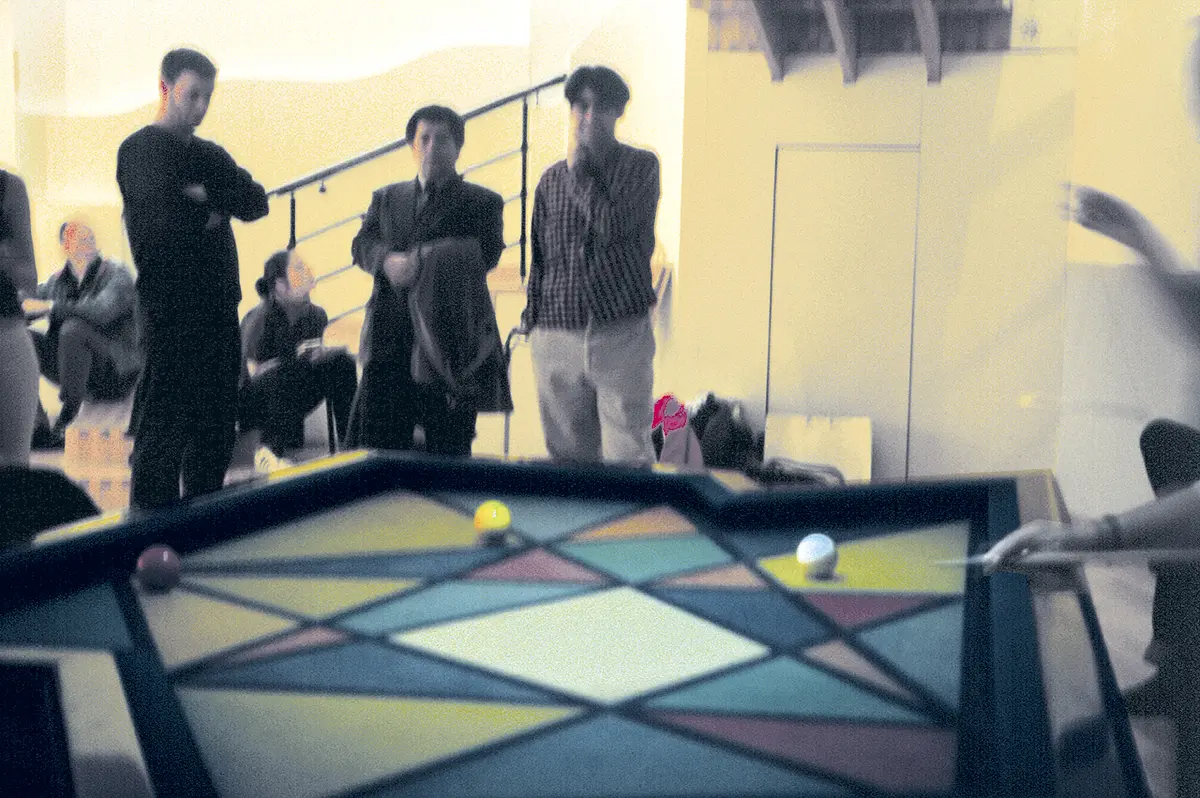
A billiard table as a concrete art painting, some billiards cues, some balls, plus pieces of paper with writings on them: in every one of these elements (as in most of Guagnini’s recent works, both alone and in collaboration with Karin Schneider) we find motifs derived from a specific historical universe —the artistic modernity that developed in South America around the middle of last century. This is why in the first instance the piece seemed to ask the viewer to see it (to read it, to explore it) as if it were an essay (about what?). But after barely a moment’s consideration, the viewer realized that the scant number of objects in the gallery formed something different, more complex than an essay. In this collection there were gestures, attributes, and dispositions belonging to one specific moment in the development of modernity: the moment when it was possible to assume that forms and colors could be configured so that the viewer would discover in them the model or the allegory, the schemata or the annunciation of a just society. Those gestures, attributes, and dispositions appeared somewhat like the remains of the day appear in a dream. And, just as in a dream, the combination of concrete art and a billiards table, of words and images, seemed possessed of necessity and created the impression of an irrefutable past, no matter how fictional.
This was an exhibition of some figurations of modernity in avant-garde projects, presented as if in an involuntary remembrance: recognizable but intermingled with a variety of other things, mounted on uncertain vehicles, as evident but forgotten monuments. Or as they could have appeared to Polish writer Witold Gombrowicz, who lived in Buenos Aires around those same years and for whom 20th-century history should be read as the progression of a catastrophic, but curiously exciting, comedy. This is, I suppose, how Nicolás Guagnini sees the history of modern art if one credits not only this show but his work of recent years. It is a central point of reference in Argentinean art of his generation and has indeed developed, in successive installments, a quiet, secret kind of comedy of modern art. There was a moment in Argentinean history when it was proposed that a union of the high arts and the just life could be verified around a visual project. In Guagnini’s variation on the topic in Homo Ludens, the two terms of the equation are not united but cross each other, and in the crossing, they are deformed —yet, in their deformation all the parts acquired a strange vitality, at once fragile and insistent.
REYNALDO LEDDAGA