In his new installation and sculpture exhibition, Pepón Osorio has recreated an island within an island —Puerto Rico in Manhattan, and in a larger sense the island of immigrants within the United States of America. This is not a new topic, but the work is a significant aesthetic experience. The artist and his circumstance, the immigrant’s history and their circumstance, all of these have been the theme of many an art show; here, however, language is virtual as well as direct. We get the objects, we get the voices, and through it all, we perceive a well-handled “absence of the human." Some will say that there is a human figure on the computer screen, but there you go precisely: that is the evil, the hierarchy of absence, the wound of solitude and nostalgia that characterizes almost all immigrants.
Osorio’s show was promoted as “two new works: Cara a Cara, a multimedia installation recreating the offices of the Bureau of Social Services, and My Beating Hearts, a sculpture.” These pieces, however, complement each other —multiplicity and unity—; the contrast between them actually increases the effect of synergy derived from contrasts and sounds. The installation revolves around a closed office on the right side, a hermetic-looking cubicle, against whose back wall a human figure is projected; to the left, there are Venetian blinds, and in the center a chain mail cage filled with things such as desks, TV and video equipment, computers, tables, roll-up curtains, office supplies, boxes, file cabinets, photographs, varied paraphernalia of personal objects belonging to the unseen workers.
This is not just a mere piling up of things, but an anxious, verbalized, oppressive accusation. It seems innocuous and inert, but it is charged with feelings of entrapment and nostalgia, filled with, above all, contrasts of life and death. Osorio is telling us that what is lost and what is gained in the act of migration cannot be measured together, because loss and gain are two very different matters. Some things are immaterial and difficult to apprehend: freedom, education vs. family, cultural heritages, aromas, popular traditions, walking rhythms, and climate. Others are more quantifiable —these don’t require mention: we all know what they are.
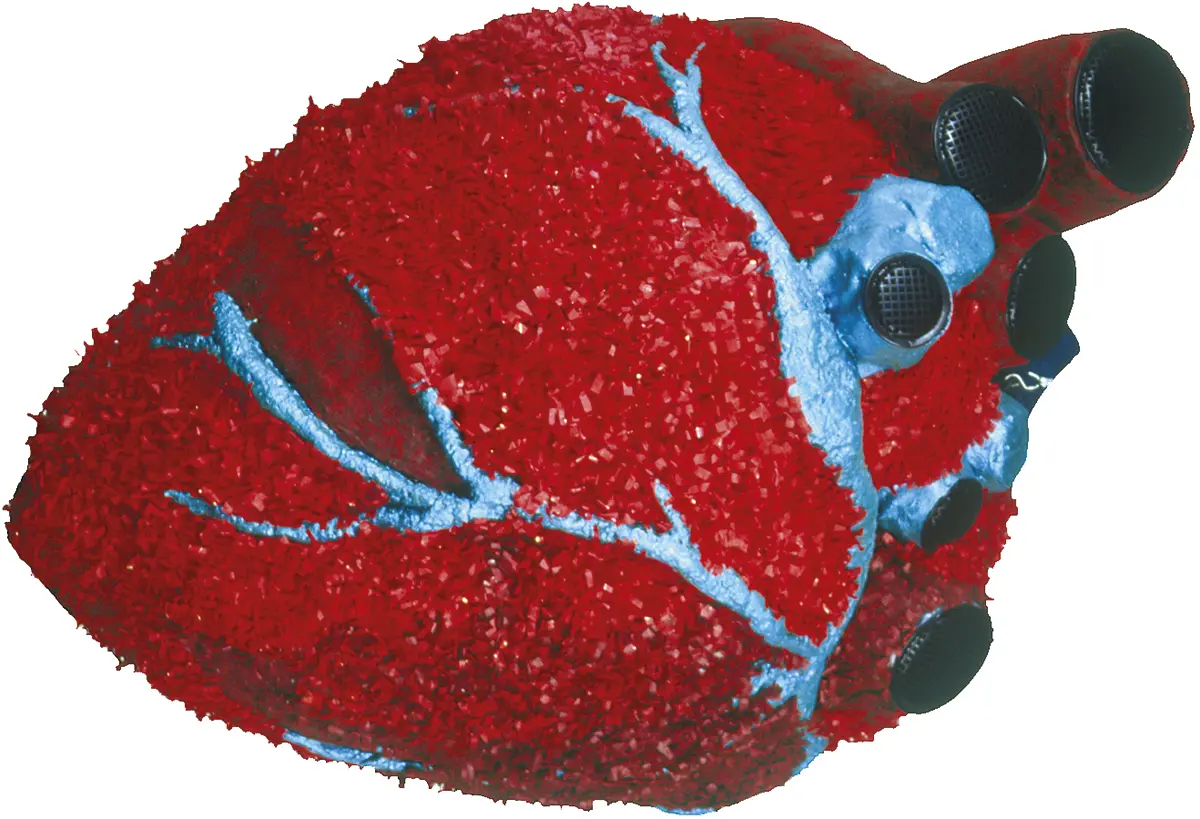
Baroque would not be an inaccurate description of these works. In the installation, because of the disturbing effect of accumulation and expressiveness. In the intensely red sculpture My Beating Heart, the baroque impulse manifests itself through the marked contrast of an otherwise empty room with a single large format, mixed technique piece suspended in its center. Comparing one room to the other, we could easily hear somebody casually comment that “what’s missing here is there,” or that “bureaucracy leaves no room for the heart.” The heart represents Latin America’s intense expressiveness. The topic of the heart in reference to religion, such as has been explored frequently in Mexico, is in this case the complement to the installation in the next room. Osorio’s suspended sculpture is like a pendant or a necklace; its exact opposite is the gigantic piñata of an anonymous bureaucracy. A microphone, integrated at the level of the sectioned valves, amplifies the beating of the artist’s heart.
In our 21st-century society, the border between the intimately private and the public has disappeared. The topic of borders is also part of Osorio’s show, but it can only be mentioned in passing here. Where does institutional action begin, and where does it end? How does one confront “face-to-face” extreme family and institutional situations? How to survive what for some are restrictions of freedom and for others perfectly correct practices? How many boxes are necessary to store away pain? How does one prepare/repair an individual who’s being fragmented and archived in files, boxes, and cabinets? How to live in a state of dissociation? How can the body inhabit one place while the heart lives somewhere else? Exposed daily, beating softly, this heart makes evident the situation “in the flesh” that the artist is pointing out. Photographed images, filmed, reproduced, and projected images: all of them play a role in emphasizing the absence of real human beings. Image and sound record modern art’s trans-disciplinarity, what authors of a century ago wished for, but languages and disciplines have transformed and expanded. Osorio’s Venetian blinds work as dividers, as containers, as a fragile frame through which “oxygen” escapes, and as an eloquent projection screen.
Osorio developed this work during his year as an Artist in Residence with the Philadelphia Department of Human Services. With his background in social work, Pepón Osorio brings to the visual arts a voice more encompassing than the merely individual. He extends the documentary gaze to an emergency room in which special attention is needed for the soul, reason, and heart. This is not a nostalgic or a decadent work. It is a muscular exercise against defeatism. The public and private realms are against each other like skin and endothelium. Pepón Osorio offers his reflections on wounds, feelings, ancestry, and immigrant communities. We must keep in mind, among the precedents, the work of Osorio’s fellow Puerto Rican Antonio Martorell. If everything seems centered around the social, we must point out that there is no aesthetic confusion here; installation is not turned into something undefined, impersonal, or blurry. On the contrary, the scene is traversed by a chilling sensation, everything is clean, organized, and controlled —except for the passion of the voice that fills this show with emotional intensity.
GRACIELA KARTOFEL